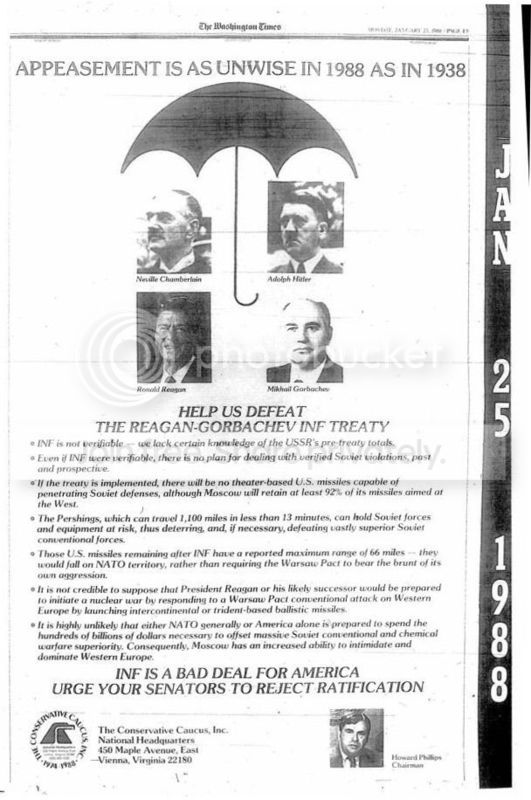
Which Nuclear Treaty will prove to be worse (POL)?

Clinton / Albright with North Korea
or
Obama / Kerry with Iran?

Only time will tell.
Neither treaty costs as much money or lives as the great Iraq blunder....and the architects of that fiasco are demanding we apply the same formula to Iran. Amazes me they can still show their face in public...or that reputable media sources would even give them a platform to preach.

Iran will be worse as they are Islamic radicals. When the first bomb goes off somewhere in the world killing a 100,000, everyone will know the answer.

I have an associate who was a pretty high ranking member of the US Naval Reserve. They do annual War games with South Korea. She would spend about a month there each year on the planning. The most common scenario is the war starts with the North firing a Nuke on Seoul. From there the fighting is over in 7 days with the North's industrial and military capacity totally destroyed, Seoul in Shambles and a big portion of our Navy off the coast in a massive relief effort. It's not a pretty picture.

The problem is, not only is NK producing Nukes and has exported Nuclear technology to Pakistan and Iran, they have threatened to supply nuclear weapons to terrorists to use against us. And there's very little we can do about it unless we catch them red handed.

There is no doubt the NK treaty was a bad one because the North did not honor its terms. The treaty with Iran could end up a very good one and reduce the threat of Nuclear proliferation and war in the Middle East or it could go bad too....but I don't see how it could be much worse than NK who cheated on it the entire time it was in effect.

The ink isn't even dry on the new treaty....and it's not just between the US and Iran. It's between 6 world powers and Iran. You've got to give peaceful negotiations a chance. If it doesn't work out, we're no worse off than if there was no treaty...unless of course you want to start bombing them right now.....which probably won't generate the outcome of a more peaceful middle east.
Quote

Originally posted by: alanleroy
You've got to give peaceful negotiations a chance. If it doesn't work out, we're no worse off than if there was no treaty...unless of course you want to start bombing them right now.....which probably won't generate the outcome of a more peaceful middle east.

DonDiego recognizes alanleroy's good will on this matter, . . . but DonDiego, nonetheless, recognizes his duty to point out that the conclusion that "we", presumedly the US and its allies, would be "no worse off" is an overly optimistic assessment.

The most immediate result of the "treaty", . . . Oops!
Wait a minute, is it a treaty?
If the agreement were a treaty it would require Congressional approval. The Obama and his Secretaries of State have been quite careful about not referring to the agreement as a treaty, . . .most often calling it a "non-binding agreement".
For purposes of discussion, DonDiego will refer to it as an "agreement". [Although it looks like, walks like, and quacks like a "Treaty."]

Anyway, if the agreement fails the United States and its allies might, in fact, be worse off.

i. The most obvious negative result of the agreement leaving the United States and it's allies worse off would be if the Iranians were to cheat and get away with it, . . . the detection of this cheating might first reveal itself in the form of a mushroom cloud rising above Tel Aviv.
Some folks would find themselves suddenly not as well off.
Those least well off might find their entire estate reduced to a human-shaped shadow burned onto a concrete wall.

ii. OK, . . . so right off, . . . like immediately, the economic sanctions imposed by the United States, and later the European Union, and lastly the United Nations are removed.
In a surprising development on the last day of negotiations a hitherto unaddressed issue was agreed upon, . . . that the removal of sanctions include immediate removal of the specific sanctions that address international trade with Iran in conventional weapons, . . . such as tanks, rockets, bombs, guns, armored vehicles, aircraft, ships, submarines, guided missiles, communications, electronics radars, satellites, etc..
So it is possible that if the agreement were abrogated, Iran might well have benefited from acquiring such conventional weaponry leaving the US and its allies less well-off than before the treaty.

iii. Thoughtful opponents of the agreement suggest that if Iran were to cheat, the sanctions will not be "snapped back" into place. Even if all parties to the agreement with Iran, except Iran, agreed to reimpose the sanctions it would be impossible to "snap them back" in an instant.
But all such parties will never agree to reimposing the sanctions. F'rinstance those countries dealing in conventional weaponry, . . .say, f'rinstance, Russia, . . . will be loathe to cease such a profitable business with Iran.
To employ a Persian reference, . . . it would be very difficult to get the weapons genie back into the bottle.

For the record, . . . and to protect poor old DonDiego from claims that he would prefer global nuclear war over a treaty with anybody, . . . DonDiego opposes the detonation of nuclear weapons with bad intentions anywhere, but especially in his vicinity, . . . and most especially within his personal space.


Many of the critics imply the United States has the unilateral ability to impose sanctions on Iran which is nonsense. And that's why Iran was able to exponentially build its nuclear program under the Bush Administration despite sanctions from the US.

The recent sanctions worked only because the United States was able to convince both China and Russia to impose them as well - and that participation was largely contingent upon a diplomatic solution to the issue. People who pretend we can continue to impose these bi-lateral sanctions in the absence of the deal are doing just that - pretending.

So in the end we are left with three groups of people: Those who want diplomacy, those who want another war, and those who just want to criticize without offering an alternative based in reality. The last group is comprised largely of the same people who criticized healthcare reform without offering an alternative - and they should be taken equally non-seriously on this matter.
Quote

Originally posted by: DonDiego
i. The most obvious negative result of the agreement leaving the United States and it's allies worse off would be if the Iranians were to cheat and get away with it, . . . the detection of this cheating might first reveal itself in the form of a mushroom cloud rising above Tel Aviv.
Some folks would find themselves suddenly not as well off.
Those least well off might find their entire estate reduced to a human-shaped shadow burned onto a concrete wall.


How is this result different than if there was no treaty at all?....except of course the Iranians would have to cheat, get away with it, and bomb Israel. If there was no treaty at all they wouldn't even have to cheat and get away with it.

Quote

Originally posted by: DonDiego
ii. OK, . . . so right off, . . . like immediately, the economic sanctions imposed by the United States, and later the European Union, and lastly the United Nations are removed.
In a surprising development on the last day of negotiations a hitherto unaddressed issue was agreed upon, . . . that the removal of sanctions include immediate removal of the specific sanctions that address international trade with Iran in conventional weapons, . . . such as tanks, rockets, bombs, guns, armored vehicles, aircraft, ships, submarines, guided missiles, communications, electronics radars, satellites, etc..
So it is possible that if the agreement were abrogated, Iran might well have benefited from acquiring such conventional weaponry leaving the US and its allies less well-off than before the treaty.


Of course a cynic might say that if Iran begins a build up of conventional weaponry, the United States as the worlds largest supplier of conventional weaponry, would be swamped with orders from our middle east allies and would benefit economically from such sales. Also there is the idea that free and fair trade benefits all nations...and the flow of Iranian oil might further benefit oil consuming nations.

Quote

Originally posted by: DonDiego

iii. Thoughtful opponents of the agreement suggest that if Iran were to cheat, the sanctions will not be "snapped back" into place. Even if all parties to the agreement with Iran, except Iran, agreed to reimpose the sanctions it would be impossible to "snap them back" in an instant.
But all such parties will never agree to reimposing the sanctions. F'rinstance those countries dealing in conventional weaponry, . . .say, f'rinstance, Russia, . . . will be loathe to cease such a profitable business with Iran.
To employ a Persian reference, . . . it would be very difficult to get the weapons genie back into the bottle.


If the US prevented this agreement and was seen as negotiating in bad faith the sanctions could effectively disappear anyway....and then there would be no snap back at all.

Already a LVA subscriber?
To continue reading, choose an option below:
Diamond Membership
$3 per month
Unlimited access to LVA website
Exclusive subscriber-only content
Limited Member Rewards Online
Join Now
or
Platinum Membership
$50 per year
Unlimited access to LVA website
Exclusive subscriber-only content
Exclusive Member Rewards Book
Join Now