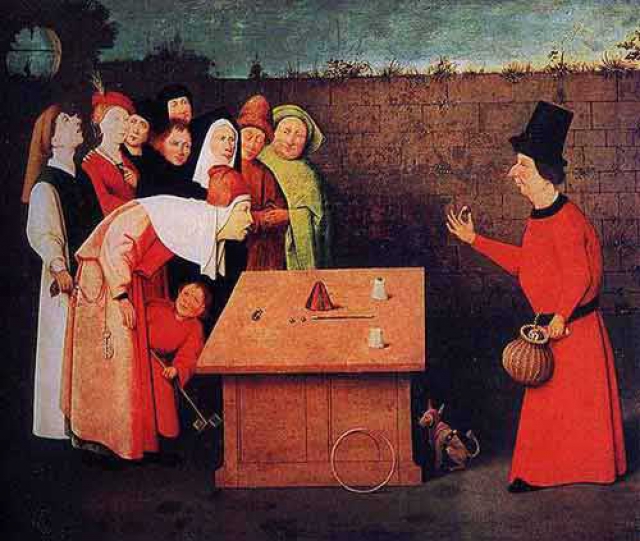
Thought to be of Spanish origin, three-card monte, also known as Find the Lady and Follow the Lady, is either a magic trick or an outright con, depending on whether or not the performer is asking you to part with any money. Either way, the whole game is based on sleight of hand and misdirection and you cannot win – unless the con man wants you to temporarily, in order to entice you into betting more money.
A newer version of ancient games such as the shell game, cups and balls, or thimblerig, which have been separating marks from their hard-earned cash for many centuries, the basic objective is to follow the "money card" (or ball) as the performer quickly rearranges the three cards (or shells, or cups, or thimbles) on his table (which, you should note, is always something highly portable, allowing for a quick exit should the scam be exposed or the cops arrive). It seems to the innocent bystander that the operator simply has fast moves, but that if you can disprove the old adage about the hand being quicker than the eye, you can beat him. But the truth is that no matter how fast your eye, you’re going to lose.
The principal move employed is called the throw, which works as follows. Let's say the card you're meant to follow is the queen of hearts, while the other two are both the four of clubs. The dealer holds the three cards lengthwise by the top and bottom edges. In the left palm he holds a four of clubs, while in the right palm he holds the other four, plus the queen. One of these cards is held between the thumb and middle finger, the other above it between the thumb and index finger. The picture sides are all facing outward, so the spectators can clearly see which card is where. Then all three cards are simultaneously dropped on the table and placed side by side in what looks like a smooth motion. However, as he drops the cards, the dealer moves his right hand sideways (watch for this subtle flick of the wrist next time you see the trick performed) to separate the two cards it's holding. This is when the sleight occurs: While the mark thinks that the lower card has fallen first, in fact the top card has been pushed out slightly early, thus swapping the positions of these two cards. Performed well, it's virtually impossible to spot.
If, by some miracle, the mark does pick out the correct card, the dealer has other tricks up his sleeve to gain the upper hand once more. For example, in a move called the Mexican turnover, the dealer apparently uses one of the black cards to turn over the queen, but in fact employs a sleight of hand to substitute one card for other. Another scam consists of apparently allowing the mark to make a crease in the queen in order to help him identify it. In fact, all the cards have had prior creases marked in them, which can be emphasized or de-emphasized at will by the con man. Frequently, an accomplice or shill is also employed, who can help both with encouraging the mark to gamble and with distracting or misdirecting him if necessary.
Although people have been being suckered by three-card monte and the shell game for centuries, it seems we never learn and the game is still being played for money in most major cities, especially in areas with large concentrations of tourists. It's classified as illegal gambling in most countries.
The cups and balls and its variants work on exactly the same principle, but involve the "palming" (hiding in the palm through sleight of hand) of the ball so it's never where it appears to have been placed and seems to pass through solid objects. Las Vegas residents Penn and Teller famously "reveal" the method in their stage show through the use of clear plastic cups, which got the magic community up in arms, although they perform the routine at such lightning speed that the audience is rarely any the wiser when they're done.
The painting shown below is "The Conjurer" by Dutch artist Hieronymus Bosch (1450-1516