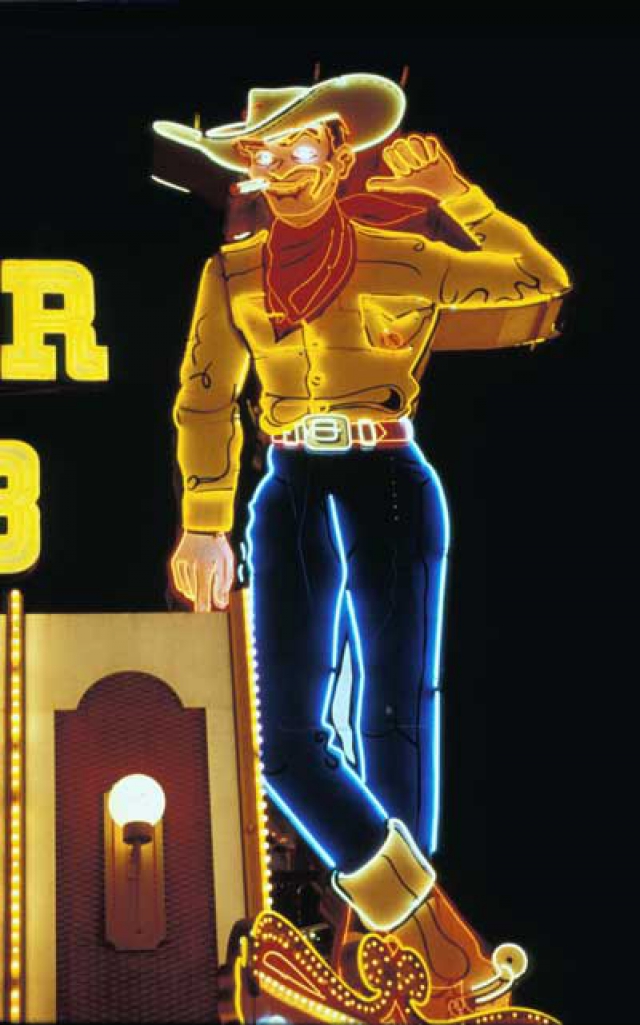
Vegas Vic dates back to the era of Wild West-themed promotions, such as Helldorado and the Last Frontier Village, in Las Vegas. The idea of a Vegas cowboy icon was dreamed up by the Las Vegas Chamber of Commerce in 1947 for a post-World War II campaign to draw visitors to southern Nevada.
The first "Vegas Vic" was erected atop the Pioneer Club at First and Fremont streets in the late '40s. It was mostly Vic's face, with a moving neon thumb and neon typography that read, "Here It Is! The Famous Pioneer Club" (you can see this sign by going to http://dmla.clan.lib.nv.us/docs/museums/reno/exneon/pioneer2.htm).
This sign was torn down a few years later to make room for a 40-foot-tall neon cowboy, which was erected on the side of the Pioneer Casino in 1951. Maufactured and installed by the Young Electric Sign Company (YESCO) for $25,000, Vic weighed six tons, his arm waved to passers-by, and his cigarette twitched and blew smoke rings. At the time, it was the largest mechanical sign in the world.
A few years later, a voicebox was installed so the Vicster could say, "Howdy, pardner, welcome to downtown Las Vegas." San Francisco newspaper columnist Herb Caen, who had little use for Las Vegas, once wrote in a column that though Vic's voice drawled "Howdy, pardner," his wink said, "Howdy, sucker."
We too have long heard the rumor that Lee Marvin, when he was filming The Professionals at Valley of Fire State Park in 1965 and staying downtown at the Mint, grew so enraged at the constant "Howdy, pardner" noise that he shot at the sign from his window across the street, not with a shotgun but with arrows from a bow he used in the movie as a prop. Whether Marvin actually shot the sign is unclear, but he did, apparently, complain about the noise; numerous other complaints led to the voicebox being disconnected around that time.
In 1994, in preparation for the Fremont Street Experience, Vic was taken down and several feet were shaved off the top of his cowboy hat to make room for the Experience canopy. Over the next few years, poor Vic saw some hard times and fell into disrepair, but in 2000, the sign underwent a major refurbishing and is now as bright as ever.
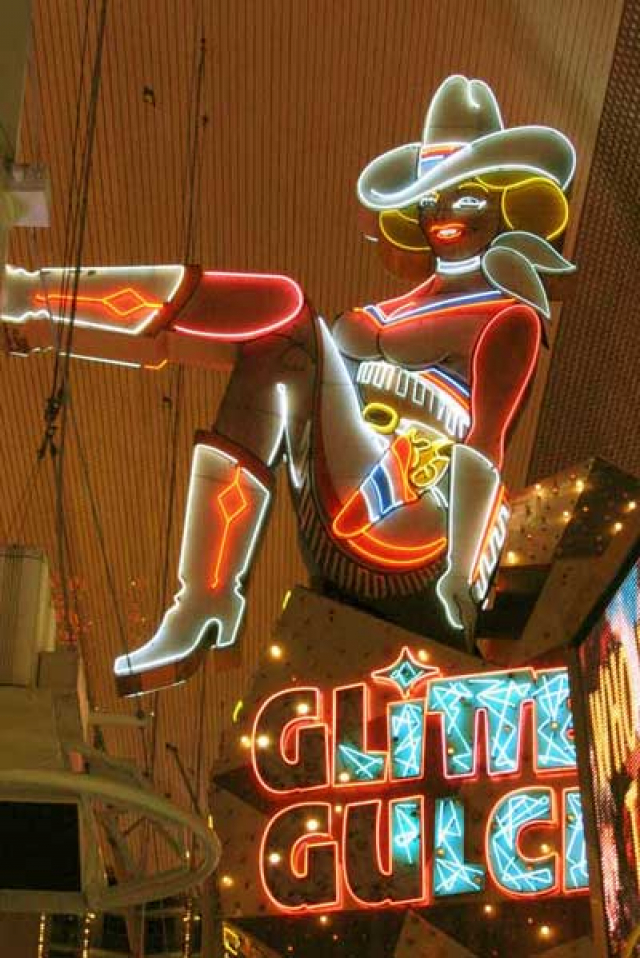
Vic remained single for nearly 30 years until, in 1980, Vegas Vickie was installed atop a small slot joint named Sassy Sally's across Fremont Street (now the Glitter Gulch topless club).
Today, Vic continues to be the most famous sign YESCO ever created and is one of the most enduring symbols of Las Vegas. No other image, certainly, evokes old Las Vegas and downtown Las Vegas more than the neon cowboy.
Photographs appear courtesy of the Las Vegas News Bureau.