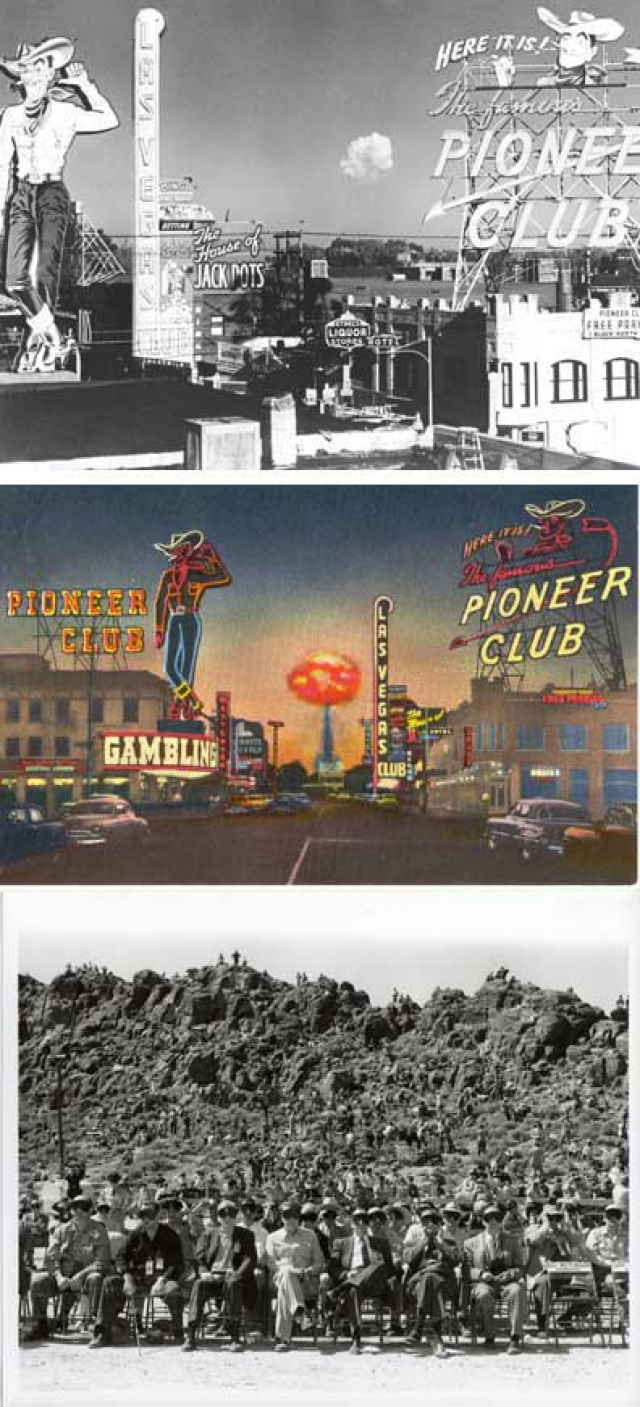
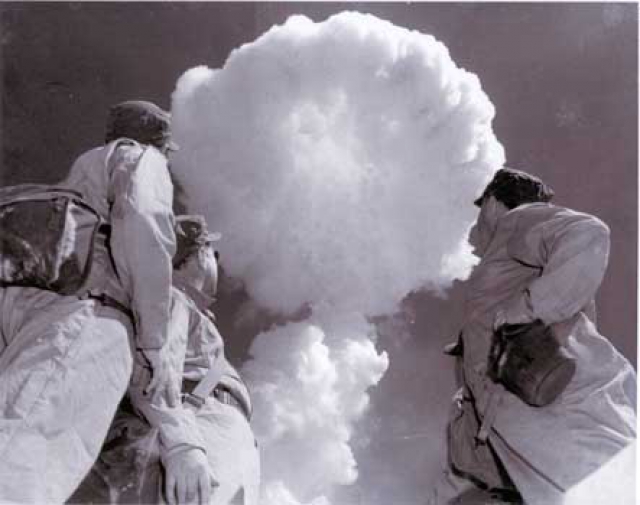
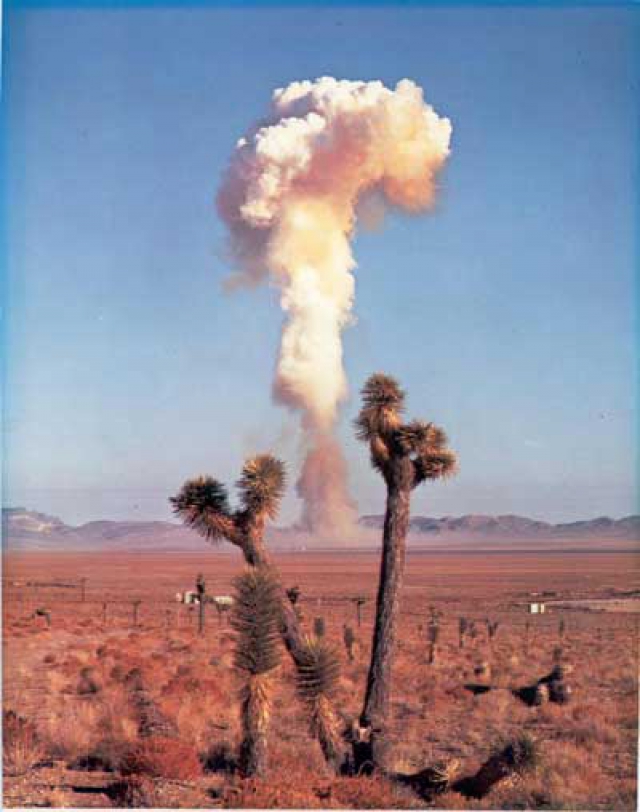
The iconic photograph to which you refer, reproduced below, was taken by Don English of the Las Vegas News Bureau back in 1953, two years after atmospheric testing of atomic bombs commenced at the Nevada Test Site (now Nellis Air Force Range). When the decision was made to undertake nuclear testing in the desert outside Las Vegas, it was initially feared that it would frighten away tourists from the infant city. To the contrary, however, thanks to the work of Don English and others, plus the general ignorance at the time about the dangers of radiation, the bomb became a major draw, as well as generating hundreds of jobs. From 1951 to 1992, when the international moratorium on nuclear testing took effect, 100 atmospheric and 828 underground nuclear tests were conducted at the NTS.
A majority of the photographs of above-ground tests were taken from Angel's Peak on Mount Charleston, and later from a site seven miles from the proving grounds that was known as "News Knob." But in a 2005 interview with KNPR radio, Don English described how the famous Vegas Vic image came about:
"I'd always thought about ... if there was a possibility of seeing the mushroom from Las Vegas. If you did that, you would have to be elevated and be on top of a building. Well, I overslept one morning and missed the bomb, or at least in time to get out to Angel's Peak to photograph it. So I rushed downtown and got on top of a building –- I think it was a drug store at that time ... I waited for a little bit, and by gosh, the mushroom came floating up. It was the first time an atomic mushroom was ever seen over an American city, and it got 'picture of the week' in Life.
"When I was on the building shooting it, there were some workmen repairing a transom on the building below, and they were curious and said, 'What are you shooting?' And I said, 'Well, I’m shooting the atomic bomb. The shock wave is going to be here any minute.' And they said, 'Oh, come on.'
"Anyway, they walked out to the edge of the building to see what I was shooting, and right about that time the shock wave came, and it shattered the transom. The glass flew everywhere. So, luckily, they missed that.'"
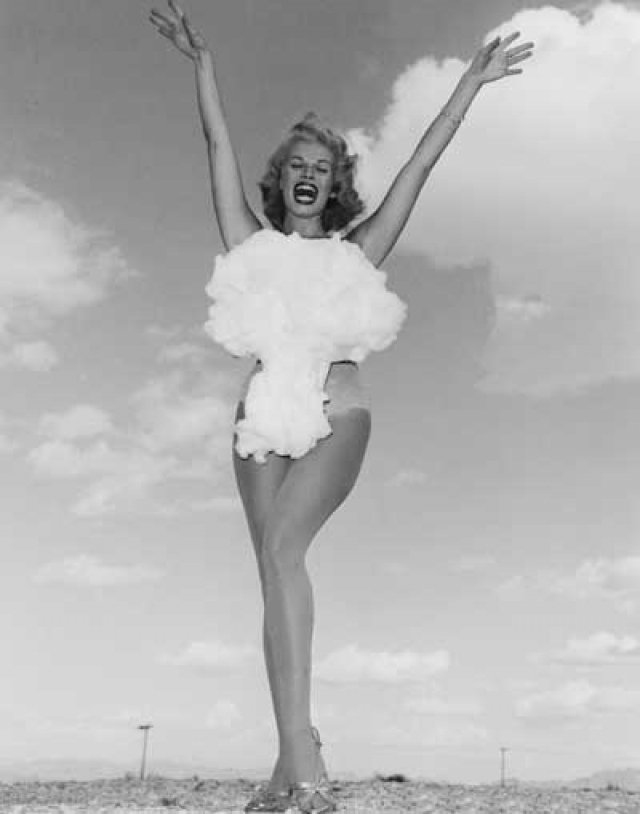
So popular were the dawn explosions that the city and its casinos flocked to market them in their publicity efforts, incorporating mushroom clouds into postcards and other memorabilia and turning the detonations into VIP events -- click on the Vegas Vic link below to see some examples. In 1957, local showgirl Lee Merlin was even dressed up as "Miss Atom Bomb," also famously captured on celluloid by English: "It was an age of innocence, I think ... We certainly were guilty of frivolity, but we just didn't realize the seriousness of what was going on."
In answer to the second part of your question, we're sad to report that Don English, who had remained a beloved resident of Las Vegas, passed away on April 18, 2006, before we were able to run this QoD. As a tribute to his and the work of the other photographers of the former Las Vegas News Bureau (who until recently had remained somewhat anonymous, thanks to a Bureau policy of not ascribing photographs to individual photographers), the Nevada State Museum and Historical Society is currently running an exhibition of their work, which runs through August 27, 2006. The exhibit includes both of English's famous "atomic" shots, plus his equally famous photograph of the floating craps table at the Sands (see QoD 08/13/2005). The museum, located at 700 Twin Lakes Drive, is open from 9 am-5 pm daily and the admission is $4 for adults and $3 for seniors, with children under 18 admitted free. Call 702/486-5205 for more information.
If you're interested in the history of the Nevada Test Site, we strongly recommend you pay a visit to the Atomic Testing Museum, as featured in the April '06 LVA. Located at 755 E. Flamingo, between Paradise and Swenson, it's open Mon.-Sat. 9 am-5 pm and Sun. 1 -5 pm, and provides a fascinating insight into the whole atomic era, from its inception to the present day, both globally and as it has pertained locally to Nevada.