John C. Fremont had a heck of a life story.
His mother was from a wealthy Virginia family. When she was 17, a marriage was arranged for her to an even richer man -- 45 years older than she. That marriage lasted 12 years, until she ran off with a handsome but penniless Frenchman when she was 29. John C. was the illegitimate result of that union, born in Richmond, Virginia, in 1813.
Fremont was a brilliant but indifferent student who was expelled from college in Charleston, South Carolina, for his habitual failure to attend class. In his early 20s, Fremont drifted to Washington, D.C., where he impressed Joel Poinsett, former ambassador to Mexico, who secured Fremont's first assignment working for the government: helping the army survey the southern Appalachian mountains.
Poinsett went on to organize the federal Corps of Topographical Engineers, a group of surveyors and mapmakers who labored under the auspices of the army. In 1838, Fremont was appointed to the Corps' first major Western project, to map the country between the upper Mississippi and Missouri Rivers. On this expedition, Fremont worked under Joseph Nicollet, a French mathematician and geographer who taught Fremont how to be an explorer and cartographer.
Back in Washington, Fremont became a man about town. In 1841, he married Jessie Benton, the 16-year-old daughter of Thomas Hart Benton, a highly influential Senator from Missouri. Benton was a champion of manifest destiny, the expansionist political crusade that considered it the United States' destiny to rule the North American continent.
Benton was instrumental in appropriating funds for surveying the far west. He also used his power to ensure that his son-in-law led the expeditions. In 1842, Fremont headed west to explore the Oregon Trail. In St. Louis, he happened to meet Christopher "Kit" Carson. Carson, at 33, was a few years older than Fremont; though essentially illiterate, he could speak English, French, Spanish, and several Indian languages, all of which he learned as a fur-trapper and young mountain man. He guided Fremont from Missouri as far west as the Wind River Valley in Wyoming, where they parted ways; Carson headed south on another trapping expedition, while Fremont returned to Washington.
Fremont's early maps were rudimentary, but he had a gift (some say it was his wife Jessie's particular talent; she was a writer all her life) to compose glowing descriptions of the wide-open plains and mountains, which fueled the fire of western migration.
In spring 1843, Fremont launched a second expedition, this time to explore the land from the Rocky Mountains to the Pacific Ocean. He traveled through Utah, into northwestern Oregon, and down to California, touching western Nevada on his way (he "discovered" Pyramid Lake and followed the Truckee River into the Sierra Nevada). In California, he headed south to pick up the Old Spanish Trail to Santa Fe, New Mexico. He stopped at Tecopa, on today's border between southern California and southern Nevada, then made his way over the Spring Mountains and descended into Las Vegas Valley. The group spent a few days at Big Springs, which Fremont described.
"We encamped in the midst of another large basin, at a camping ground called Las Vegas, a term which the Spanish use to signify fertile or marshy plains. Two narrow streams of clear water, four or five feet deep, gush suddenly with a quick current, from two singularly large springs; these, and other waters of the basin, pass out in a gap to eastward. The taste of the water is good, but rather too warm to be agreeable; the temperature being 71 in the one and 73 in the other. They, however, afford a delightful bathing place."
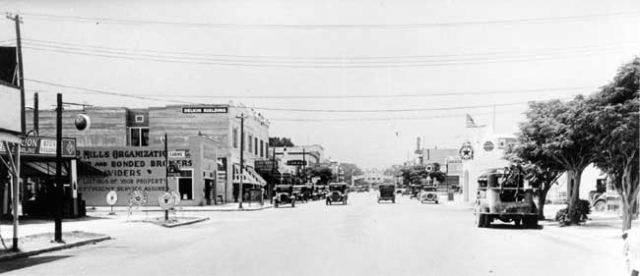
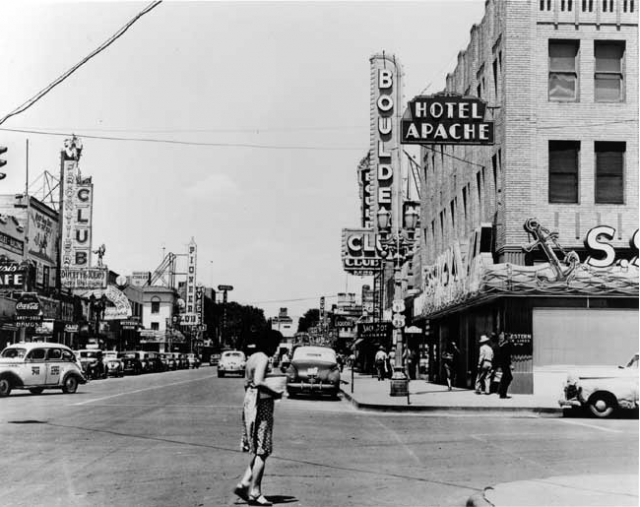
From that description, early Las Vegans honored him by naming their central thoroughfare after him.
From there, Fremont continued into southern Utah, north to southern Wyoming, across Colorado, and back to St. Louis and the east. The map he drew from this trip was published, with a print run of 20,000. They were so readily available that Fremont’s fame was insured.
He undertook a third expedition in 1846, straight to California through central Nevada and back, but that was his last for the government. For the next ten years, he continued exploring, though with private backing. He ran for President in 1856, the new Republican Party’s first national candidate, but he lost to James Buchanan.
After a few more adventures -- he became the army Commander of the West and the governor of Arizona Territory -- Fremont and his family settled in Los Angeles, and lived mostly on his wife Jessie’s literary income.
John C. Fremont died of a ruptured appendix on a trip to New York City in 1890 at the age of 77.