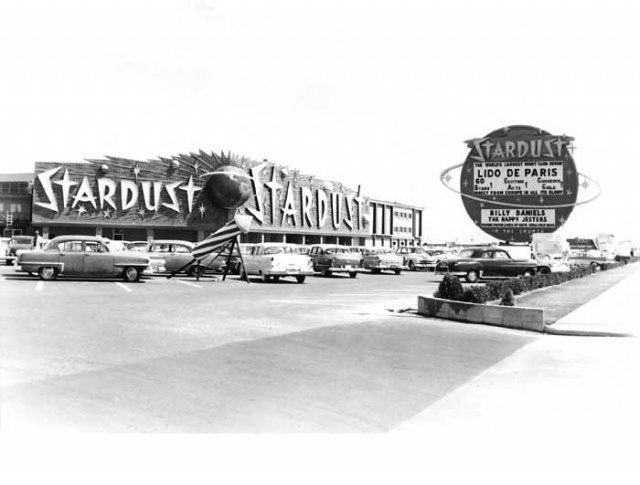
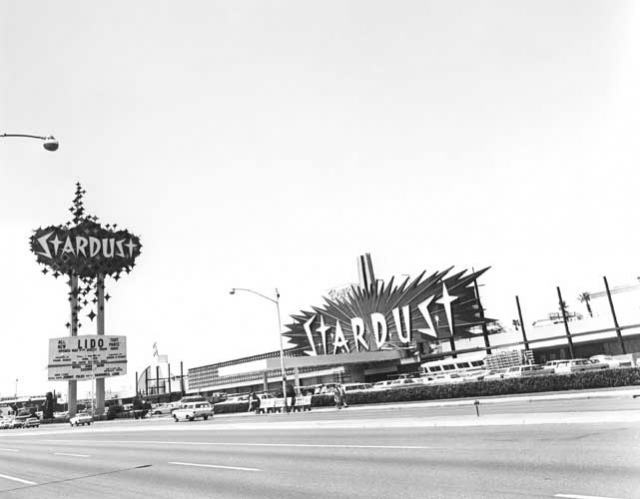
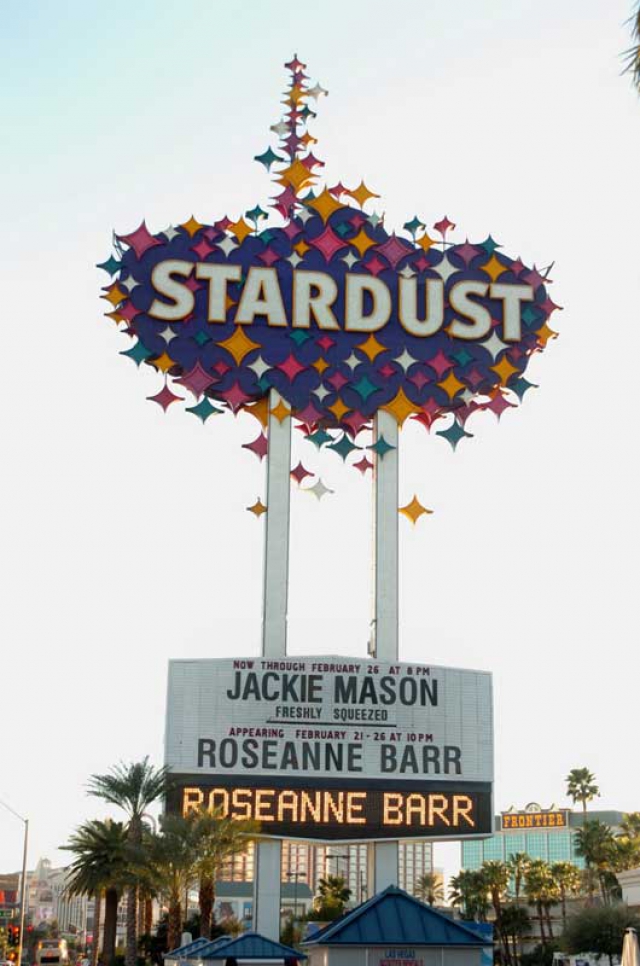
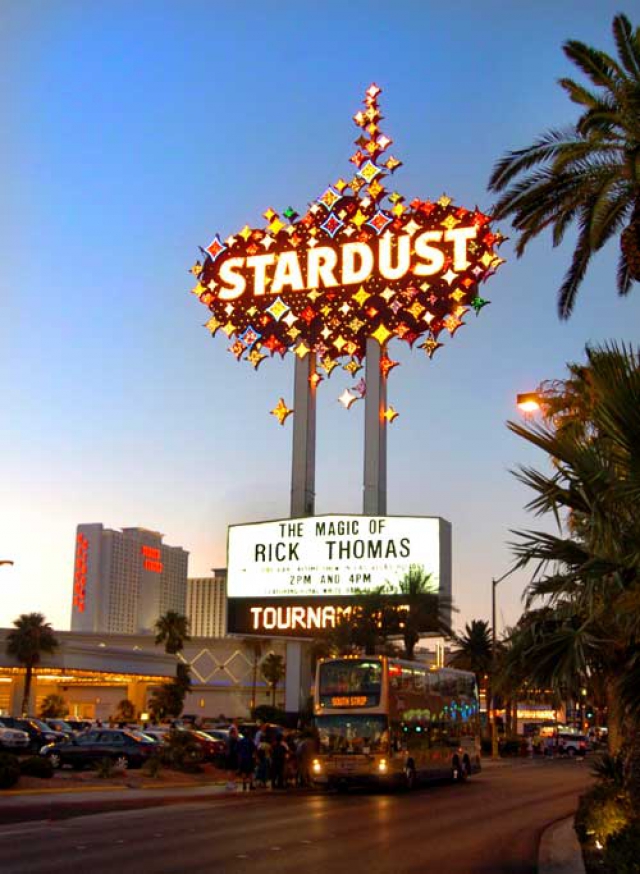
Originally installed in 1968 at a reported cost of $500,000, the glittering 188-foot-tall, 97-foot wide (at its broadest point) Stardust pylon was the largest free-standing sign in the world, earning it the nickname of the "Queen of the Strip" for many years. The award-winning design, by local sign artist Paul Miller of the company Ad Art, replaced the original 1950s planet-Jupiter-style sign (see below), but used the same Electra-Jag lettering as the building's cosmic façade (which comprised 7,100 feet of neon tubing and 11,000 light bulbs), inspired by the Russian Sputnik space program.
The new shimmering starburst pylon was apparently designed to suggest an atomic mushroom cloud, reflecting the evolution of one of the Strip's first ostensibly "themed" hotels from its '50s space-age roots to the subsequent fascination with all things atomic, thanks to the frequent atom-bomb tests being conducted in the Nevada desert by that time.
In a combined drive toward modernization and energy conservation (the building's galactic signage was costing a fortune in the midst of an energy crisis), in 1977 the massive "Stardust" frontage signs were removed and replaced with a new neon-and-mirrors design. The roadside starburst pylon remained untouched, however, until 1991, when the final remaining vestige of the space-age theme bit the dust and the Electra-Jag Sputnik lettering was replaced by a subdued contemporary typeface. The designers at Ad Art were mortified: "We couldn't believe it when they called us up and said they wanted to take down the old letters and put up Helvetica. We were heartbroken. But we did it. We basically screwed up our own sign." The Sputnik lettering went to the Neon Boneyard, where it's still sitting today -- awaiting, hopefully, a reunion with its original housing.
Which brings us, finally, to the answer to your question, which is that at this moment, we regret we don't know the fate of the sign, following the announcement of the Stardust's closing for redevelopment. The nascent Neon Museum, which has been collecting and preserving Las Vegas' old signage for a decade, is hoping the Stardust's sign will go to them when the property is shuttered at the end of this year.
And when we questioned their plans for the sign's future, a spokesman from Boyd Gaming stated, "We recognize its significance in Las Vegas' history," but would not have any further information until later in the year. It seems the potential problem is the sheer size of the thing, which will certainly pose some logistical challenges if it's to be dismantled and relocated. But we know we're not alone in sincerely hoping that some kind of agreement is reached and the technical obstacles overcome, so that the sign can be preserved for posterity. As more information becomes available, we'll be sure to pass it on.
Meanwhile, if you're interested in the history of Las Vegas' famous neon signage, visit the Neon Museum's Web site at www.neonmuseum.org, where you can get the walking route for their Fremont Street outdoor exhibit of restored signs, including the famous Hacienda Horse and Rider and one the Aladdin's lamps.
Their three-acre Boneyard site is home not only to the Stardust letters, but also to other iconic gems stretching back to the 1940s, including additional items from the Aladdin, and others from the Silver Slipper and Binion's Horseshoe. This is the unrestored part of the collection, partly donated and partly on loan, which they're hoping one day to open to the public when sufficient funds have been raised (you can make a donation on the Web site).
For now, the location is deemed too unsafe to allow general admission, although it is open for guided tours by prior appointment to groups of 10 or more at $5 each (or smaller groups, for a $50 donation) and is regularly used as an evocative backdrop for photo shoots and music videos.