The desegregation of Las Vegas was a slow, painful, and delayed process.
The segregation of Las Vegas, however, began just as Las Vegas did, with J.T. McWilliams' original town site, west of today's downtown. McWilliams laid out Las Vegas in 1904, in anticipation of the railroad arriving. But the town moved east of the tracks when the railroad founded the official Las Vegas in 1905. McWilliams' town site, known as Oldtown, lacked water, the source of which was controlled by the railroad, and it burned mostly to the ground that same year.
Still, people continued to live there. The term Oldtown evolved into West Las Vegas, which evolved further into Westside. Gradually, it became segregated, as African-Americans who came to Las Vegas looking for work discovered that they had to live west of the tracks. Westside, in fact, didn't get water -- or electricity or phone service or paved streets -- for another several decades. Still, a strong, vital, and separate community developed, with its own businesses, churches, schools, and small casinos. The demarcation line between white and black Las Vegas, the railroad overpass, was locally dubbed the "Concrete Curtain." The rest of the country, however, came to know segregated Las Vegas as the "Mississippi of the West."
Segregation was not only strictly enforced, it was blatantly hypocritical. The policy remembered unfondly today is that of black performers, who entertained on Strip-casino stages in the '40s, '50s, and even into the '60s, but weren't allowed to eat, drink, sleep, or socialize in those same hotels. On the contrary, they had to make their way to Westside for accommodation in boarding houses or private homes. And that, in part, gave rise to the idea of the Moulin Rouge.
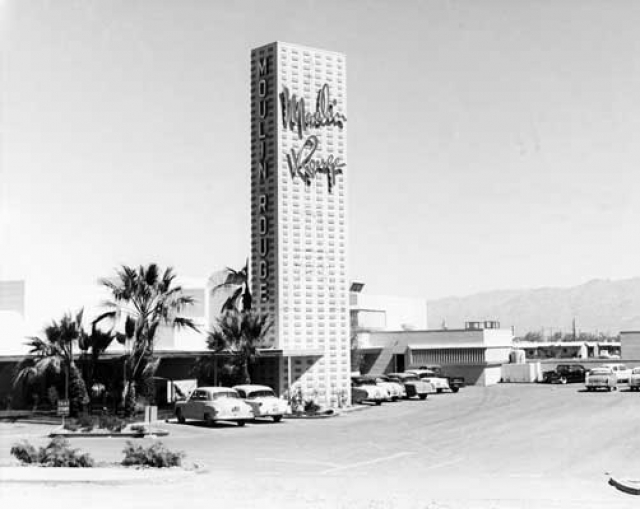
On May 24, 1955, Las Vegas' first integrated casino opened. The Parisian-themed Moulin Rouge was built at 900 W. Bonanza Rd., just on the other side of the Concrete Curtain, by three white partners in a construction company. It was an immediate smash success. The biggest black entertainers of the time -- Lena Horne, Sammy Davis Jr., Louis Armstrong, the Mills Brothers -- were booked into the Moulin Rouge's showroom. The Tropicana Revue went on at midnight, with black dancers, showgirls, and musicians.
White performers, who traditionally roamed the Strip's lounges in the wee hours after their own shows, frequented the Moulin Rouge. That drew audiences looking for some impromptu performances of all the biggest stars in town. In addition, the white showgirls from the Strip revues started flocking to see the black dancers. That drew the white gamblers. (It also prompted a stern reaction from the Strip bosses, who posted notices in dressing rooms that any cast member seen at the Moulin Rouge would be fired and blackballed.)
For six months in 1955, everyone who was anyone in Las Vegas or Los Angeles hung out at the Moulin Rouge, especially for the third show, which started at 2:30 a.m.
Then, without warning, the Moulin Rouge closed. One day in late November 1955, the employees showed up for work to find the doors secured with chains and padlocks. To this day, the real story behind the closing is shrouded in mystery and rumor.
One theory is that 1955 was a tough time to make a profit in the Las Vegas casino business. A year earlier, the Castaways opened on Boulder Highway. In 1955, the Riviera, Dunes, rebuilt New Frontier, and Royal Nevada opened on the Strip, with the Tropicana being built. The next year, the Fremont opened downtown. Las Vegas was overbuilt (the Royal Nevada survived only a year) and the Moulin Rouge was far off the beaten path in a touchy part of town.
Another theory is that the Strip bosses made the owners a deal they couldn’t refuse. A week after the Moulin Rouge closed, for example, one of its partners started a job as an executive at Moe Dalitz's Desert Inn.
A third theory holds that the owners had expected wealthy African-Americans to frequent the Moulin Rouge, but that never materialized. Upper-class blacks, the idea goes, didn’t relish being restricted to a single casino in Westside.
Five years later on March 26, 1960, the Moulin Rouge, which had reopened as a restaurant and motel, was the site of the seminal moment in the history of Las Vegas integration, known as the "Moulin Rouge Agreement." In 1960, the then-NAACP president, James McMillan, issued an ultimatum to Strip and downtown casinos. They had 30 days to allow black customers or they’d face an organized boycott. Finally, the bosses capitulated. To the surprise of some, but not others, they cared less about the colors black and white than they did about green.
The Moulin Rouge limped along as a tiny casino, eatery, and motel into the late 1990s, with a succession of owners and developers attempting to do something with the property. In 1992, a group called the Preservation of the Moulin Rouge managed to get the original building placed in the National Registry of Historic Places. Sarann Knight-Preddy, the first black woman to receive a Nevada gaming license, tried to bring it back, unsuccessfully. Bart Maybie, a Canadian developer, bought it in 1997 and announced big plans for the place, hoping to reopen it for its 50th anniversary in 2005. He also rented the 120 hotel rooms, which had been turned into apartments, to people on government assistance. Even Bob Stupak announced plans in July 1999 to invest $20 million to buy, renovate, and reopen it. The property was also a setting for the filming of the movie Casino.
Then, in June 2003, a flash fire that was quickly determined to be arson hit the Moulin Rouge. Firefighters were able to save the apartment complex, along with the facade, but the original casino building was totally incinerated.
In March 2004, a group of black businessmen purchased the historic 15-acre site for $12.1 million. The new owners announced plans to spend $200 million refurbishing the property, with 50 hotel rooms, a 40,000-square-foot casino, an events and community center, movie theaters, and a Motown Cafe. The plans called for the casino to open in December 2005. Nothing happened.
Today, all that remains of the Moulin Rouge is the façade and sign with its stylized letters.