It's hard to tell which came first, the eccentrics or the eccentricity (flamingos in the desert? psychedelic carpets? 20th century sphinxes? drive-through wedding chapels?), but there's no doubt that Las Vegas has long been a magnet for some of the nation's more colorful individuals who have often chosen to make it their home: Howard Hughes, Elvis Presley, Liberace, Siegfried & Roy, and Penn & Teller, to name a few. And yes, the bricks and mortar are often as weird and wonderful as the people who dwell within.
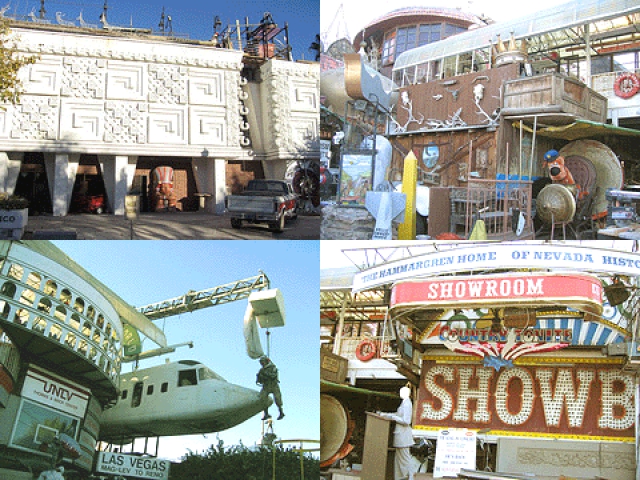
The home you're referring to is known variously as Castillo del Sol, "The Principality of Paradise," "Hammargren's Home of Nevada History" or, less romantically, "Looneyland." It’s the residence of retired neurosurgeon, erstwhile NASA flight surgeon, former lieutenant governor of Nevada, and general eccentric and self-promoter Dr. Lonnie Hammargren. Since he bought the original property located at 4318 Ridgecrest Dr. (near Flamingo and Sandhill roads) some 30-plus years ago, the good doctor has spent millions of dollars incorporating two neighboring houses into the mix — which now comprises a 12,000-square-foot property with 10 bedrooms, nine bathrooms, and a façade that's a copy of the Palace of the Governor as found in the Mayan Ruins of Old Mexico — and collecting all kinds of memorabilia and, frankly, junk that now adorn/litter his home, both inside and out.
Take the yard, which consists partly of a topographical map of Nevada and bits of South America and is home, among other things, to a scaled-down replica of the Fremont Street Experience, a giant octopus, a brothel (apparently used for storage), various old casino signs, a fire-breathing dragon, the doors to the first Clark County jail, the railcar that brought Howard Hughes to Las Vegas, a collection of antlers, an experimental airplane, a missile silo, a submarine, a genuine Apollo space capsule, a model of the Statue of Liberty, and the High Roller roller coaster that formerly graced the top of the Stratosphere Tower. You get the picture.
The interior tells a similar story, featuring an observatory, planetarium, and toy room, plus a host of other themed rooms that house a mix of genuine antiques, artifacts, and antiquities from around the world, side by side with the array of miscellaneous flotsam and jetsam that Hammargren continues to accumulate.
If you're interested in seeing the place for yourself, once a year on Nevada Day (which also happens to be Halloween), Dr. Hammargren holds an open house, offering free ice cream to anyone who cares to drop in. The house has also been the subject of HGTV's "Extreme Architecture" series -- click here for a link that takes you to a virtual video tour of parts of the house.
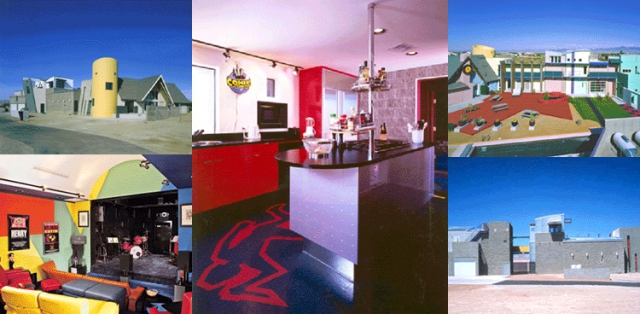
Another local residence that's been featured regularly on TV and in print is the residence of Penn Jillette, a.k.a. "The Slammer." Home to the larger, noisier half of Penn & Teller, the home was designed, under Penn's guidance, by local architecture firm CSA, along with Outside the Lines design consultancy based in Santa Monica, and has won several awards. Built in the middle of the desert several miles outside Las Vegas, the house veers between the playful and kitsch to the austere and downright macabre: It is, in the words of its owner, "the house of a 12-year-old with a lot of money." And, you could add, a fairly twisted imagination.
The abode actually comprises an existing 1,500 square foot house that was "hinged" onto a new 2,500-square-foot extension, via the addition of a large, yellow, cylindrical tower. From the exterior, the property closely resembles a maximum security penitentiary (hence the name), which was Penn’s intention. But once you’ve made it past the watch tower, the rolling chain link fence, and obligatory mugshot-taking, you’ll find the interior is a colorful and eclectic mix of styles, from the genuine prison toilet to the Goldfish cracker-shaped koi pond, the plush multi-colored state-of-the-art home theater to the S&M bondage room and the well-equipped kitchen that features a coroner’s victim outline, posed for by Teller, on the floor, and is the end of a line of apparent blood that extends from the shower in the master bathroom. To get to and from the master bedroom, Penn walks along a seventy-five-foot outside catwalk, overlooking the courtyard. "We have created things far outside the normal envelope of residential design," comment the designers on their Web site. "This is appropriate for someone who has, in general, lived outside usual definitions."
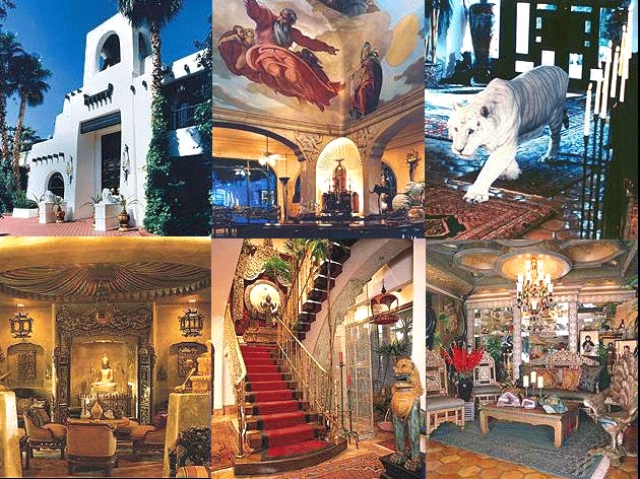
So that’s Penn’s place. Then, of course, you have the two residences of Siegfried and Roy. These are not only opulent to the point of vulgarity (we consider a replica of the ceiling of the Sistine Chapel over the cappuccino bar to be just ever-so-slightly OTT), but also stand out from the norm for the fact that you might at any point bump into an enormous white tiger—or, perhaps even stranger still—a small donkey, whether outside or in. Perhaps taking a page out of Marie Antoinette’s book, there’s the main formal home called the Jungle Palace (the "Versailles" of the duo, as it were) and the rustic retreat (equivalent to the hapless Queen’s Petit Trianon) called Little Bavaria. With its Lalique crystal candle holders, Persian carpets, Swiss hand-carved furniture, and original Dutch Old Masters on the walls, it’s a pretty fancy chalet; but it’s positively shed-like compared to the Jungle Palace.
From the photographs we’ve seen, the Palace is actually a treasure-trove filled with some extraordinary and beautiful items that the pair have collected or been given: the 5000-pound silver tiger from India; the hand-carved mother-of-pearl inlaid furniture from King Farouk of Egypt; the Afghan carpets; the Singaporean temple gate; the set of gold candelabras gifted by Liberace (who else?); a clock once owned by Napoleon (Bonaparte, not Dynamite), and – one of their most prized possessions – a jewel-encrusted sword once belonging to Ghengis Khan. Wow. Wonder what their insurance premiums are.
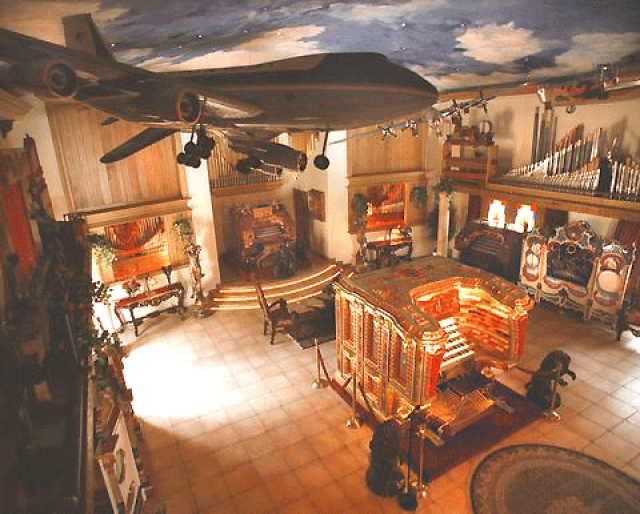
Another lesser-known but fascinating home is that of George Maloof’s elder brother, Phil, whose hobbies include collecting vintage cars, old organs (of the musical variety), art, and antiques. Although not open to the public, the Estate or "Funhouse" of Phil Maloof is regularly thrown open to friends, family, and associates, and features entire rooms dedicated to his various passions. "If you’re going to do it in Vegas, you’ve got to do it big and special," commented the owner in another HGTV "Extreme Homes" episode, and he meant it.
When Maloof bought the house, back in 1996, he added two five-thousand-square-foot extensions, which each comprise a single room. One houses his art collection and has 1/6th scale models of various aircraft, including the Enola Gay and Memphis Belle, suspended from the 34-foot-high ceiling, which is decorated with a swirling sky mural and fiber optic stars. The windows are stained-glass representations of some of his favorite autos. This and other rooms house Maloof’s treasured collection of rare 1920s pipe organs from the silent movie era, now rescued and restored. These include the Chicago Stadium Barton Organ (the largest free standing pipe organ console in the world), and the Kimball Organ from New York’s famous Roxy Theatre, which previously resided at his brother George’s Fiesta Casino, before the property was sold to the Station group. The latter is 3-storys high and took a crew of 25 artists working 9,000 hours to restore it to its former painted and gilded glory. Other gems throughout the estate include several Egyptian throne chairs, the ship’s telegraph used in the movie Titanic, and a collection of over 1,800 works of art, from oil paintings to statues and fountains that adorn the landscaped grounds.
And last but by no means least, there’s the fabulous Underground House, which was the subject of a former QoD (5/20/2005). In brief, this 16,000-square-foot secret dwelling is concealed 25 feet beneath an innocuous-looking modern home, but is an untouched shrine to the opulent (and Cold War-paranoid) ‘70s, with its deep yellow shag-pile carpets and kitsch furnishings. There’s everything you could want in a home, including underground putting green, underground pool, sauna, and hot tubs, underground (artificial) trees, and even views of desert vistas (painted murals on the walls outside the windows). It’s not open to the public but is available for private hire for $15,000 and up.
Another interesting side note: Liberace maintained a 19,000 square foot mansion in town known as "Las Vegas Villa." This opulent residence became a haven for the visiting rich and famous, holding one of only three private gaming licenses in the state. The other two were held by Frank Sinatra and Howard Hughes. Las Vegas Villa is still available today for private parties and functions.