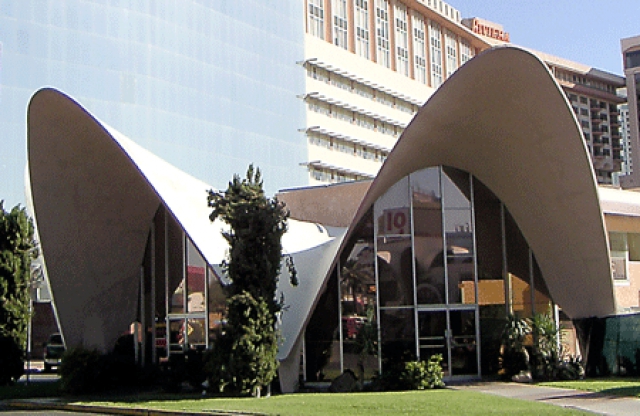
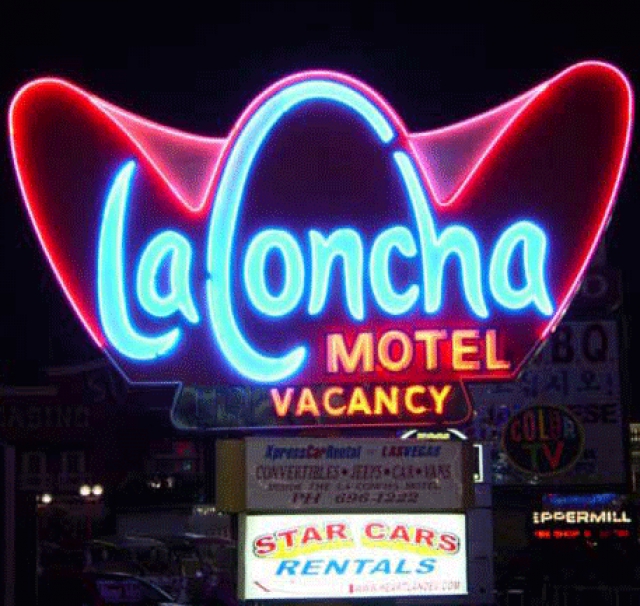
The La Concha Motel opened in 1961 just south of the Riviera on the north Strip at 2955 Las Vegas Boulevard South.
It was designed by Paul Revere Williams, an African-American architect. Williams was the first black member of the American Institutes of Architecture, inducted in 1923; he's credited for more than 3,000 buildings during his career. Based in Los Angeles, Williams designed many of his buildings to reflect the roadside Googie architecture, rooted in Southern California's car culture and featuring oversized glass walls, upsweeping roofs, space-age accents, and sleek autodynamic motifs. (Googie, which took its name from a space-age-looking 1950s' roadside coffee shop on Sunset Boulevard in Los Angeles, flourished from the '40s to the mid-'60s. Williams also designed Las Vegas's distinctive Guardian Angel Cathedral.)
La Concha's lobby building had three 28-foot soaring parabolic arches, with massive windows supported by thin-shelled poured-concrete cantilevers. The clamshell (conch) shape, in Williams's "mid-century modern style," was considered an architectural and engineering marvel for its time.
It's believed that La Concha was named after the resort community of La Concha, Spain, which would account for the Mediterranean details, such as Spanish nobels in the foil wallpaper, gilded lanterns in the corridors, and ornate scrolled borders of the bathroom vanities, of its interior decoration. The El Morocco Motel next door, with its circular arched lobby, was similar. It's not surprising that you noticed it in the early '60s the first time you saw it and you noticed it again as it was being torn down.
La Concha was built by the Doumani family, which has owned the property since 1959. The builder's grandson, Lorenzo Doumani, announced as far back as November 2000, that the motel, along with the El Morocco, would be torn down to free up 5.5 acres of prime north Strip frontage for a new development. The motel closed and the 350 rooms, plus the swimming pool, were demolished in 2003. A business had a lease on the lobby that didn't expire until 2005, which saved the building from the wrecking ball.
Meanwhile, the Doumani family donated the building to the Neon Museum, which raised $500,000 to dismantle the lobby building and move it a few miles north to the corner of Las Vegas Boulevard North and Foremaster Lane, a couple blocks up from Cashman Field. That's what you saw last month. Because the 1,200-square-foot building was nearly 30 feet tall, it had to be cut in half to move it.
First, the asbestos had to be removed, then the glass. Then workers had to hack, carefully, the structure into eight pieces. A 90-ton 100-foot-long crane lifted the 12-ton pieces onto a flatbed truck. The truck moved the building in the wee hours, with four pilot cars running interference; the two-plus-mile trip took four hours.
The pieces are now stored at the Neon Museum's Boneyard. More funds need to be raised to put the whole thing back together. Once it's rebuilt, the La Concha lobby will serve as the façade and part of the museum's visitor center. The museum hopes to build it in 2007 and open it in 2008.
As for what will be built on the site of La Concha, Lorenzo Doumani originally announced a small five-star hotel, Hilton Hotel's luxury Conrad brand, to operate the new non-casino hotel he was planning to build, along with a 654-foot condo-hotel called the Majestic Las Vegas Resort. The $250 million Majestic and Residences were to be housed in the second-tallest tower in Las Vegas, along with a dining-retail complex on the 5.4-acre parcel.
The details were as follows: The 442 suites in the 37-story Conrad Hotel were to be a minimum of nearly 800 square feet, among the largest on the Strip. The 44-story residential tower was to house 144 upscale condos ranging in price from $850,000 to $3 million. A 100,000-square-foot open-air retail and dining complex would have rounded out the new property, which was announced to open sometime in early 2006.
But by summer 2005, the Conrad Hotel and the Majestic were cancelled, and not much word about the use of the site has been heard since.