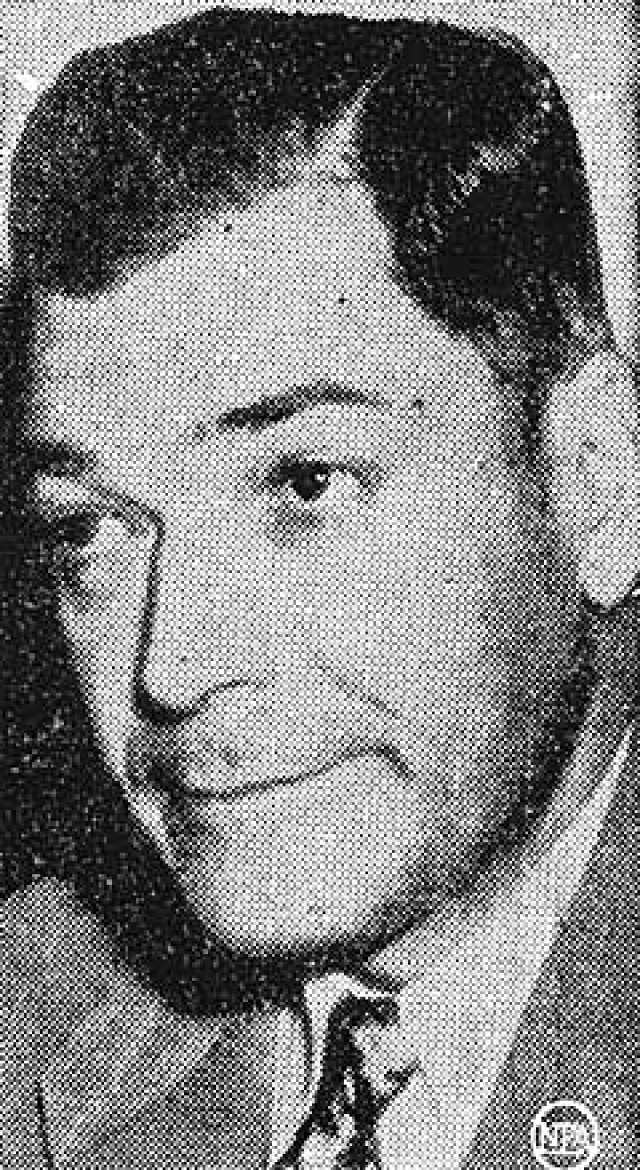
Many thanks to all of you who wrote in about your favorite QoDs when we recently opened up the archives (and to all who wrote in just saying how much they'd enjoyed the chance to browse). Many people wrote in saying in general how much they love the historical questions and some specifically picked the double-bill that ran 05/05-05/06/06, so today's QoD about Tony Cornero, now with a photo added, begins a week-long "Best of" series from your picks, as well as ours -- of course, we have our own favorites. Enjoy.
Anthony Cornero Stralla's is one of the most colorful and incredible stories in Las Vegas history.
Tony Cornero, also known as Tony Stralla and Admiral Cornero, was born in 1895 (or 1900, depending on the source) in a small village in Italy near the Swiss border. The story goes that the Corneros owned a large farm, but his father lost it in a card game. It's also believed that as a boy, Tony accidentally set fire to one of the harvests, which broke the family and forced them to move to San Francisco.
Apparently, Tony ran a little wild in the Bay Area and when he was 16, he served 10 months in a reform school for robbery. After moving to southern California to evade further legal troubles, Cornero was reportedly arrested ten times in ten years, mostly on bootlegging charges, but also on several attempted-murder bits.
Rum-running was his main source of income during Prohibition (though he also drove a cab). He started by smuggling top-shelf whiskey from Canada, which he sold to upscale speakeasies in Los Angeles. He also bought or stole a number of small boats, with which he ran booze between southern California and Mexico. Cornero wound up specializing in running his small boats between mother ships off the southern California coast to deserted beaches late at night. Moving up, he acquired a merchant ship, the SS Lily, which could hold 4,000 cases of alcohol at a time. But he finally got busted, was convicted, and served time in prison.
He was released in 1930 and in 1931, he and his brothers Frankie and Louie wandered east to Las Vegas to build a fancy hotel-casino. Arguably, Cornero should receive credit that's usually reserved for Bugsy Siegel; his Meadows Club, which opened a mere two months after gambling was legalized in Nevada (the Cornero brothers were building the casino before gambling was even legal in Nevada), was a classy carpet joint near the intersection of Charleston Blvd. and the new Boulder Highway, just outside the city limits and beyond the Las Vegas Police Department’s jurisdiction. It contrasted sharply with the Western-style sawdust saloons in vogue downtown. Each of the 30 rooms had its own bath and hot water was available 24 hours a day, as were electric lights. In addition, the Meadows was celebrated locally for the "friendliness" of the food and beverage waitresses (meaning they were for sale). In fact, Frank Wright, in his book Nevada Yesterdays, writes, "The Corneros thought they had a deal with city politicians. Block 16, the downtown red-light district, would be forced to close, and the entire operation could be moved out to the Meadows. If they had a deal, it fell through with the election of new officials in 1932."
The Corneros sold the hotel to a southern California developer two months after the Meadows opened; a fire on Labor Day 1931 burned it down. They bailed out of the casino in 1932. Some say the business failed. Another account claims that Tony refused to fork over a cut of the action to the New York mob, led by Lucky Luciano and Frank Costello (dubious). Whatever the cause, the casino closed and the Meadows turned into the Cocoanut Grove, modeled after the famous L.A. club of the same name. That closed too, and the building became a cathouse before burning down in 1943.
Meanwhile, the Corneros returned to southern California. With Prohibition ending and casinos now in their blood, they went into the offshore gambling-boat business. Tony was involved with several gambling ships that operated just outside the three-mile jurisdiction of the L.A. authorities, but were only a 10-minute water-taxi ride from the Santa Monica Pier. He reportedly lost the ownership of one of those boats, the SS Tango, at a crap table -- a game with which Tony had an unhealthy relationship.
Then, in May 1938, Cornero bought and remodeled the SS Rex for $600,000, money believed to be fronted by Bugsy Siegel and ac
He got out of that business in 1944 and headed east again to Las Vegas, where he leased the Apache Casino from Pietro Silvagni, who owned the joint, renaming it the SS Rex. That only lasted six months; Cornero was by this time so notorious that the city officials threatened to revoke Silvagni’s casino license if he continued to associate with Tony.
Cornero went back to Los Angeles, bought yet another gambling ship, named it the SS Lux, and anchored it off the Long Beach coast. Again, people flocked to the casino. Again, the authorities besieged the Lux. Again, Cornero beat the local rap and went right back to minting money on his ship. This time, however, the feds got involved. The Coast Guard seized the Lux, charging that it was licensed only to engage in coastal trade. Cornero’s days as an admiral were over.
Meanwhile, his personal life was as colorful as his business life. In 1946, when he was in his late forties or early 50s, he married a 27-year-old grifter named Barbara Land. The marriage lasted a few months before Tony and Barbara were divorced. But they subsequently remarried.
Through the late ‘40s and early ‘50s, Tony tried his luck at opening a few backroom casinos in Los Angeles. But Mickey Cohen, the reigning mobster, wanted his piece of the action. Cornero, as was his custom, refused. So Cohen fire-bombed Cornero’s house in Beverly Hills. That didn’t discourage him, but one day, when he answered the door to his house, he was shot in the stomach. The bullet ripped apart his small intestine and he was in intensive care for several weeks. Now he was afraid, and again he returned to Las Vegas -- to fulfill a vision he had of building the largest hotel-casino in the world.
His idea, now, was to build a casino for the masses. He wanted 1,000 rooms. He wanted a plain building, bargain food, and a low rolling casino. He wanted to go up against the classy trappings and big-money casinos of the Desert Inn across the street and the Sands down the Strip. He planned to charge $5 a night for rooms and handing everyone who walked in the door $5 to make their first bets. He also wanted "the little guy" to be able to invest in what he believed would be the most profitable casino ever.
Cornero launched the Stardust Company in 1954 with $10,000 in cash and two million privately printed stock certificates that he failed to register. He personally sold the stock to speculators and investors and bought 36 acres of land across on the west side of the Strip. He drew up grandiose blueprints and arranged for contractors, labor, and building supplies. The plans called for separate low-rise garden rooms, each named after a planet; guests would shuttle around the acreage on personal motorscooters.
But by this time, Cornero was so notorious for his unusual business practices that the Nevada governor, Charles Russell himself, intervened to prevent him from gaining a gambling license. The Securities and Exchange Commission, as well, began insisting that he subscribe to standard stock-registration procedures. The DI’s Moe Dalitz and his partners were also holding a grudge against Cornero for building his monstrosity right across the street from them. As these and other pressures mounted, Tony Cornero, similar to Bugsy at the Flamingo, began to unravel. By the summer of 1955, 3,000 investors had contributed $6 million, some of which was dropping into the lock boxes in the Desert Inn casino -- Tony just couldn’t stay away from the DI crap tables.
Mob writer John William Tuohy tells the following tale about Cornero’s last hours on Earth.
"Cornero had gone to the Desert Inn for a last-chance meeting with Dalitz to beg the mob's favorite front man for financing to help him complete construction on his casino, the cursed Stardust.
"The place was scheduled to open in just two weeks, on July 13, 1955, and Cornero didn't have the cash to pay the staff or supply the house tables. He was in over his head and Dalitz and everybody else knew it. Tony was in the hole … to the tune of $6,000,000 that he had borrowed to finance the Stardust's construction, and he couldn't account for half the cash. …
"Cornero and Dalitz met for several long hours in a conference that went nowhere. Cornero wanted the mob's money and the mob wanted Cornero's casino, but had no intention of paying another penny for it. During a break in the meeting, Cornero went out to the floor and gambled at the crap tables and quickly fell into the hole for $10,000.
"Then a waitress came and handed him a tab for twenty-five dollars for the food and drinks he'd had.
"Cornero went ballistic. He was a guest of Moe Dalitz. The waitress didn't care. She wanted the money. Dalitz stood by and watched as Tony Cornero suffered through the ultimate Vegas insult to a big-timer.
"Cornero screamed, ranted and raved and then he grabbed his chest and fell forward on the table, desperately clutching his heart through his shirt, the dice still wrapped in his chubby hot hands.
"For decades the story circulated in the underworld that Cornero didn't die of a heart attack, that his drink had been poisoned.
"If he was poisoned, the answer went with him. An autopsy was never done. His body was shipped off to Los Angeles for a quick funeral. … Within eight hours after he hit the cold floor of the Desert Inn, Tony the Hat was eight feet under the ground.
"Nobody checked the contents of the 7&7 he had been sipping before he dropped dead. No one cared enough to ask any serious questions anyway. The important thing was that Tony Cornero was dead, Jake the Barber Factor, a Chicago favorite, was moved into position as the Stardust's new owner of record, and everybody in mobdom was happy.
"Well, everybody except Tony Cornero."
Another account summed it up this way. "Tony went out like the gambler he was. Of the estimated $25 million he had earned during his career as a gambler, Tony Cornero had less then $800 in his pockets when he died."