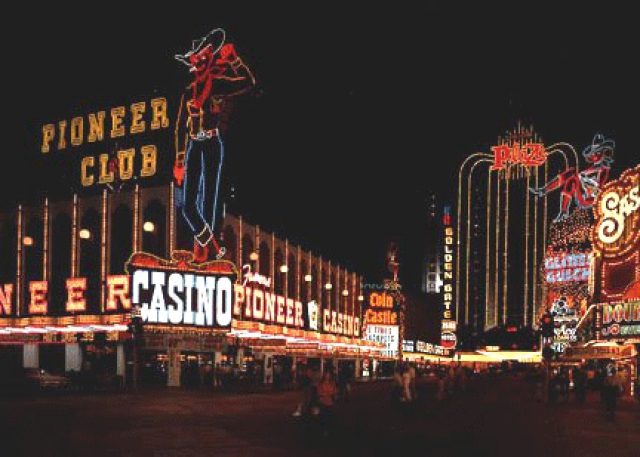
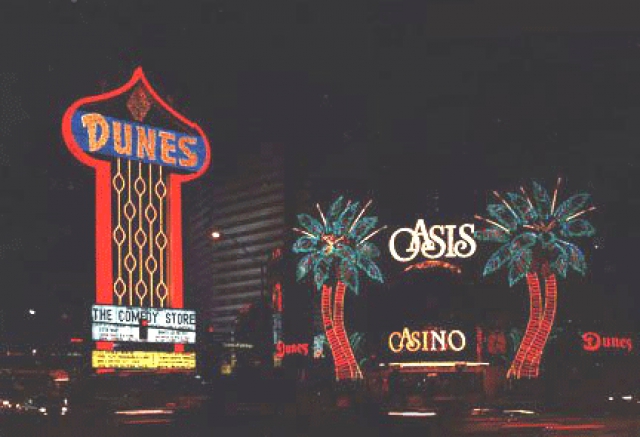
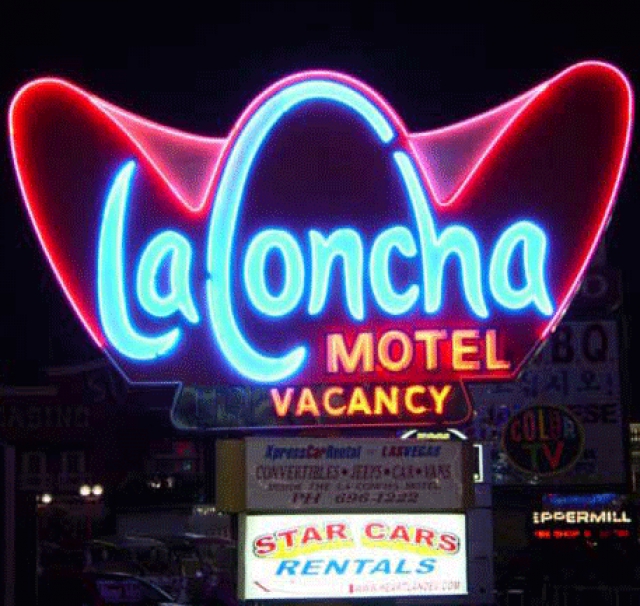
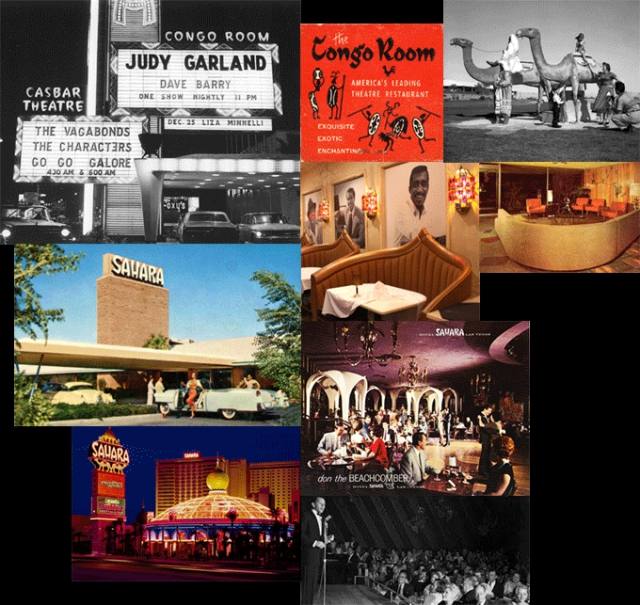
It's my (Jessica's) turn to choose one and I'm going to pick a Deke answer that combines one of my favorite things, namely the history of science, with one of our readers' favorite things, pictures of vintage Vegas (which I also love). Deke's in his element answering QoDs like this and I bet lots of people missed this one the first time around (11/10/05) and may not have found it in the archives, so here it is again, this time with added pics. Enjoy!
In 1643, Evangelista Torricelli, an Italian physicist and mathematician, invented the barometer (also known as "Torricelli's tube"), an instrument for measuring atmospheric pressure. Torricelli, acting on a suggestion from Galileo, filled a four-foot-long glass tube with mercury and created what’s generally considered the first sustained vacuum. Torricelli next observed that the daily variation of the height of the mercury in the tube was caused by changes in atmospheric pressure. He went on to build the world’s first mercury barometer around 1644.
A little more than 30 years later, in 1675, a French astronomer, Jean Picard, noticed a faint blue light in a barometer. When he shook the tube, it resulted in a glow. Now known as "barometric light," it would be a long time before its cause, static electricity, was understood.
Indeed, it wasn’t until the mid-1800s that a German glassblower, Heinrich Geissler, applied electrical voltage to gas in a tube and got a strong glow.
Then, as electrical power gained prominence, especially in scientific circles, in the late 1800s, a number of chemists experimented with applying electricity to glass tubes filled with gas. The first "electric-discharge lamps," also known as vapor lamps, were produced simultaneously in Europe and the U.S. in the early 1900s; these were filled with carbon dioxide to create a bright white glow. Almost immediately, the CO2 lights were used in commercial signage.
In 1898, meanwhile, British chemists William Ramsey and M. W. Travers discovered neon gas in London. Neon (from the Greek "neos," meaning new gas) is a monoatomic, or inert, gaseous element present in the atmosphere. It’s relatively rare: 1 in 65,000 parts of air. Ramsey and Travers obtained neon by liquefying and boiling air, then fractionally distilling it into separate components, also discovering other monoatomic gases, such as argon, helium, krypton, and xenon, in the process.
A French engineer, chemist and inventor, Georges Claude, was the first to apply an electrical discharge to a sealed tube of neon gas, sometime around 1902, and created its distinctive bright red glow. Georges Claude introduced the first neon lamp to the Parisian public in 1910.
Of all the gases, neon best permits the ready passage of an electric current and the term "neon" is now used to describe any brightly colored gas-discharge lamp bent into letters or designs. However, an argon-mercury combo is also used in signs; it glows bright blue. Helium glows gold. In addition, the inside of many glass tubes used for signage is coated with fluorescent powders, known as phosphors, that filter out various colors from the light spectrum. A green tube filled with argon/mercury creates a green light. The same tube filled with neon lights up orange. A blue tube filled with neon emits a pink glow. Using phosphors, signmakers have a palette of 150 colors to work with.
Unlike incandescent bulbs with filaments that burn out, neon lights have no filament, so the typical minimum lifespan of a neon sign is seven years; they can last as long as 20. Neon uses higher electrical voltage (pressure), but lower amperage (volume). It’s like a garden hose: When you put your thumb over the end of it, a low volume of water comes out at a high pressure. Think of the neon sign’s transformer as your thumb. It increases the electrical pressure emerging from whatever it’s plugged into, keeping the cost low. Thus not only is neon bright and versatile, it’s highly cost-effective as well.