Indeed we do: This is the story of the Great Camel Experiment of 1848 (or thereabouts) and its aftermath.
Horses were first introduced to America in the sixteenth century by the Spanish conquistadors and subsequently flourished. There's some evidence that the first camels may have been brought over to Virginia by a slave trader in 1701. But it was the California Gold Rush of the mid-19th century, and the necessity of moving people and provisions through hostile Indian country, not to mention protecting the southwestern real estate taken in the war with Mexico, that prompted the military to consider importing camels which, it was considered, might fare better than mules and oxen in the desert terrain and climate.
In the mid-1850s, the Army budgeted $30,000 to import camels and dromedaries and by 1857 a total of 77 Arabian camels had been shipped to Texas and transported to California. The so-called Camel Corps spread throughout the West when the animals proved to the numerous skeptics that they could not only carry massive loads – some up to a ton – but also cover enormous distances without water, while subsisting on food that no other beast of burden would eat.
Nevertheless, a combination of the overwhelming popularity of the horse and the gathering clouds of the Civil War culminated in the demise of the Camel Corps, and a plan to import a further 1,000 beasts for the army was abandoned. Some of the existing military camels were subsequently sold at auction to a company in Esmeralda County, Nevada, for transporting salt from the marshes up to the silver mills in northern Nevada, some 200 miles away. But the mine owners didn't treat them as well as the military had and a number of the camels died, while others escaped and ran off into the desert.
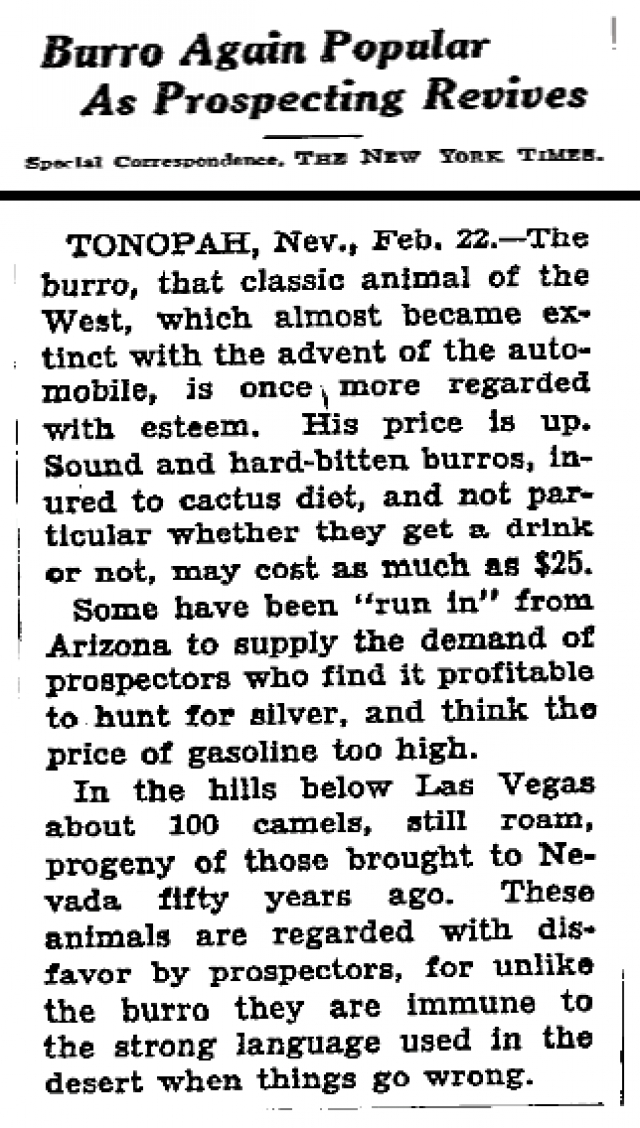
A group of nine of these "wild" Bacterians (two-humped camels) was apparently rounded up by a couple of French adventurers and sold to Virginia City in 1861 for the same salt-carrying purpose. However, their famous intransigence and ill-temper [see the New York Times article to which you referred, reproduced below] combined with the disastrous effect their odor had on mule trains (apparently the slightest whiff of camel was enough to cause havoc) meant that the hardy survivors were soon banished from mining camps in favor of the more pliant burro.
The wild beasts evidently became enough of a nuisance that in February 1875, the Nevada legislature passed a law prohibiting camels to wander at large on the public roads, although it's unclear who was supposed to enforce this and in 1899 the act was repealed. Reports continued well into the twentieth century of camel sightings in various parts of the Southwest and Nevada, but while the odd one survived as a sideshow curiosity, others were shot at for scaring horses, mules, and people. Eventually the last few died out.
You could be forgiven for thinking that this was the end of the rather sorry tale of Nevada's camels. Not so. Fast forward a half-century or so to 1959, when a prankster and editor named Bob Richards, no doubt inspired by the town's prior history, printed a hoax story in Virginia City's Territorial Enterprise concerning the results of some entirely fictitious camel races that he claimed had taken place in town. The story was picked up by the San Francisco Chronicle and to cut a long story short, Richards' bluff was called the following year when the Chronicle decided to hire a couple of camels and challenge Virginia City's to a race.
When other regional papers got in on the act, the race became a reality and additional camels were contributed by San Francisco Zoo. As if the story couldn't get any more bizarre, the race was actually won by director John Huston, who happened to be in the area filming The Misfits with Clark Gable and Marilyn Monroe (neither of whom participated in the race, as far as we know).
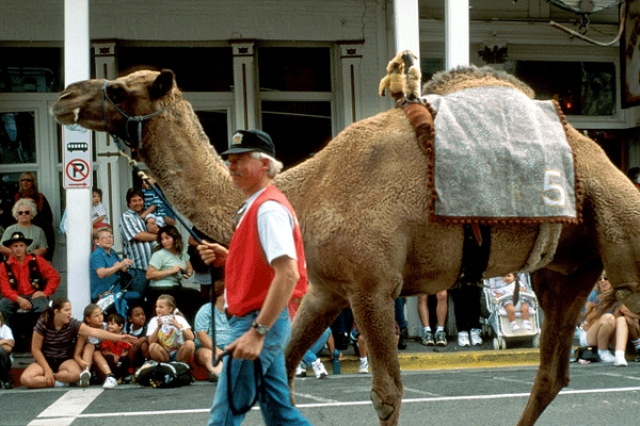
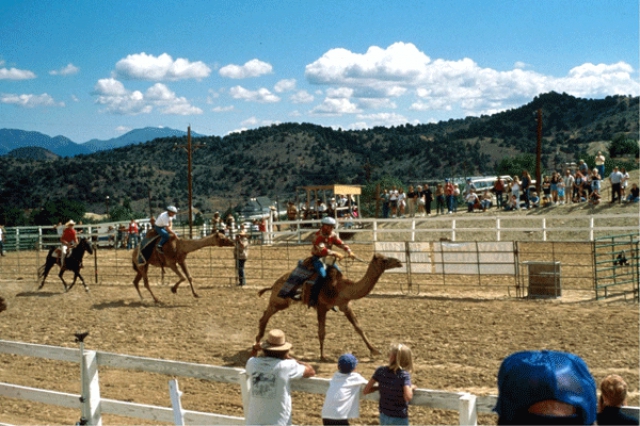
What started out as a big joke then developed into an annual event, with riders traveling from as far afield as Australia, and you’ll be happy to hear that the 48th International Virginia City Camel Parade and Races is yet to take place, commencing at noon on Saturday, September 8. These days the camels, which are untrained, are loaned by the Wild Animal Training Center in Riverside, California, and the races involve 100-yard straight dashes where just making it across the finishing lie is often enough to win.
As if camel racing wasn’t enough, there are bull and ostrich races, the latter of which, we understand, are even harder to control than the camels. It all sounds like a lot of fun and if you think we’re just making it all up, check out the pictures below, kindly provided by the Nevada Commission on Tourism.
For more information, call 775/887-1294 or 800/NEVADA-8, or visit www.eventsnevada.com New York Times article, which originally appeared on February 20, 1934 is © New York Times 2004>
https://www.lasvegasadvisor.com/showpic.cfm?qid=1109&ID=3
https://www.lasvegasadvisor.com/showpic.cfm?qid=1109&ID=2
https://www.lasvegasadvisor.com/showpic.cfm?qid=1109&ID=1