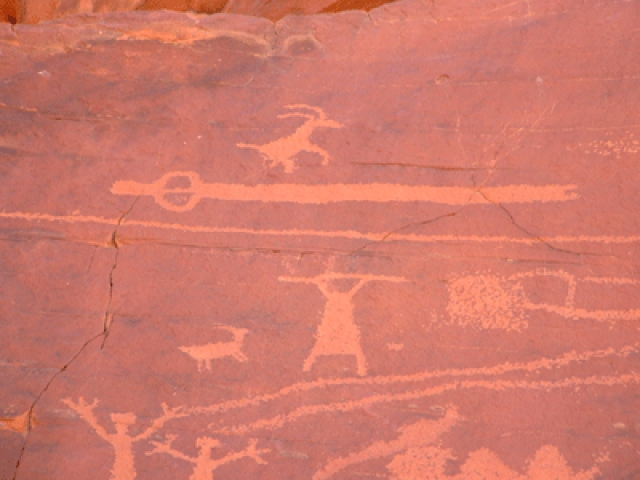
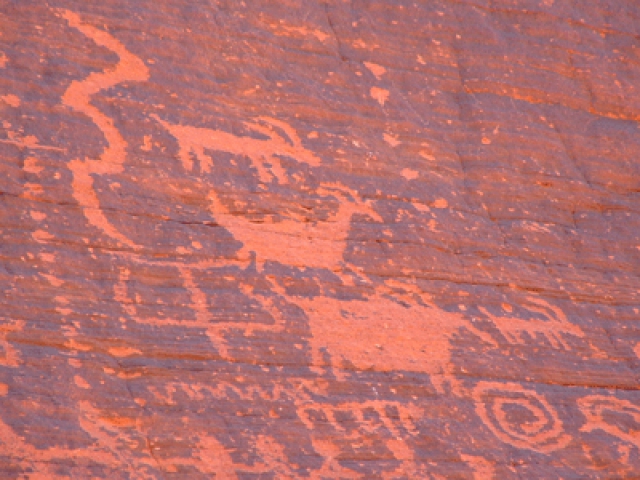
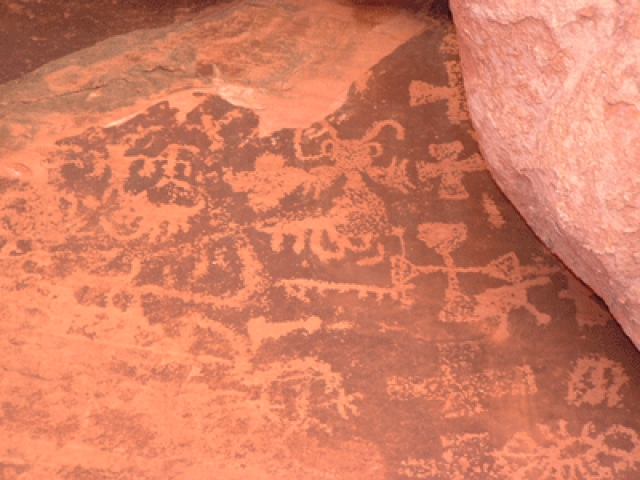
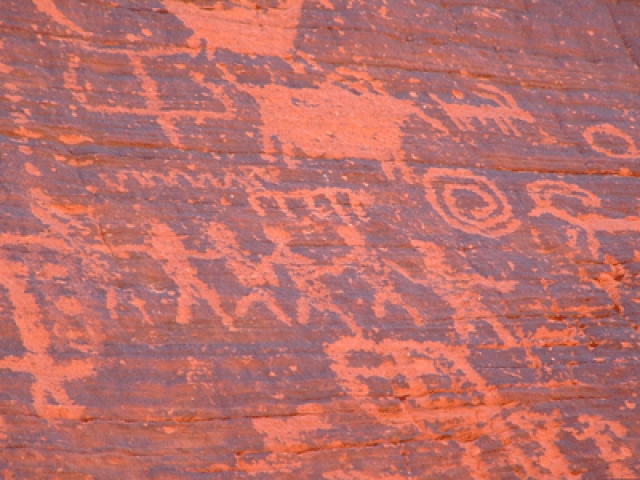
Petroglyphs are prehistoric rock carvings representative of the culture and religion of ancient natives. Petroglyphs shouldn’t be confused with pictographs, which are designs or images painted on to the surface of the rock, rather than scratched or etched into it. Though some of the shapes and figures of the artwork are recognizable today, their significance has mostly been lost. Scientists speculate that rock incision was one of the rituals performed by shamans before a hunt, special event, or life passage, or to mark a healing ceremony or site, or that the renderings served as graffiti or a sort of community bulletin board.
The petroglyphs in Valley of Fire are numerous, noticeable, and downright mysterious. (Many of the best carvings are 40-60 feet up a sheer sandstone cliff called Atlatl Rock, which you need a 40-foot staircase to access. How did they get all the way up there thousands of years ago? Read on.) Many of the images are believed to be upwards of 4,000 years old.
The Valley of Fire sandstone is coated with a layer of oxidized iron and manganese, sometimes known as "desert varnish," which often give the rock surfaces a wet or shiny patina. When carved, the surface rock gives exposes a white underlayer, so the artistic conditions hereabouts were propitious. It’s not hard to imagine how a smooth, flat, and high-hanging face such as Atlatl Rock would have been irresistible to the graffiti artists of the day. The petroglyph of a ladder might shed some light on the subject and would point to more recent Puebloan carver, rather than Anasazi artists of a thousand or so years ago. But the incised atlatl directly above it returns the aura of mystery; this "spear-launcher" predates the bow and arrow, which arrived in southern Nevada around the year 500.
Experts recognize certain totems, or clan signs, in the petroglyphs; in fact, some Hopi clan symbols appear in Valley of Fire, supporting the theory that the ancestral Puebloans who migrated into Arizona and New Mexico intermingled their culture with that of their northern cousins.
Some of the artwork’s symbolism seems obvious: suns, snakes, animals, people. But you’ll also see petroglyphs that could represent musrooms and cacti (with renderings reminiscent of the psychedelic peyote cults farther south), feet, sheep, a cross, butterflies, octopuses and starfish, Greek letters, menorahs, tic-tac-toe games, spermatozoa, treble clefs, even the Great Prophet foretelling the arrival of 747s, roller coasters, and basketball. Road maps? Advertising? Headlines? Interpretations are limited only by one’s imagination.