Good question. We had no idea, so we contacted Controlled Demolition Inc., the company that, we discovered, has been solely responsible for every single casino implosion in Las Vegas (and all the non-casino implosions too).
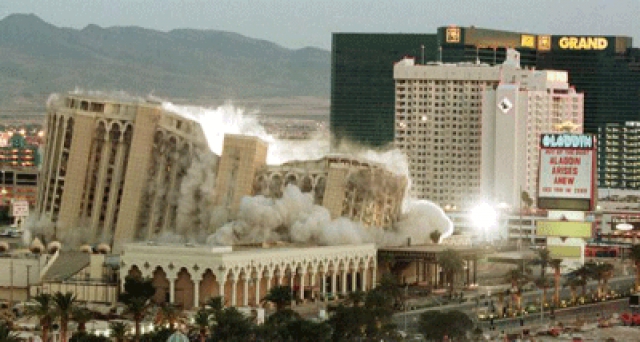
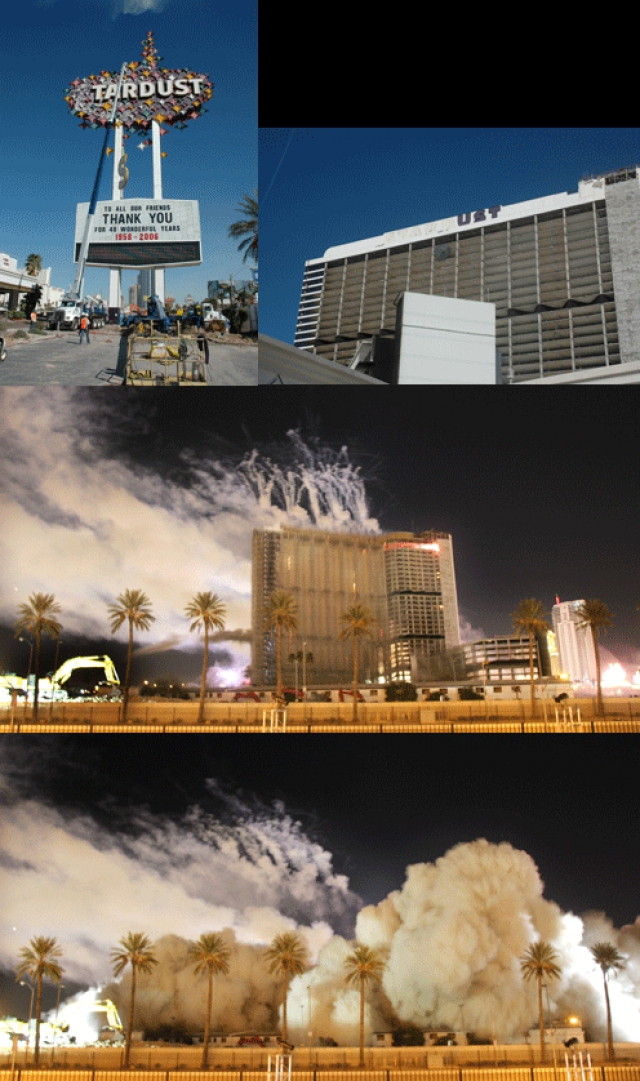
That's right: In October 1993, they blew up the Dunes North Tower; the following July they imploded the South Tower. The next year they dispatched the Landmark, closely followed in 1996 by first the Sands and then the Hacienda. In 1998 they blitzed the Aladdin. They obliterated the El Rancho in October 2000, then from 2001 through 2004, various elements of the Desert Inn bit the dust. 2006 was a bumper year for implosions, with the Castaways in January, Bourbon Street the following month, and the Boardwalk in May. On March 13, 2007, with a big bang we bid adieu to the Stardust, and then, in November, to the New Frontier.
That's a lot of dynamite, the explosive used for structures made from reinforced concrete, like Las Vegas casinos. The New Frontier alone took 1,200 pounds of the stuff and the Stardust 818 pounds, for example. A case of dynamite contains 44 pounds and the average cost (depending on what region of the world you're working in) usually runs around $3.25 per pound, the CDI folks helpfully informed us. At less than $4,000, the tab for explosives on the New Frontier job seems pretty cheap and helps to account for why imploding it is the cheapest way to knock down a reinforced concrete structure.
One thing CDI couldn't and wouldn't give us was the specific price of any individual project. It's an absolute company policy stemming largely from the fact that no two projects are ever alike, so it's unhelpful to compare imploding an apple with an orange, so to speak. The very helpful Stacey Loizeaux, (who's the granddaughter of CDI's founder and has been present for every Vegas implosion) was happy to generalize that somewhere in the $100,000-$400,000 range would be a safe ballpark figure for their part of the demolition process, "depending on numerous project-specific variables."
Case in point. The 16-story 286,440-square-foot New Frontier took nearly 25% more dynamite than the 32-story and nine-story Stardust towers together, with their combined area of 879,601 square feet. The 12-story Hacienda took a whopping 1,125 pounds of explosives (compared with 50 pounds for the 14-story El Rancho), along with 30,600 feet of detonating cord that initiated charges in 4,128 locations, to bring down the three towers in concert. This was because the hotel's three wings were built at three different times under three different building codes, with the two newer towers built with three times the reinforcing of the original one, necessitating a complex progressive collapse pattern to keep to the whole thing safe.
The spectacle, which took place on New Year's Eve 1996, was enhanced by a massive fireworks display that preceded the implosion and culminated in a 150-foot-diameter fireball (using 110 gallons of gasoline) from the roof of the central tower exactly at midnight.
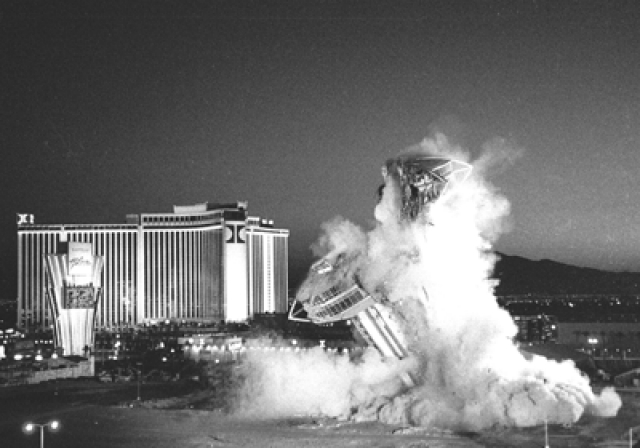
The Landmark was another tricky customer to fell. While a large vacant lot to the northwest of the structure provided an ideal lay-down area for the tower, CDI’s structural assessment revealed that the front half of the tower would naturally shear off of the back half, possibly endangering the nearby intersection of Paradise Rd. and Convention Center Drive. So a delay pattern was developed, which permitted the front half of the structure to crush at different levels as it reached grade, while the rear half remained full height, with a notch in the direction of fall at the bottom, creating an eccentric load and the rotational moment to move both halves of the structure toward the fall area. It worked like a dream and was captured on celluloid for a scene in Tim Burton’s Mars Attacks.
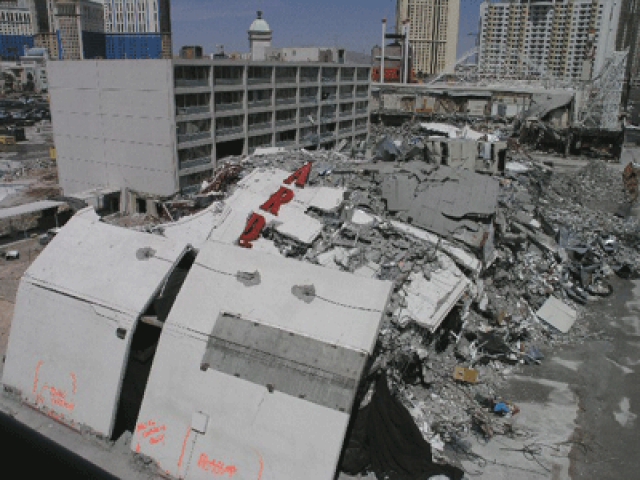
Of course, the "explosion"* is only one element of the total cost of demolition. The other major factor is the removal of all the debris afterwards.
As far as the Stardust is concerned, everything not steel or concrete (including the tinted windows) was removed prior to the implosion, with much of the contents auctioned off or else salvaged for reuse in other Boyd Gaming projects (see QoD 12/13/07). When asked at the time to put a figure on the total cost of removing the Stardust from the skyline, a spokesman was unable to quote an exact number, but said it was "in the millions." We checked back with him while researching this answer and that's still the official line -- they haven't and aren't planning to release specific figures, but we'd take a guess that it's in the low seven figures.
The site will become home to the $4 billion Echelon Place hotel-casino complex, scheduled to open in the third quarter of 2010.
*Although the building appears to collapse in on itself, technically it's not an implosion, which entails destruction from external rather than internal forces. However, the wife of CDI’s founder adopted the term "implosion" way back as a gentler way of describing the process, and it's been used ever since.