Like the recent question we tackled about the Las Vegas Downs race track (1/22/08), it's been strangely difficult to find out much about the history of the Las Vegas Jockey Club, which opened so many years after the race track had closed that we can't conceive of any connection between the two.
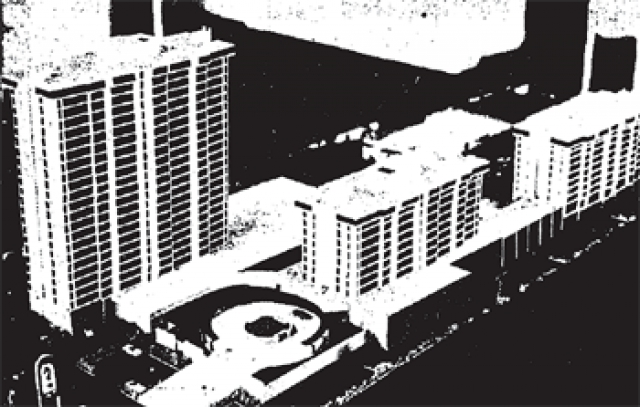
We unearthed an article from the August 12, 1973, edition of the Los Angeles Times reporting that furnished models were now open at the Jockey Club, a "$35-million, high-rise apartment/hotel complex at 3700 Las Vegas Blvd. South on the Las Vegas Strip." The complex was to incorporate three towers, with Phase 1 comprising 348 units in the two 11-story towers that remain and Phase 2 a 30-story tower with 650 units, which never happened (see below for an architect's rendition at the time). The average price of the apartments was $35,000.
What must be one of, if not the first of, the now omnipresent mixed-use condo-hotel projects in Las Vegas was developed on a 10-acre site by a company called Sultan Corp., part of the Scribe Property Group of Miami. According to the L.A. Times piece, "The complex was specifically designed for corporate customer entertainment, executive family vacations, sales incentive and company motivational programs, general holiday usage, and other public relations work." The developer's job was to build and market the condos and to build a club facility to lease to the Jockey Club of Las Vegas Inc., part of the Club Corporation of America's private-member club properties, which had nothing, to the best of our knowledge, to do with horses or the Atlantic City jazz venue. The condos were to be sold to invitees and members of the national Club Corp. network, who would be given Jockey Club membership (whatever that entailed -- presumably just access to the member facilities) with payment of initiation fees.
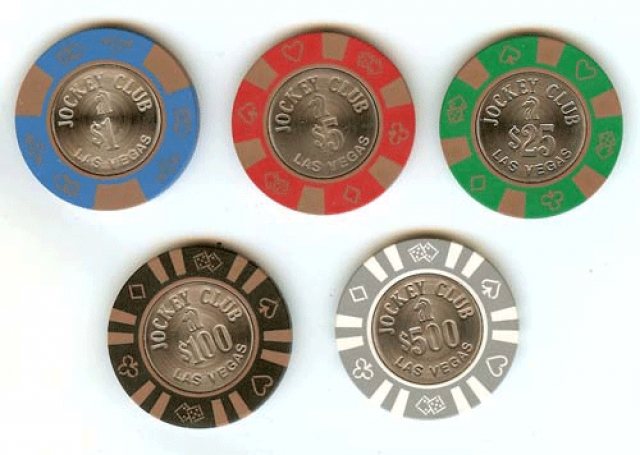
We know that the property was scheduled to feature a small casino and got as far as installing the slot machines and minting the chips. But at the last moment, the Gaming Control Board refused to grant the owner(s) a gaming license, so the casino never opened and we understand that the contents were all sold in a bankruptcy auction. Since none of it had ever been used, collectors still find them today in mint condition (see below).
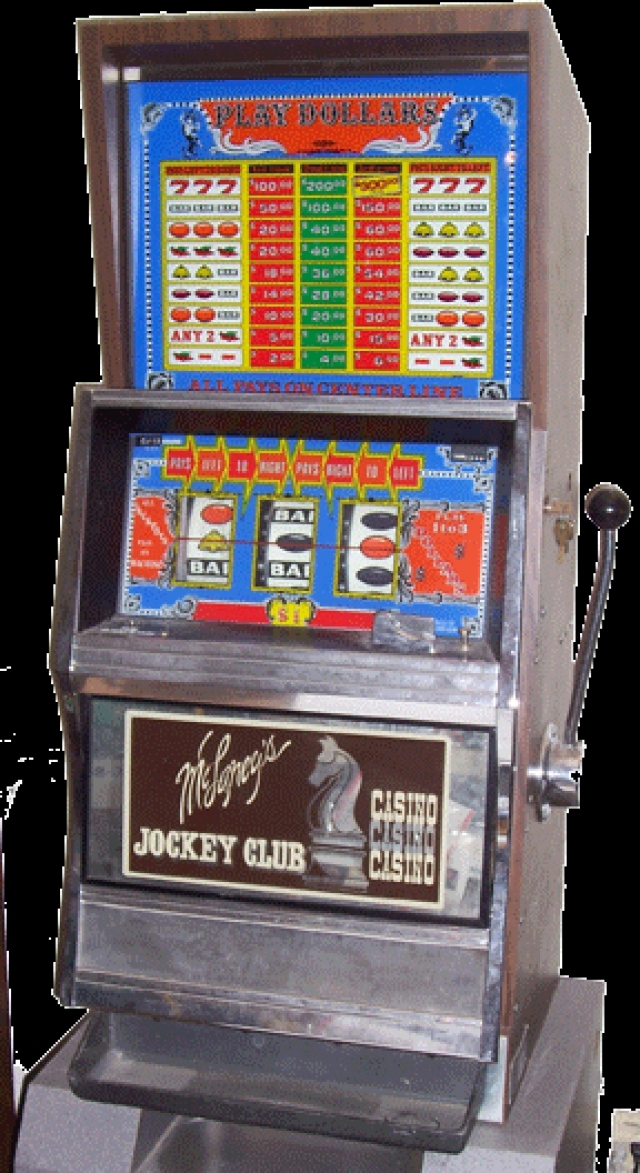
An interesting fact about the slot machine pictured below, which was apparently manufactured by Seeburg (of jukebox fame), is that it operates off Susan B. Anthony dollars (although it also accepts newer ones, the current owner informed us). The name on the glass -- "McLaney" -- is interesting. Is this the same McLaney who owned the McLaney Carousel casino downtown in the early '70s? If anyone knows anything we don't, please drop us a line.
Another interesting tidbit is that one of the regular famous (or notorious) guests at the Jockey Club was the late card counter Ken Uston, who from 1976 operated his Uston Institute of Blackjack out of his condo there, also the scene of many a wild party.
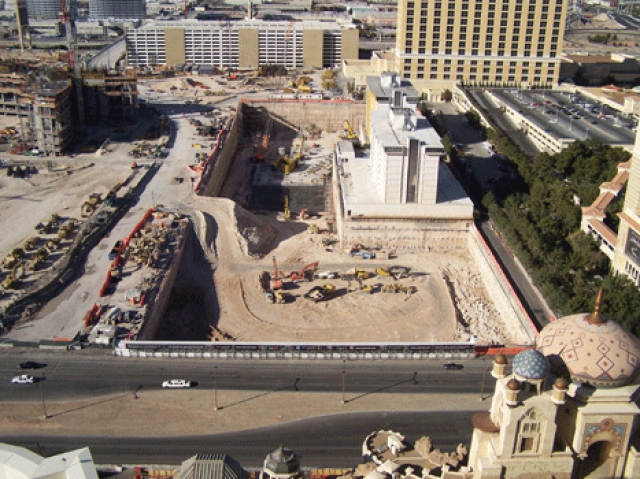
Sometime in the late '70s or thereabouts, the Jockey Club switched to being a timeshare property, which has since passed through several sets of hands, including Dynasty Inc., a Canadian company that filed for Chapter 11 bankruptcy in 1998 and sold what it could of the property -- the lower levels and surrounding real estate, minus the privately owned timeshares on the upper levels -- to Margaret Elardi (former Frontier owner), who later sold to developers. Today, the Jockey Club is managed by Tricom Management, Inc., a Vacation Village Resorts Co.. based in Anaheim, California, and is said to have 14,000 owners, without whose approval it can't be touched.
The land surrounding the Jockey Club, including its former parking lot, was sold to developer 3700 Associates LLC, headed by Ian Bruce Eichner, for the purpose of building the Cosmopolitan. As part of the agreement, 3700 Associates was to permit Jockey Club guests to use a portion of the Cosmopolitan's underground pa