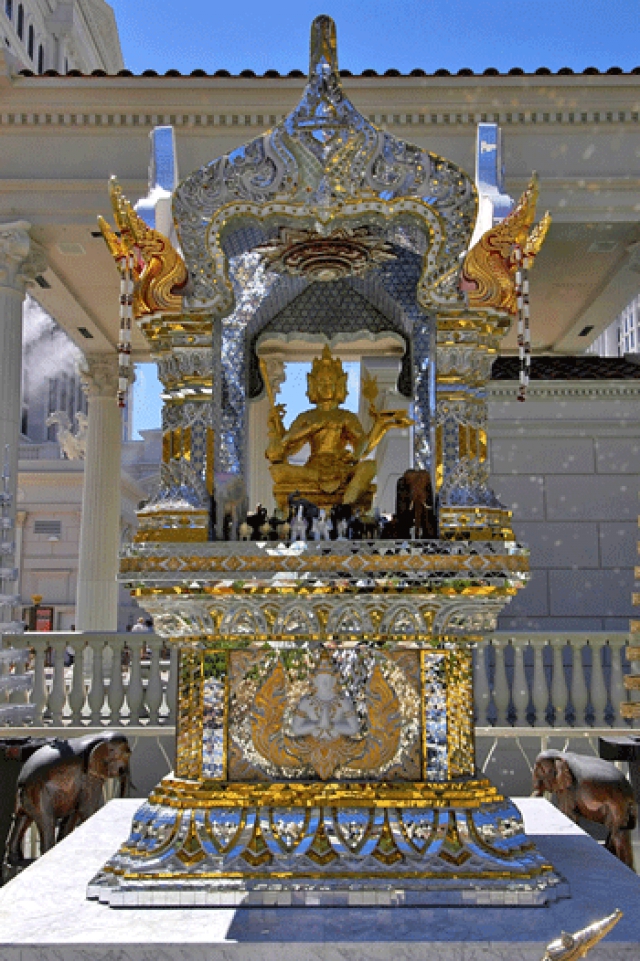
This is similar to a QoD that we answered back on June 18, 2006, although there have been some (international) developments since then.
The casino out of which you stumbled was Caesars Palace and the location you found yourself in was not a temple, but rather an authentic replica of one of Thailand’s most popular Buddhist shrines, representing the four faces of the Hindu god Brahma, who’s also very popular among Buddhists (the Thai representation is named Phra Phrom). He's associated with creation and his four faces represented by the statue signify the Four Divine States of Mind: lovingkindness, compassion, sympathy, and equanimity.
The original shrine or spirit house was installed in 1956 during construction of the Erawan Hotel (now the Grand Hyatt Erawan) in Bangkok. After various disasters and delays, it was decided that the spirit house wasn't working effectively enough, so it was replaced by the four-headed image of Brahma. Afterwards, the construction proceeded smoothly and the Thai shrine came to be associated particularly with luck and prosperity.
The Caesars statue, the only one of its kind in the Western world, was a gift to the casino from a Thai newspaper tycoon, Kamphol Vacharaphol, and his wife Praneetslipa, as well as Yip Hon, a leading citizen of Hong Kong. Cast in bronze and plated in gold, it stands 14 feet high and weighs more than four tons.
For almost a quarter-century, visitors to Caesars have paused at the Brahma shrine to offer flowers, light joss sticks (incense and matches are kept fully stocked there), even make donations (in a lock box; Caesars supports charities in Thailand) -- and, of course, pray for luck at the tables and machines.
Since it first arrived in Las Vegas, the statue has been moved only once, from its original location near the central Strip entrance to its current location, in the Roman Plaza at the south end of the property, just north of the pedestrian overpass over Flamingo Road. The move was necessitated by Caesars’ expansion projects, but was conducted by qualified Buddhist monks who heeded all necessary protocols, the hotel assured us.
It hasn't been such smooth sailing for the original shrine, however. In the early hours of March 21, 2006, the Erawan statue was smashed to pieces with a large hammer by a man who was subsequently beaten to death by angry bystanders. Although the incident took place in the midst of some unrest in Thailand and was hailed by some as a portent of doom, it was concluded that the man was mentally ill and not acting from any political motive.
Exactly two months later, on May 21 at the auspicious time of 11:39 am, a restored statue was replaced at the Erawan shrine as hundreds of worshippers and tourists looked on at a ceremony attended by the Thai prime minister. We understand that the renovated Erawan shrine is now protected by a 24-hour guard.