The Aladdin started life in 1963 as the Tally Ho, a large motel that billed itself as the first non-gambling resort on the Strip. It was an idea whose time had yet to arrive and it folded after eight months. When it reopened in 1964, it was called the King’s Crown, which lasted six months.
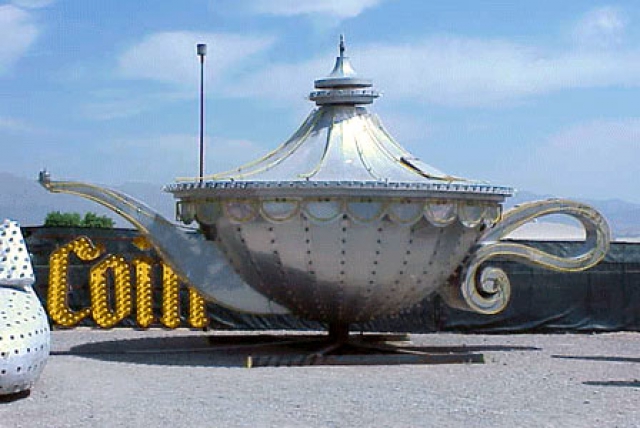
Finally, Milton Prell, the congenial L.A. investor who helped open the Sahara (and sold it to developer Del Webb a few years previously), bought the property for $16 million in the fall of 1965. He added a casino, a 500-seat showroom, and a gourmet restaurant and lounge, and refurbished the rooms. In order to open on New Year’s Day 1966, Prell completed the new resort, which he dubbed the Aladdin, in a miraculous three months. Aladdin’s Magic Lamp -- which stood atop 15-story support beams and featured 40,000 light bulbs -- fronted the new resort.
Elvis and Priscilla were married in Milton Prell’s private suite in 1967, which put the Aladdin on the map.
Prell suffered a stroke not longer after the famous wedding and the brief glamour of the Aladdin started to fade. It was bought in 1968 by the Parvin-Dohrmann group, which also owned the Stardust and the Fremont and is now known to have been a front for the mob. Continuing to decline, the Aladdin was sold to "St. Louis investors" in 1972 for a fire-sale $5 million. In 1974, the Aladdin was investigated by both the state and feds for its alleged role as an "R&R center for the underworld." And though a major expansion in 1976 added the 10,000-seat Theatre for the Performing Arts (now the Planet Hollywood Theatre) and a 20-story high-rise, two years later hotel executives were convicted of conspiring to allow hidden interests to profit from the property. In March 1979, the Gaming Control Board closed the Aladdin.
A year later, Wayne Newton and Ed Torres reopened it; the partnership failed and Newton quickly sold out. Further legal and financial troubles plagued the casino, which went bankrupt in 1984. In 1985, Ginja Yasudi, a Japanese developer, bought the Aladdin for $51.5 million cash, but he went bankrupt in 1989.
A court-appointed receiver held the place together with super glue and baling wire for a while, with several management teams running the joint.
In 1995, a local real estate magnate, Jack Sommer, bought the Aladdin for $80 million. Sommer imploded the place in May 1998 and immediately began building a brand new Aladdin, which opened in August 2000 -- the first new Las Vegas megaresort to keep its name and theme after being imploded and rebuilt.
True to its long sordid history, the Aladdin under Sommer’s management was a disaster from the start. During its first four and a half months of operation, the Aladdin sustained a net loss of $76.2 million. An audit revealing the property’s inability to make a $66 million bank-debt payment due in eight months could have forced the company into default, but creditors agreed to restructure that key provision to avoid the first step on the road to bankruptcy. Meanwhile, $4 million was spent to redesign the Strip entrance and driveways to increase visitor traffic, to little avail.
By August 2001, only a year after the reopening, London Clubs International, a minority partner in the place, took control of roughly 85% of the casino. The move made it easier for the British casino company to resell the whole casino to a third party, but no buyer materialized, due to the high debt load that came with the property.
In October 2001, the Aladdin filed for Chapter 11 bankruptcy, citing debt totaling nearly $600 million. Closing the casino was avoided, however, with a $9 million bailout from its bankers, part of a $41 million loan that kept the joint open.
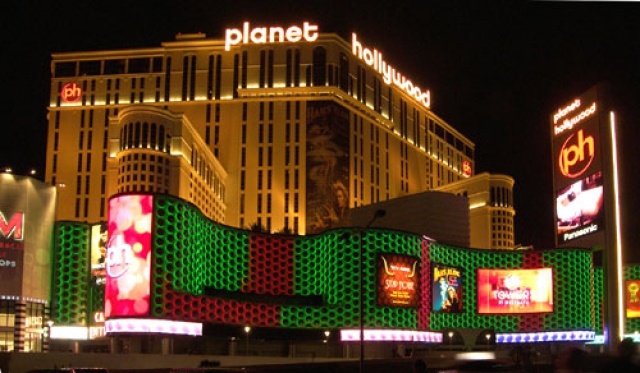
It took two years for an acceptable suitor to be approved by the bankruptcy judge who, in May 2003, accepted a $635 million offer from a partnership of Starwood Hotel & Resorts and Planet Hollywood; the deal closed in September. At that time, the conversion of the Aladdin to Planet Hollywood was expected to take one year and cost $90 million. However, the timetable slowed, stalled, then almost starting moving in reverse. It took another full year for the Planet Hollywood principals to make their way through the gambling-license investigation process. Finally, on September 1, 2004, the old Aladdin become the new Planet Hollywood, though the Aladdin name remained. At that time, the conversion was planned to take 15 months and cost $100 million.
True to 40-year form, it took another year for the new owners to announce details of the makeover, by now budgeted at $140 million. Work began a month later in October 2005 and was scheduled for completion by the end of 2006, when the name would change to Planet Hollywood. Toward the end of 2006, however, it was announced that due to remaining open during construction, the estimated completion time had to be moved ahead till spring 2007.
In April of that year, the Aladdin unofficially turned into Planet Hollywood in a (very) soft opening. Though the name change came a little earlier than expected, the grand-rebranding celebration was postponed till late September, as more work needed to be done before the place was ready for a party. Additionally, the former Desert Passage Mall was officially renamed the Miracle Mile Shops.
The end of the Aladdin era finally occurred in mid-November 2007, after four and a half years and upwards of $200 million in upgrades and rebranding, with the official grand opening of the property’s new incarnation. All in all, it was worth the wait. The Planet Hollywood redesign, in our opinion, has vastly improved the access, given the casino an upscale sophisticated look, and didn’t mess with the successful buffet formula, all of which, it’s hoped, has erased the ill-fated Aladdin’s karma.