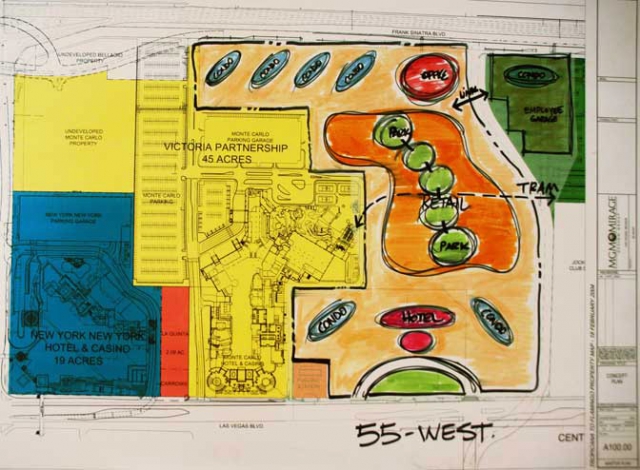
The role of former CEO J. Terrence Lanni is the subject of some dispute. According to his successor, Jim Murren, the concept was Murren’s own: "When the company started looking at the land between Bellagio and Monte Carlo in terms of another resort, I really felt that would have been missing the mark. That’s kind of just more of the same. So I started thinking about the concept of an integrated urban plan that would incorporate some of the elements that are feasible here..."
After making some doodlings and do-it-yourself computer renderings, "I brought in Bill Smith over at [MGM Mirage Design Group] and had a couple of meetings with him ... That was the genesis of it."
Smith seconds Murren’s account. "The initial CityCenter concept was generated by Jim Murren sometime around February 2004," he told the company’s in-house publication, Momentum. The two roughed out what have been described as "bubble shapes and squiggly arcs scrawled over the thin blueprint lines and block letters of an assessor’s map." It was a long way from what CityCenter was to become but it was a starting point.
"We drew up a bubble plan [and] I snuck it into a board meeting one day back in ’04, showed it to my board [as] kind of an off-agenda item. They were very intrigued. [Kirk] Kerkorian loved it and he got it right away like he gets every major trend that I know. He gets it in seconds," Murren recalls.
"And that created the impetus for Terry Lanni, who was the CEO at the time, to commission [CityCenter President] Bobby Baldwin and myself and a few others to go to New York and start interviewing urban planners, and that’s how it all began."
So, to hear Murren and Smith tell it, the then-CFO was the moving force. Since Kirk Kerkorian was at that time the majority shareholder of MGM Mirage, if something had his approval, it was essentially a fait accompli. In Murren’s version, Lanni simply put Kerkorian’s wishes into motion.
A Nov. 29, 2009 profile of Murren in the Las Vegas Sun depicts Murren as a Lanni protégé but also emphasizes the Trinity College graduate’s longstanding interest in art and architecture. It portrays Murren chafing under the Lanni regime – a period in which the company developed a reputation for having trouble getting projects off the drawing board – and finding an ally in Kerkorian: "It was more of the same, with a different theme, different position, different partner. Everything we were looking at before I thought was just a worthless enterprise. [Kerkorian] kept challenging me, without saying what it is I should think of, to think beyond what I could see."
Casino Connection blogger Roger Gros stops just this side of saying, "Liar, liar, pants on fire!", vis-à-vis Murren’s role in CityCenter. "I was there almost exactly five years ago when MGM Mirage called a press conference right in the middle of the industry’s largest trade show, G2E, at the Bellagio to announce CityCenter. Hundreds of media and MGM execs attended to hear about this unlikely project, which would sit on the site of the old Boardwalk Hotel Casino and other parcels of land acquired by MGM when it bought Mirage Resorts in 2000," he wrote recently.
"But it wasn’t Murren who was explaining the idea and the vision behind the project, it was then chairman, Terry Lanni ... With a great eloquence, Lanni hovered over the model of CityCenter, explaining the different elements and how they would work in the 'new' Las Vegas. The announcement of CityCenter spurred a debate about the 'Manhattanization' of Las Vegas. But Murren? I can’t remember him even speaking...
"I know Terry Lanni well enough to know that if Murren was the one who was driving the boat on CityCenter, he would have had a greater role in the press conference that announced CityCenter five years ago," Gros continues. "Lanni also has an ego, but was always fair when distributing credit for good things happening in any of his businesses."
Gros has little more than hunches to substantiate his theory that Lanni – whose primary hobbies were racehorses and politics – was the one who conceived CityCenter … not former art history and urban planning student Murren. Both Lanni and Gros are old Atlantic City hands, which also may also color the latter’s perspective.
The only concept Lanni ever publicly articulated for the then-Boardwalk acreage was the nebulous notion of an "Internet-based" resort. Whatever that meant, it could hardly be used to describe CityCenter – especially since the new über-resort is developing a reputation for poor cell phone reception and wi-fi access.
Finally, we put your query to MGM spokesman Alan Feldman, who replied, "Fair question. Jim was absolutely the originator of the concept and Terry was fully supportive as the then CEO. Terry, however, did not involve himself in the details of the design -- he kept his input to a 30,000-foot perspective [i.e., a broad overview]. He did of course participate in the approval process initially as the MGM Chair and later along with the other JV board members. Jim was active all through the process in both the project design and the development of the art program."
Should CityCenter not be a success, Lanni’s defenders might not want it to be known as his landmark achievement. Murren, by contrast, has so closely identified himself with the project that he has no choice: It will be either the anchor that drags him down or defines his tenure at MGM Mirage as one that brought about a transformative event on the Strip as revolutionary as The Mirage was, 21 years ago.