We weren't aware of this story until you brought it to our attention, and we're glad that you did, because it's an interesting tale.
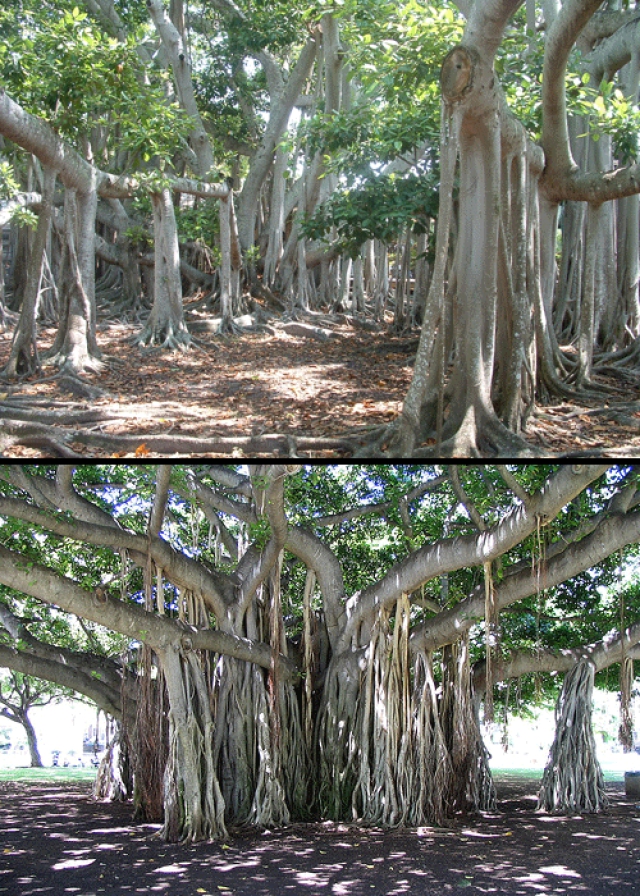
First of all, for any reader not familiar with the banyan, it's actually a member of the fig family that starts its life as an epiphyte, i.e., its seeds are spread by fruit-eating birds and germinate in the cracks and crevices of a host tree (or structure). The seeds send down roots towards the ground, and may envelop part of the host with their roots, giving rise to the nickname of "strangler fig." As the trees get older, they're characterized by huge aerial prop roots that grow into thick woody trunks that give the effect of a molten, dripping candle (see images below).
The trees are considered sacred in several eastern cultures, particularly India, where a member of the Ficus family is the national tree. They're seen as symbolic of eternal life, due to their seeming capacity to grow continuously and their longevity – a particularly famous banyan on the island of Kabirvad in Gujarat is known to be more than 300 years old.
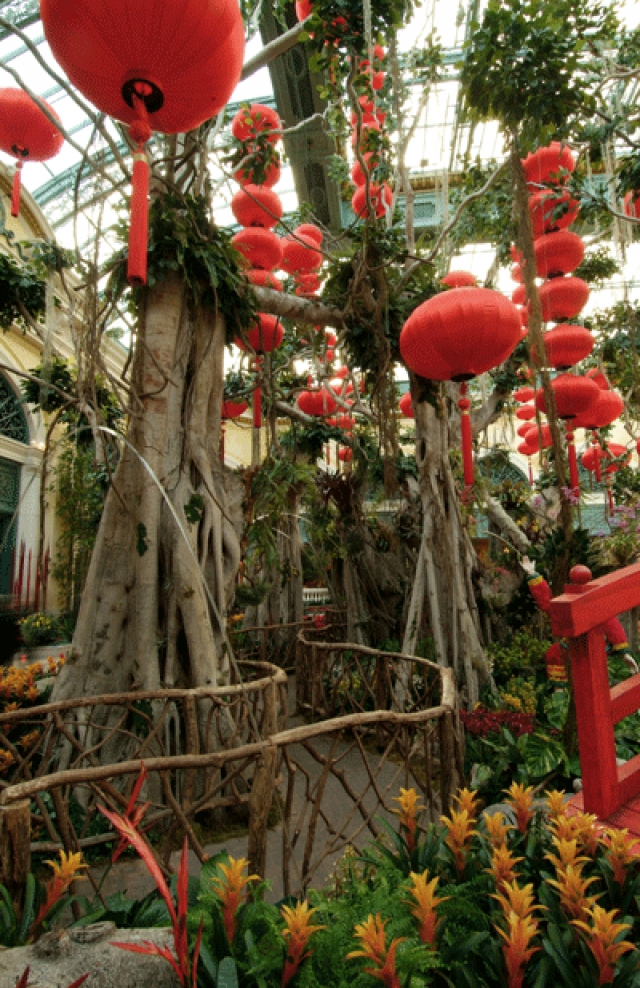
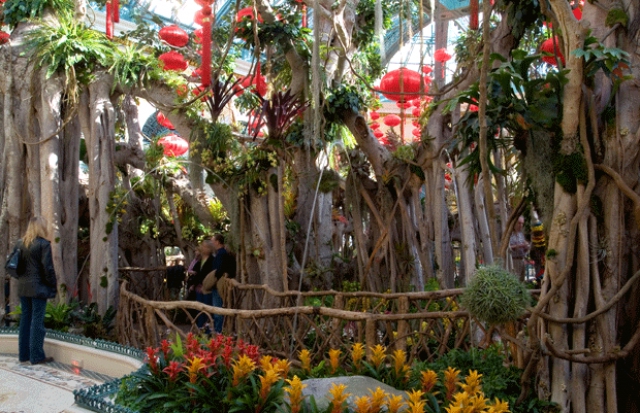
Back to Bellagio and back to 2005, when Audra Danzak, director of horticulture at the property, heard about the plight of a banyan tree in Palm Beach, Fla. The 110-foot-tall, century-plus-old tree was a focal point of the community, but had become infected the previous year with the incurable fungus hypoxylon canker, which eventually killed it.
Danzak was in love with the idea of having a banyan tree in the Bellagio Conservatory, but feared any live one would grow too big to contain. When she heard of the existence of a dead tree, she had to go check it out. So, she went to visit the tree in Florida, just days before it was scheduled for a date with the wood chipper, and became determined to bring it back to Las Vegas. Evidently, the tree felt the same way, since the president of the Society of Four Arts, a nonprofit organization that was keeper of the tree in Palms Springs, was on vacation when he received a phone call telling him, "You're not going to believe this. The tree wants to go to Las Vegas."
Nobody wanted to deny the wishes of a 200,000-pound banyan tree, but transporting it to Las Vegas was no mean feat and there was no precedent to indicate whether or not the project would succeed, or if the dead wood would simply disintegrate. As it turned out, everything went smoother than anticipated and the tree not only arrived here in good order (albeit in sections) but was reconstructed in just a day and half – less than a third of the time anticipated.
The banyan's full weight was too much for the Conservatory's foundations to withstand, but approximately 80% was able to be used, with the rest being saved for making other floral arrangements and installations around Bellagio. The first exhibit that the banyan took part in was Chinese New Year, after which the tree remained in place for another 11 months or so (we're not sure exactly when it came down), being adapted to other displays like Spring, when it was utilized as a butterfly habitat. Eventually, once its second life at Bellagio was over, the tree was turned into compost.