Excellent question.
The sculpture you cite at Hoover Dam was created by a Norwegian-born and naturalized U.S. citizen named Oskar Hansen. His most famous pieces are the 30-foot-tall bronze "Winged Figures of the Republic." He’s also responsible for the concrete bas-reliefs on the elevator towers.
Funding for the public art at the dam, as well as countless public-art and public-works projects in Nevada and throughout the nation, came from the federal Public Works Administration (PWA), Works Progress Administration (WPA), Civilian Conservation Corps (CCC), and Civil Works Administration (CWA), all New Deal programs instituted by President Franklin Roosevelt as projects to stimulate the economy out of the Great Depression.
Roosevelt had a curious connection to Nevada, a backwater state in the Far West in the 1920s if there ever was one. The story goes that in 1920, when Roosevelt was running for vice president on the Democrat ticket of James Cox, governor of Ohio (defeated by Warren G. Harding), he was on his way to campaign stops in California when the train stopped in Las Vegas. He stepped off the train and chatted with a few local folks who came to greet him, establishing a fond memory about the town and the state.
Whether there’s a connection or not is a matter of speculation, but when it came time to dole out federal stimulus funds after Roosevelt became president in 1933, Nevada received more than any other state. It was first in total per capita expenditures, which wasn’t difficult, since the place was so unpopulated in those days. But it was also first per capita in loans, Civil Works Administration and Civilian Conservation Corps funds, and funds for public roads.
Indeed, the CCC established camps in Nevada a mere five weeks later. One of them, at Deer Creek, began work on roads and campsites on the slopes of Mount Charleston that July. CCC crews also worked on the Old Arrowhead Trail, a road connecting California, Nevada, and Utah in what, in 1935, became Nevada’s first state park: Valley of Fire. Travelers’ "shelters" built from native sandstone by the CCC in the early ’30s still stand inside Valley of Fire Park -- one Depression-era project you can visit.
Of course, Hoover Dam itself is another. President Herbert Hoover signed the appropriation bill for the dam in 1930 and work began in 1931. It wasn’t a WPA or PWA or CCC project, but it did give 25,000 workers jobs in the early part of the Depression.
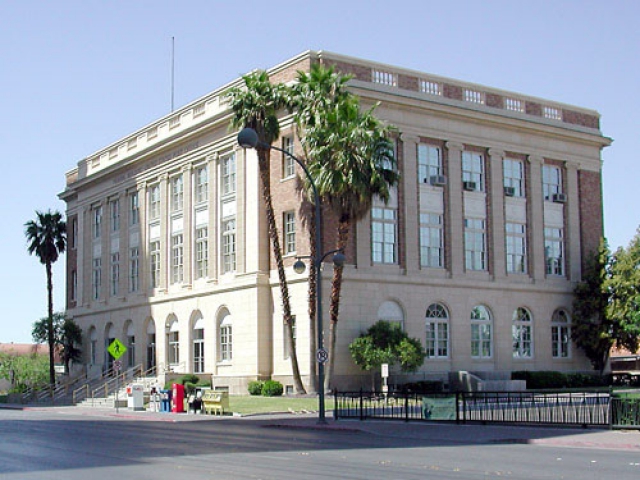
But the major federal construction project in Las Vegas proper that remains from that time is the Downtown Post Office and federal building, located at 301 Stewart Ave., built in 1933 by the WPA.
Distinctive is the Beaux-Arts neoclassical architectural styling, which reflected the taste of the Treasury Department’s architects of the early 1900s. At the time it was the most elaborate building in Las Vegas; the style of the three-story steel-frame building, clad in brick and terracotta, was meant to signify its importance as a federal building, especially among all the casinos and bars and hotels of downtown Las Vegas.
The building opened on November 27, 1933, serving as the post office and courthouse; the U.S. Senate Special Committee to Investigate Organized Crime in Interstate Commerce, the so-called Kefauver Hearings, took place there in 1950.
The Downtown Post Office was listed in the National Register of Historic Places on February 10, 1983.
The City of Las Vegas took over the building in 2002. It’s currently being readied to reopen as the Mob Museum -- official name: Las Vegas Museum of Organized Crime and Law Enforcement -- scheduled for mid-2011.