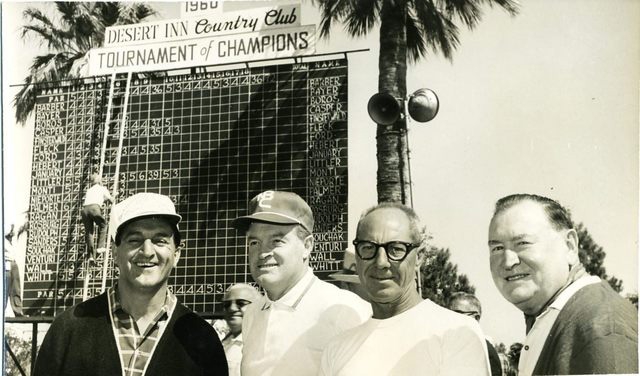
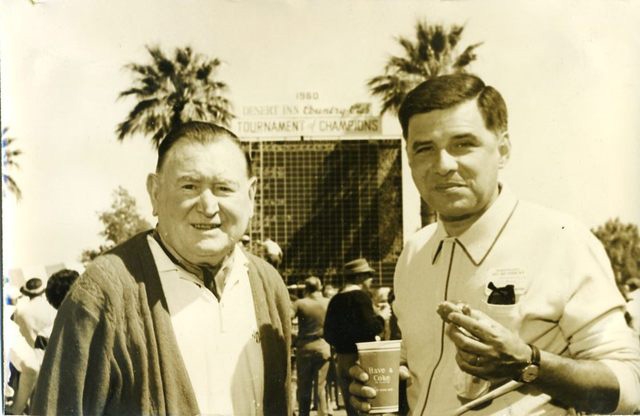
It’s true, we sometimes come up empty, as was the case with a gentleman who looked like a casino executive and was photographed at various Strip events in the Sixties, including a Desert Inn golf tournament (see QoD 8/31/2009). Gene Trimble, of TheChipBoard.com, has been doing some detective work and identified the schmoozer in question as Cleveland mobster Thomas J. McGinty.
Mr. McGinty was an associate of mobster Moe Dalitz, with mutual business interests dating back at least as far as early 1919, when he was part of Dalitz’s bootlegging crew, the "Little Jewish Navy." In 1939, the two were co-defendants in a lawsuit filed against a Bainbridge, Ohio, casino: the Dalitz-run Arrow Club. McGinty operated another Cleveland-area gambling joint, the Mounds Club. His membership in Dalitz’s Mayfield Road Gang would subsequently bring McGinty under the scrutiny of Sen. Estes Kefauver’s Special Committee to Investigate Organized Crime in Interstate Commerce, which called him as a witness during its 1950-1 marathon of hearings.
McGinty had his fingers in seven racetracks in the U.S. and Mexico, and was also a boxing promoter. He also ran the Hotel Nacional in Havana on behalf of Meyer Lansky. (One of McGinty’s old tracks – the Fair Grounds, in New Orleans, subsequently became a casino. Another, Thistledown, in Ohio, is now owned by Harrah’s Entertainment.)
According to Ed Reid’s Green Felt Jungle, Dalitz, McGinty and their associates "cut themselves in" for a 74% share of the Desert Inn when Wilbur Clark ran short of cash, with McGinty getting 7%. He also held a 4.5% stake in the Stardust (Dalitz owned 22%). The structuring of the Mob’s Desert Inn ownership, and others like it, is laid out in David G. Schwartz’s Suburban Xanadu.
Although he retired to Florida in 1962, McGinty can be spotted in old photos of Desert Inn events, sometimes alongside celebrities like Bob Hope and Danny Thomas. He is credited with launching the first golf tournament created for TV, a charitable tourney on the Desert Inn’s famous links. Like Dalitz, he had numerous philanthropic interests. These included John Carroll University and Boys Town. He died in Palm Beach in March 1970.