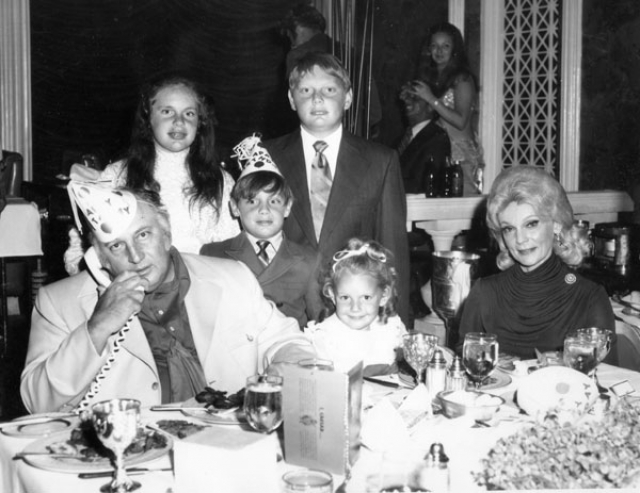
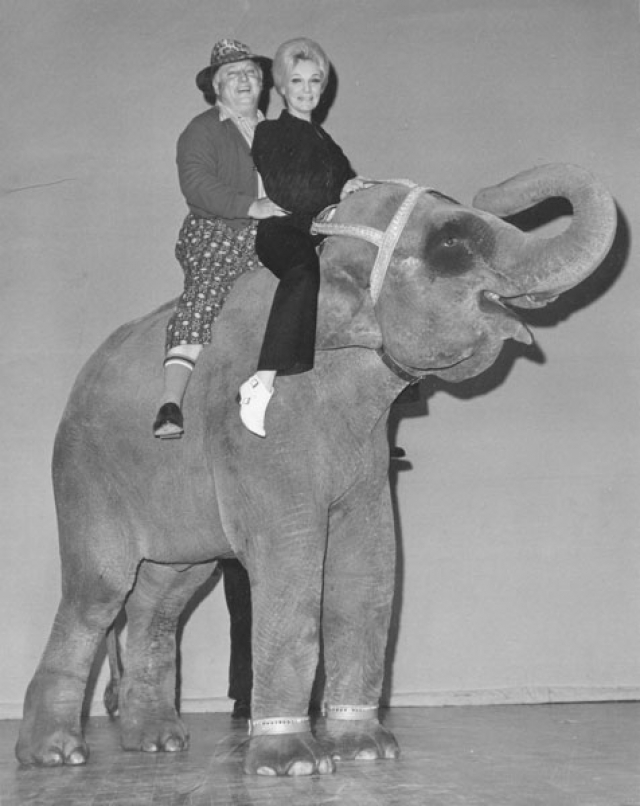
Certainly not! We don't do "mini" at QoD. We're happy to oblige with a lengthy bio, however, which we'll be serving up in two parts, today and tomorrow.
Rather than reinventing the wheel, in this instance we're going to reproduce A.D. Hopkins' fine biography of Jay Sarno, taken from our award-winning book, The First 100: Portraits of the Men and Women Who Shaped Las Vegas, of whom Sarno was most definitely one. He has a street named for him that runs between Frank Sinatra Dr. and Las Vegas Blvd. Sth.
A.D. Hopkins writes:
You can get an argument over who started the Las Vegas Strip, but there’s no question that it was Jay Sarno who changed it forever. The fast-living genius behind Caesars Palace and Circus Circus invented the fantasy resort and the modern family resort, twin ideas that have guided the past three decades of Las Vegas’ growth.
He lived so large that it is difficult to exaggerate his appetites. Or, for that matter, his creativity and generosity. Unlike most casino moguls, Sarno was himself a gambler. "I would say in one evening, at craps, he could swing a quarter of a million one way or the other," said his former wife, Joyce Sarno Keys, who divorced him in 1974. His cabinetmaker father and homemaker mother, who lived in Missouri, pinched pennies to make sure all seven of their children attended college. At the University of Missouri, Sarno set up on-campus businesses delivering laundry and selling corsages. His classmate Stanley Mallin, who would become his lifelong business partner, said Sarno was already a plunger even in those days. "He would pawn his clothes for gambling money," remembered Mallin in a 1999 interview.
Both partners served in World War II in the South Pacific. They returned to finish college, then teamed up as tile contractors in booming Miami. "If the season was good, you got paid and if it wasn’t, you didn’t," said Mallin. They tried their luck in Atlanta, building government-subsidized housing. The partners saw opportunity in motor hotels, but banks wouldn’t loan them money.
Then, said Mallin, the partners met Teamsters boss Jimmy Hoffa and the union’s money manager, Allen Dorfman. The first loan Dorfman ever arranged from the Central States Pension Fund was to build the Atlanta Cabana motor hotel in 1958.
"Jimmy and Jay just hit it off," said Mallin. "They were different in some ways; Jay lived high while Jimmy lived in the same house he bought for $7,000. But they were both hard-driving guys, impulsive, almost compulsive."
It was then that Sarno met Jo Harris, an interior designer who had just finished architecture school at Georgia Tech. She asked for a job decorating the Atlanta Cabana. "Jay said, ‘I like your work but if anybody is going to work for me, I expect her to be my girl,’" Harris remembered. "I said, ‘I’ve been to Miami and I know that if I wanted to be a prostitute, I could earn six times what you’re offering me.’ I wanted to be hired for my ability, plus I was married. Two weeks later he called and said I wouldn’t have to be his girl. He offered me $100 a day, which was all the money in the world." Harris would design for Sarno as long as he lived.
They filled the Atlanta Cabana with fountains and statues and mirrors. The operation was immediately successful, so Sarno and Mallin built Cabanas in Palo Alto, California, and in Dallas. But a side trip to Las Vegas changed their direction. Joyce said, "He could see the kind of money that was being exchanged, mostly going in favor of the hotels, and decided that just one big hotel with a casino would make more money than a Hilton without one."
"He was a man who loathed plain vanilla," said Sarno’s daughter September. "Las Vegas hotels at that time just oozed mediocrity." They attempted to distinguish themselves by adopting names that sounded vaguely French, or vaguely Moroccan, or Western American, but the theme was skin-deep.
No one would ever say that about the hotel Sarno, Mallin, and Harris dreamed up. Caesars Palace was a fantasy world where every guest was a Caesar or a Cleopatra. "Jay insisted that people be in uniform from head to toe," said Harris. "We sketched our ideas, then brought in a wardrobe mistress, as if we were costuming a show, to execute them." Waitresses wore sexy, short, bare-shouldered togas; desk clerks wore tunics suggesting Roman military fashions. "We caught lightning in a bottle with Caesars," recalled Mallin happily. "It took right off. It was the nicest thing in Las Vegas and maybe in the country."
Caesars cost $24 million and sold in 1969 for $60 million. From the time it opened in 1966, the most successful new gambling resorts would be those that, like Caesars, carried out some escapist theme.
Tune in tomorrow for Part II of this answer, where Sarno turns his attention to a new property -- Circus Circus.