We wish we could help you, but having delved into the history of baccarat in Las Vegas, we confess to being as confused as you are.
In its earliest form, baccarat dates back to the Middle Ages and was originally played using a Tarot deck. The name derives from the old Italian word "baccara," meaning "zero." It became popular in France, particularly with the nobility, where it evolved into a version known as Chemin de Fer.
What is known as "American baccarat," where the casino controls the bank, actually originated in England and spread from there to South America in the early twentieth century, as the latter became a playground for the world's jet set. The version of the game that is played today came from the Capri Casino in Havana, Cuba, where it became known as Punto Banco.
It was around this time that one Frances "Tommy" Renzoni, a junior executive at the Capri Hotel Casino in Havana (co-owned by Meyer Lansky, Santo Trafficante, and actor George Raft), claims to have brought the game to the Sands in Las Vegas, which ties in with the claims of the first documentary you cite. This, however, is where things get murkier.
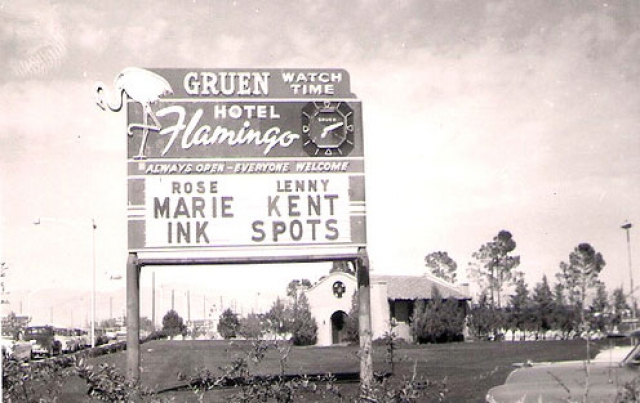
Sources we've read say that baccarat, in its earlier incarnation of Chemin de Fer, was introduced into North America via the illegal gambling dens of New York around 1911 or 1912, but that it did not catch on and disappeared for the next four or five decades. On the other hand, we've also read accounts of the opening night of the Flamingo, in December 1946, that have George Raft dropping $75,000 or so on the baccarat tables (in spite of which, the casino was still down $200,000 at the end of its opening night and was forced to close temporarily shortly thereafter so work on the hotel could be finished). The Flamingo re-opened in March 1947 and started to turn a profit; Siegel was shot to death in his Hollywood bungalow the following June.
To conclude, it's known that George Raft knew the game of baccarat from his Cuban casino experience; it's known that he was present on opening night at the Flamingo, and it's known that singer Rose Marie performed that night, along with Jimmy Durante. So it's possible that the game of baccarat was dealt -- perhaps for that one night only, to indulge a high-profiling, high-rolling guest? -- but may have disappeared again the next morning, or when the casino reopened after its hiatus.
Either way, it's still Frank Sinatra and the Sands, along with James Bond, that are credited with popularizing the game by imbuing it with its sense of glamor, exclusivity, and mystique. It remains popular today with wealthy gamblers, particularly Asians, and has recently been responsible for some major fluctuations in Strip casinos' bottom lines, thanks to the large amounts wagered by high rollers and the relatively small house edge (in 2010, baccarat surpassed blackjack in winnings for the first time ever).
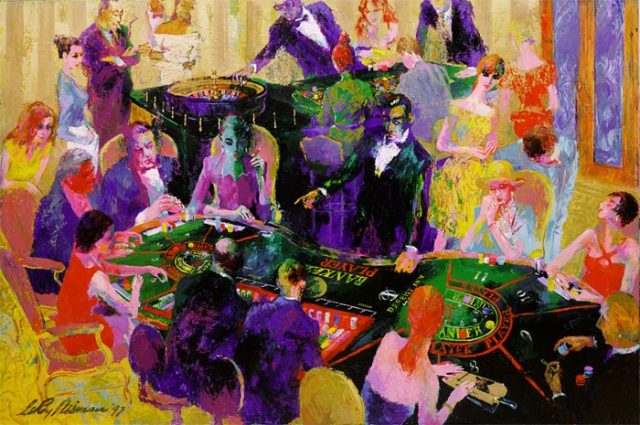
For more about the history of gambling games, check out The Art of Gambling, our beautiful coffee-table book co-authored by Anthony Curtis, that chronicles the depiction of gambling through fine art over the centuries, with detailed explanations about the games and the artists who depicted them, including Leroy Neiman's depiction of baccarat at the Desert Inn (below).