Firstly, we're glad you enjoyed the book. Frank Cullotta is certainly a colorful character...
To answer your question in a nutshell no, there's no connection (either to each other, or to the pizza chain). Here's the story, or rather the stories.
As far as the diminutive dive of a casino is concerned, we assume that the name "Little Caesars" was a tongue-in-cheek reference to the BIG Caesars Palace across the street.
How Joseph DiVarco got his nickname we're not sure, but he was a big cheese in the Chicago mob and we assume his mob moniker was derived from the 1931 movie of the same name, starring Edward G. Robinson and Douglas Fairbanks, Jr., that charts the rise and downfall of Rico, a fictional street hoodlum who ascended to the upper echelons of the Chicago crime syndicate.
So, that's the short answer; but here's some more detail about both Little Caesars, beginning with the man.
Born in 1910, Joseph DiVarco was a senior mobster with the Chicago Outfit and came to oversee the day-to-day operations of the so-called Rush Street crew, whose businesses included illegal gambling, loan sharking, extortion, protection rackets, nightclubs, brothels, and pornography. He reputedly carried out many hits for his ultimate boss, Sam Giancana, whose murder put a stop to DiVarco's rise.
When a planned hit on fellow mobster Ken Eto went wrong in 1983, leaving Eto alive to testify, it was pretty much over for DiVarco, and a subsequent undercover surveillance operation led to his conviction, in 1985, of RICO violations and of running an illegal sports-betting operation, for which he was sentenced to ten years. He died the following year in a federal prison in Washington, where members of the President's Commission on Organized Crime were attempting to talk him into becoming an informant. He was 74.
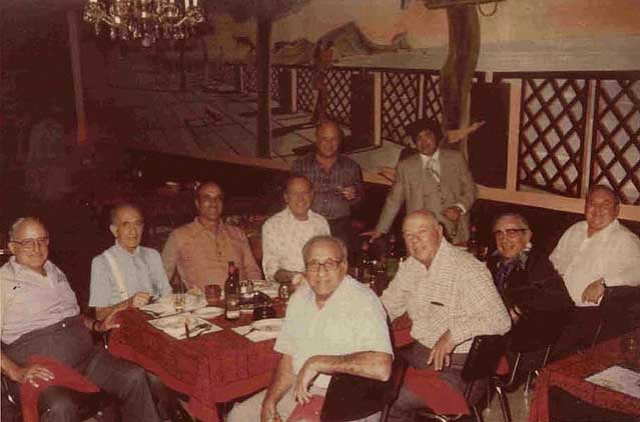
As an aside, the photograph in Cullotta to which you refer is an infamous snapshot known as "The Last Supper." Discovered at DiVarco's home during an IRS raid, it features every then Chicago mob boss dining at the now defunct Sicily Restaurant in the 2700 block of North Harlem. Allegedly, it was the meeting at which Vincent Solano was named successor to Dominick DiBella, the then North Side boss, who was dying of cancer.
So, there's the lowdown on one "Caesar." Here's the background on the casino, taken from a previous QoD (12/10/09):
The Little Caesars casino and sports book opened in 1970. It was located in a squalid little strip mall at 3665 Las Vegas Blvd. S., a block south of Bally's.
This was a joint in the best and worst senses of the word. It was the dingiest little storefront you ever saw, with perhaps the busiest pay phones in Vegas outside the front of the place. You walked in through a sort of sliding glass door, whose handle had a dozen or so layers of duct tape wrapped around it; facing west, the metal handle heated up to third-degree-burn temperatures in the afternoon sun. A hand-written sign on the slider instructed patrons to close the door behind them, so as not to lose any precious air-conditioning, which lowered the temperature in the place about two degrees on a good day.
As we recall, there were a couple of crap tables, one of which offered crapless craps, and a couple of blackjack tables, one of which offered double-exposure 21, both carnie games dreamed up by Bob Stupak of Vegas World; Stupak and Little Caesars' owner Gene Maday were buddies (which we'll further elucidate in a minute). Maday hired mostly break-in dealers, so the games were always, shall we say, colorful. Little Caesars also had four antique penny slot machines with a top jackpot of $50, which no one, to our knowledge, ever hit.
Little Caesars was known for fifty-cent draft beers, which you often poured yourself from an iced keg in the corner, as well as pour-your-own wine (no cocktails). To the bitter end, free cigarettes filled bowls everywhere.
Owner Gene Maday was known for two things: a ferocious temper that was always a sight to behold and a gambling streak that couldn't be beat. Maday was one of the most fearless bookmakers in the world, famous for booking the biggest bets in town. He said, "The big joints are like stockbrokers. They work on volume and commission. We make our money the old-fashioned way -- we gamble for it."
Only the Gaming Control Board got between Gene Maday and the gamble in him. The inimitable Billhere, in a reminiscence of the man in 1999, wrote that Maday rated right up there with Benny Binion as being the biggest gambler in his own joint.
Does anyone recall that, in 1987, the televangelist Oral Roberts announced that God told him he needed to raise $8 million to postpone being called immediately home to heaven? Well, Maday tried to post a line on the proposition, but the GCB wouldn't let him.
"I would have made the over-under line at $4.6 million," Maday told a reporter after being denied by the Board. "We'd book anything if the gaming board would let us."
Which brings us to the million-dollar Super Bowl bet. Yes, it was Maday who booked Stupak's million-dollar bet on the 1989 Super Bowl (you can read the whole story in our Stupak biography by R-J columnist John L. Smith, No Limit: The Rise and Fall of Bob Stupak and Las Vegas' Stratosphere Tower). Briefly, Maday apparently needed more money on the Cincinnati Bengals to balance his Super Bowl book that year, so he accepted $1,050,000 for the Bengals to cover the seven-point spread against the San Francisco 49ers. He also gave Stupak a 50% break on the 11-10 vig, which is why Stupak only had to pony up $1.05 mil, instead of the standard $1.1 mil. The Bengals lost, 20-16, but covered the point spread, so Stupak collected a cool million for his trouble.
When Maday paid off Stupak the same day, Stupak gave him a gift: an experimental sports car, which sat in front of the joint for a while.
But that wasn't Maday's largest payout, not by a long shot. A couple years later, he lost a $228,000 four-team parlay to a pair of Texas bettors for $2.4 million (though he won much of it back to their subsequent losing bets).
Little Caesars closed in 1994 to make way for Paris. When Gene Maday died a few years later, he took a lot of secrets with him to the grave.
L-R (front row): Anthony "Joe Batters" Accardo, Joseph "Black Joe" Amato, Joseph "Little Caesar" DiVarco, James "Turk" Torello; (back row): Joseph "Doves" Aiuppa, Martin Accardo, Vincent Solano, Alfred Pilotto, Jackie Cerone, Joseph "The Clown" Lombardo.