The famous Million Dollar Display at Binion's Horseshoe has a history as colorful as longtime owner Lester "Benny" Binion. In fact, when the display was sold for the second time, in 2000, legendary poker player Puggy Pearson commented that, "That's a part of Benny."
So interesting and convoluted is the story behind those $10,000 bills that we're going to split this answer across two QoDs. In Part I, today, we tell the tale of how the collection came to be in the first place; tomorrow, we'll let you know about its fate.
Some time in 1954, Benny Binion was on vacation in Washington D.C. with his family and paid a visit to the U.S. treasury. He saw how the public lined up to look at all the money and Benny, ever the promoter, figured that a million-dollar display could be a crowd-puller for his casino.
Binion had a close -- and wealthy -- friend named Joe W. Brown, who liked the idea and agreed to supply the cash. It was Brown who came up with the idea of a gold horsehoe in which to display it. But this was the exact same time the feds caught up with Binion for tax evasion and he spent the next three years as a guest of the government in Leavenworth Penitentiary. The felony conviction also robbed the Horseshoe's owner of his casino license, but once again his friend stepped in.
In a maneuvre to keep control of his casino, Binion "sold" it to Brown, basically in name only, with the understanding that effective control would revert back to Benny as soon as he got out. In the meantime, Joe W. ran with the million-dollar idea and had the loan department at the Bank of Nevada branch at Fifth (now Las Vegas Boulevard) and Gass Street order 100 $10,000 Salmon P. Chase Federal Reserve Notes from the Denver Mint. The story goes that Brown put the bills in his pocket and walked back to the casino, sans security, stopping on the way to give a few bucks to a collection for the Salvation Army.
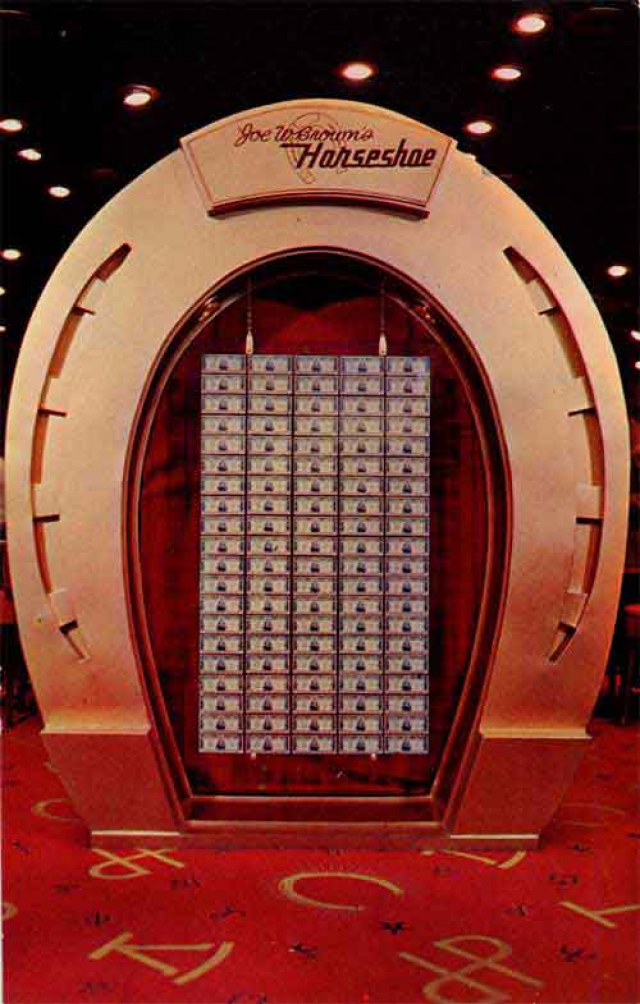
Once he got back, the money was displayed in a custom-built, eight-foot-tall, bullet-proof case, shaped like a horsehoe and painted gold, just as he'd envisioned it. At the top was a large plaque inscribed with "Joe W. Brown’s Horseshoe."
In 1959, conscious of its significant increase in value, Brown sold the display. By this time, Benny was back running his casino and he ordered a Brinks armored car to transport it to the bank. In true Binion fashion, however, Benny didn't actually put the cash in the truck. No, the vehicle was just a decoy; he transported the notes to the bank inside his cowboy boots.
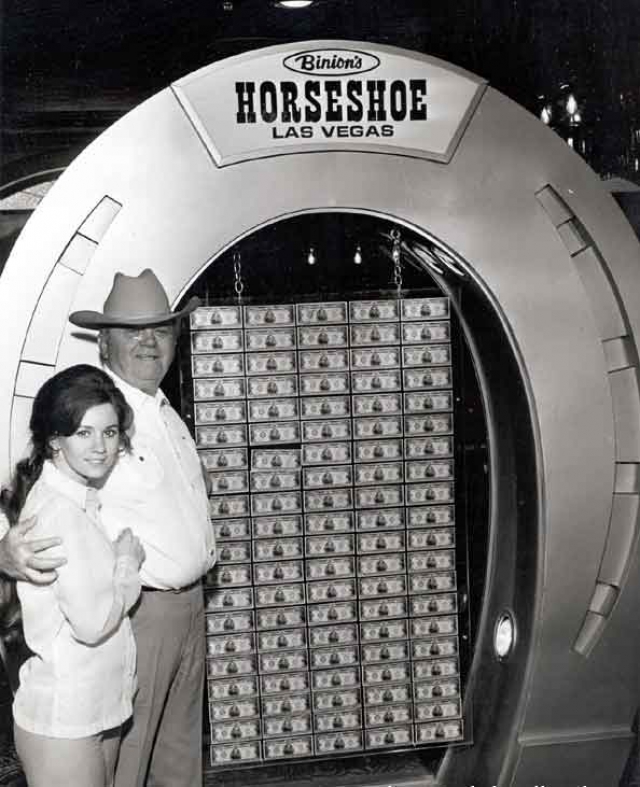
Evidently, Binion later missed the gimmick and the attention it drew, so in 1964 he decided to revive the million-dollar display and scoured the country for enough "megabills," as they're known, to recreate it -- only this time with his name on that same plaque. (As an aside, distribution of $10,000 bills was halted in 1969; they remain legal tender, but are removed from circulation if received by a bank.) Binion also supplied a photographer to take free photographs of tourists posing in front of the display, a service which an estimated 5 million people took advantage of over the course of the next 35 years.
Among them was the late Bob Stupak, builder of the Stratosphere, who had souvenirs snapped with every single family member over the years, while perhaps the most notorious poser was Charles Manson. Our own Anthony Curtis has more than a few Million Dollar family photos in his collection.
We'll end today on that happy note. Tune in tomorrow for the beginning of the end, and the demise of one of Las Vegas' most famous attractions, plus news of its latterday whereabouts, and the third incarnation of the million-dollar display.
Images appear courtesy of Jay Parrino's The Mint and UNLV Special Collections, respectively.