Clark County is named for a William Clark, but not the William Clark to whom you refer and, upon researching his career, "our" Clark appears to have been a pretty dubious character, although he did literally put Las Vegas on the map.
William Andrews Clark, Sr. was a politician and entrepreneur who hailed from Pennsylvania but who spent the majority of his adult life in Montana, where he hoped to make a fortune mining during the gold rush. Although his claim turned out to be only moderately lucrative, Clark still succeeded in amassing a fortune through a succession of entrepreneurial endeavors, including trading in eggs, banking, newspapers, railroads, sugar plantations, oil wells, and copper mines. According to Wikipedia, the fortune he made from the latter left him one of the 50 richest men ever in American history when he died in New York in 1925 at the age 86.
In addition to his business interests, William Clark had big political aspirations and, apparently, little integrity: His 1899 election to the U.S. Senate resulted in a huge scandal when it was revealed that he had bribed members of the Montana State Legislature for their votes. Although the exposure led the Senate to deny Clark his seat that year, and was part of the impetus behind the 17th Amendment that established direct election of U.S. Senators by popular vote, the taint of corruption doesn't seem to have lasted long, since a second campaign two years later was successful. The Senator apparently remained unapologetic, reportedly stating, "I never bought a man who wasn't for sale," and failed to follow through with any of his promises to enact legislation to protect miners, although his election was in large part due to support from the miner's union.
The vehemence with which Mark Twain denounced Clark suggests that Clark's morally dubious behavior must have been even more pervasive, although the only other specific incident we came across was his desertion of the Confederate Army to pursue his interests in the mining industry. In a 1907 essay the social commentator had the following to say of the man for whom our county is named:
"He is as rotten a human being as can be found anywhere under the flag; he is a shame to the American nation, and no one has helped to send him to the Senate who did not know that his proper place was the penitentiary, with a ball and chain on his legs. To my mind he is the most disgusting creature that the republic has produced since Tweed's time."
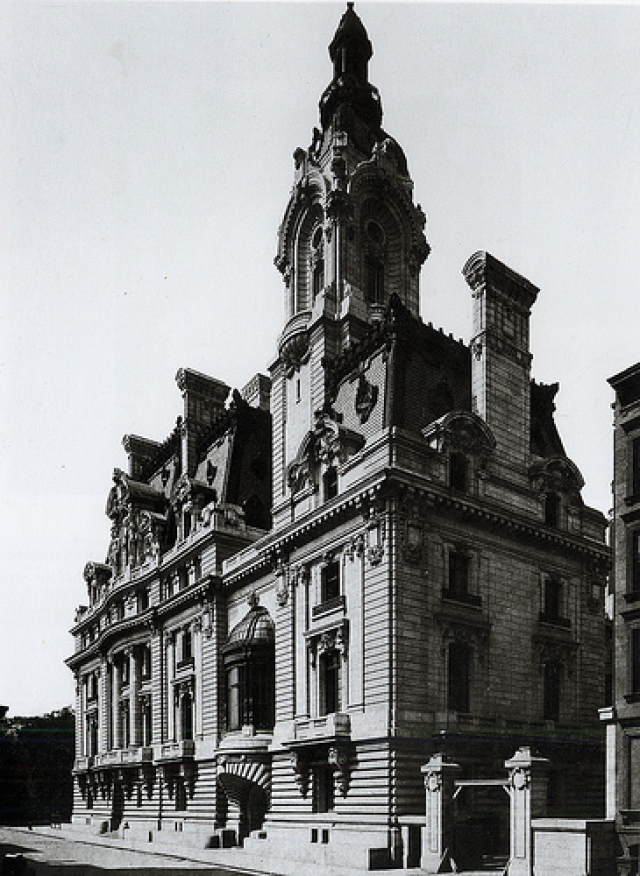
It's not even clear whether Clark, who by 1907 was living in an extravagant Gothic mansion he'd had built on New York's Fifth Avenue, spent much, if any time in the county named for him, but he was given that honor on February 5, 1908, on account of his transformation of a ranch he owned named Las Vegas into a town of the same name, established as a maintenance stop for Clark's San Pedro, Los Angeles, and Salt Lake Railroad. His ostentatious New York home was razed three years after his death due to Clark's unpopularity, although The New Republic questioned the decision, claiming that "time has consecrated its ugliness and it is almost an act of vandalism to tear it down ... It should be presented to the city as a permanent curiosity ... as a monument to one of the strangest of millionaires." He died leaving a fortune of $200 million ($2.6 billion today).
You can read more about William A. Clark in A.D. Hopkins' The First 100: Portraits of the Men and Women Who Shaped Las Vegas.