No, the New Frontier didn't have a race track behind it; what you see on that map (reproduced below and which is actually c.1950, not 1960) is the office building for a race track that actually occupied the space that now houses the Las Vegas Convention Center and LHV (formerly the International Hotel and the Las Vegas Hilton. Here's the sorry story.
There have actually been two thoroughbred race tracks in Las Vegas' history (and a dog track), although the first, to which you're referring, was so short-lived that there's very little information about it. You can see its location on the map (big green area, top right), on the north end of the Strip, behind the Thunderbird hotel, although the Sales and Executive offices for Las Vegas Park Race Track you spotted, were on the other side of the Strip (by the Nevada Broadcasting Station). The course itself was accessible solely via a narrow gravel road called Las Vegas Park Way, which ran from Paradise Road to the track.
The project was the pipe dream of one Joseph M Smoot, a promoter out of New York (and one-time running mate of Hank Greenspun, founder of the Las Vegas Sun, with whom he first traveled out West). Smoot had already been involved in building race tracks in Florida and California but had parted ways with all three projects prior to their completion; still, somehow, he apparently conned a new set of investors into backing his Las Vegas venture.
Needless to say, Las Vegas Park did not open on time and Greenspun's Sun apparently published a five-paragraph apology from Smoot, but his former associate had no illusions and chronicled the various delays with comments including the fact that even Ponzi wouldn't give Smooth a loan, and suggesting that he sell the house and cars he'd purchased with the promotional stock and put the proceeds back into the track, where they belonged.
Eventually, Smoot and two of his associates were charged with felony embezzlement, unable to account for half a million dollars in missing funds (and that was back in the early '50s!), while another two were charged with felony forgery. According to a report in a more recent edition of the Sun, even Sen. Pat McCarran, who had posed for promotional photos with Smoot by the half-built grandstand, was accused of taking an $8,000 back-hander from from the promoter in a room at the adjacent Thunderbird Hotel.
However, with Smoot ousted and a new board of directors in charge, it seemed that the project might yet get back on track, so to speak. The clubhouse and grandstand were completed and painted in festive pink, after Argentina's Hipodromo Rosado. Almost $2 million -- a huge amount for the time -- was promised in prize money for the first year's 67-day meet, and top stables started sending horses to the desert, with promises to stable them there year-round.
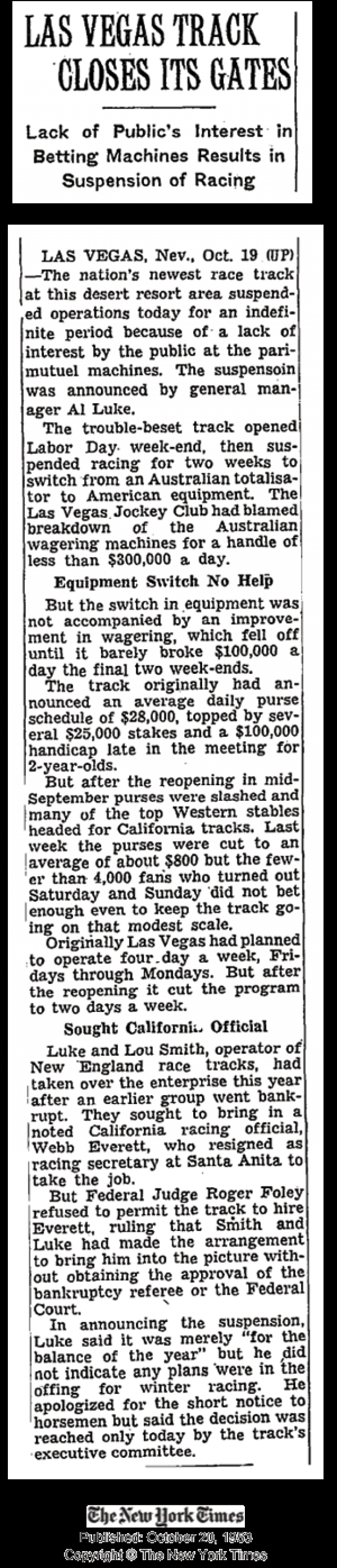
On Sept. 4, 1953, after already having gone bankrupt once, the $4.5 million park finally opened. It was a disaster from the start. Racing was suspended for two weeks after only three days, because the Australian "totalisator" with which it debuted broke down repeatedly and had to be replaced with an American model. The Las Vegas Jockey Club blamed the malfunctioning machine for the poor handle, which averaged less than $300,000 a day, but this wasn't the only problem. And machines inside the $50 and $500 betting windows broke down, too, so high rollers were forced to make multiple small wagers at the "commoners’" windows. Access along the dirt track was far from ideal, not all the entrances were open, and the crowd was forced to wait in long line in the heat.
The new totalisator proved to be of little help, and plans to operate four days a week were scrapped and purses slashed to $800 (as opposed to the $28,000-or-so intended average). With the track barely breaking $100,000 per day its final two weekends (one the poorest showings by a racing crowd ever recorded), those top Western stables rapidly abandoned the track in favor of California. Less than 4,000 fans turned out for the final Saturday and Sunday meetings and the evident lack of public interest resulted in the track's closure on October 19, after just 13 days of racing.
It seems some additional scandal followed in the wake of this short-lived fiasco, with the Oct. 20 edition of the Los Angeles Times reporting that directors and officers of the track had been ordered to appear in Reno on Nov. 2 to show cause "why they shouldn't be removed from office and why an investigation should not be conducted into the finances of the Jockey Club." There was some discrepancy regarding the size of the shareholdings of several prominent stockholders, too, who included a number of politically prominent New Englanders.
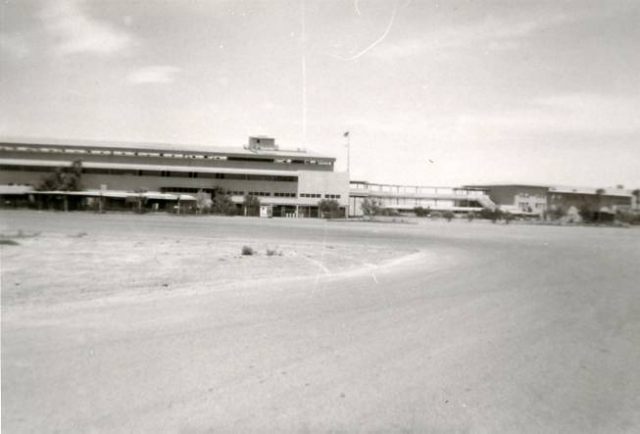
In 1954 Las Vegas Park reopened for a planned 48-meet schedule of quarter horse racing, but found itself unable to compete with the lure of the casinos, nor to erase the tainted memories of the local crowd, and after only seven weeks it closed once more, this time for good* (see below), having lost money every day of its existence. Following a second and definitive bankruptcy, Las Vegas Park Race Track was closed for good; it was demolished in 1958 (see the photograph below, published in the Sun in 1958, shortly before it was razed to make way for the Convention Center and International Hotel).
*As an addendum, when we initially wrote about this topic, back in 2008, a contributor to the LVA forums wrote in with the following interesting aside:
"That was not the last event held at that facility: In October of 1955, NASCAR sanctioned a 200 mile stock car race at that very horse track. Several websites mention this race and location, including Nascar.com.
This is a cut-and-paste from the Full Throttle website:
'There is a single dusty memory of the Good Old Days of NASCAR when the Desert Classic was held was on Oct. 16, 1955. The place was Las Vegas Park Speedway, a one-mile dirt track, now the site of a Hilton hotel.
'Norm Nelson, driving a '55 Chrysler for legendary car owner Carl Kiekhaefer, won the dirt-track race. Nelson collected the grand sum of 4,745 dollar and averaged a tick over 44 mph. Primarily a USAC stock car star (three-time series champ) the Vegas event was his only Cup win in five career starts, the last at Riverside in 1968.
'The event was the 43rd of the 45-race season. Scheduled for 200 laps, it was shortened to 111 due to darkness, caused in part by a 12-car accident early in the race.'"
So that's the story of Las Vegas' first race track...
Images appear courtesy, L-R, of: UNLV Special Collections; New York Times; Las Vegas Sun