Happy to oblige. Well, in all honesty we'd be lying if we said researching this one was a "happy" experience, since we must confess that after wading through the Trademark Electronic Search System for some hours, we reached a certain breaking point and could take no more. If you've ever used it, you will understand what we're talking about... However, we'll do almost anything for the QoD faithful, so here ya go.
Usually, when a company is acquired, all trademarks are considered assets of the purchaser. When an individual property is sold (e.g., Frontier, Castaways, Dunes, etc.) it's usually a real estate transaction and the trademark may be held separately. There isn't always a consistent rule and it often is buried in the sale documents, but here's what we were able to find in answer to your question, on a case-by-case basis.
Sheldon Adelson named his casino and conference-center empire Las Vegas Sands Inc., after the historic casino on whose site the Sands Expo Center and Venetian hotel were built, so all the rights to that incarnation of the old casino name and its derivatives are tied up, which would almost certainly preclude any new Sands Casino from being built in Las Vegas.
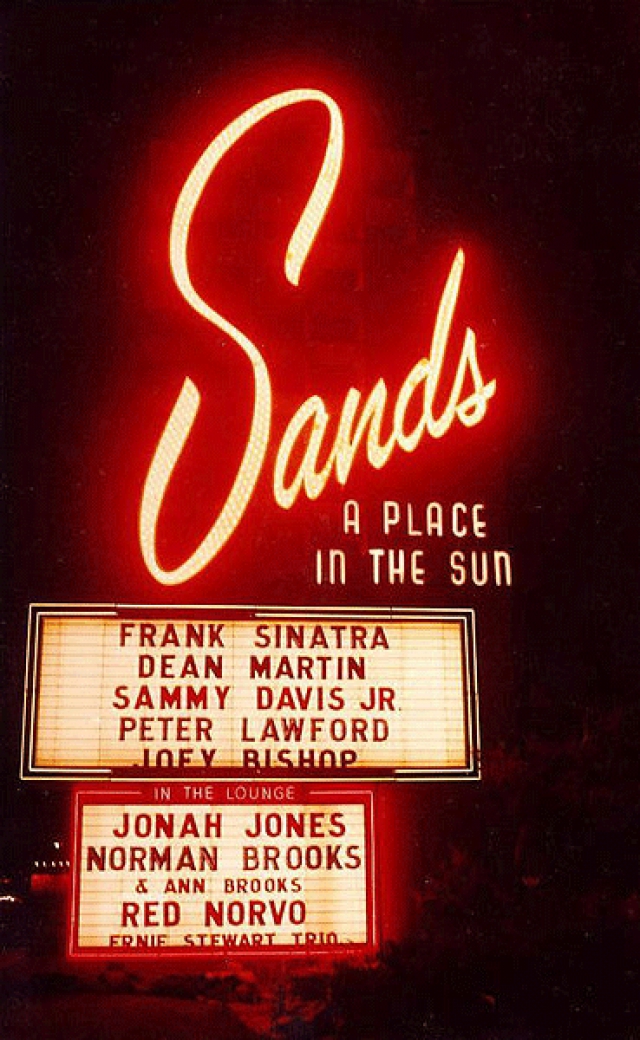
The modern Sands logo is not the one used by the original hotel, however, which was also subtitled, "A Place in the Sun." From what we were able to ascertain from our copious digital digging, the last time the logo from the 1952 original was purchased was by Greate Bay Hotel and Casino, Inc. Corporation of New Jersey, back in March 2003. The company abandoned the branded Sands logo trademark a couple of years later, in January 2005, so it looks like it may be up for grabs again.
As to the "A Place in the Sun" part, which is also recorded by TESS as having first been used in commerce in 1952 (i.e., in conjunction with Sands), this appears to have last been owned from December 22, 1980 to February 22, 1983 by the Summa Corporation of Delaware (Howard Hughs' former company). The trademark is now recorded officially as "dead," i.e., it's not currently owned by anyone and is also available for purchase.
Summa Corporation is also the present owner of the "Desert Inn" trademark, which was registered to it in May, 1983; it's renewed this service mark and have kept it "live" ever since.
Interestingly, although it's widely known that he originally planned to call his new property Le Rêve, in 2001 -- the year in which he imploded the original -- Steve Wynn applied for the the rights to "Steve Wynn's Desert Inn" and he kept renewing until finally abandoning the logo (it's recorded as a "typed drawing" mark code) in 2009. Since he already had a name in mind for the resort that he ultimately named for himself, Wynn presumably was simply controlling the name to ensure that no one else could use it.
Back in 1986, Wynn also paid the princely sum of $750,000 for the "La Mirage" moniker, the name of a small hotel-casino on East Flamingo that opened in 1973 as the Ambassador and would subsequently be renamed the Key Largo. The now defunct Glass Pool Inn had previously been called The Mirage, and Wynn also paid $500,000 for the rights to that name (the property itself subsequently sold for just $5 million!) Wynn wanted The Mirage name so badly for his new megaresort that he was prepared to pay that much for it.
For those you who have been paying close attention, you will have noticed there was once a Castaways hotel on the Strip. A later one arose at the intersection of Fremont Street and Boulder Highway. The latter was, circa 1998, a Showboat casino. When Harrah’s Entertainment – now Caesars Entertainment – bought the Showboat brand, it only wanted the non-Vegas Showboats, one of which still operates in Atlantic City. So, three local businessmen bought the local Showboat and, reaching back into Vegas history, dredged up the Castaways name. They probably reckoned that in this instance, the owner of the site of the Strip’s Castaways – Steve Wynn – wasn’t going to fight over the name of a place he’d razed in 1987 to make room for ... yep, The Mirage.
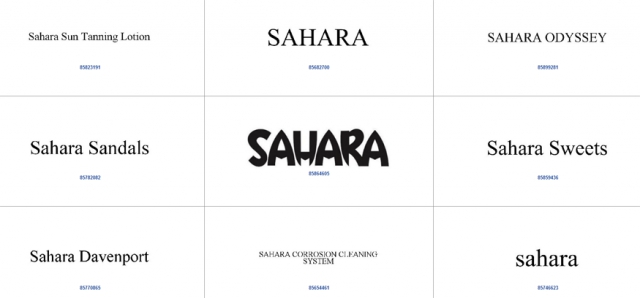
The Sahara name, in its iconic stylized lettering, is the property of Stockbridge/SBE Holdings, who purchased the historic casino and are currently in the process of transforming it into the boutique SLS Las Vegas, so no likelihood of this one being revisited anytime soon.
As to the Dunes, Bellagio LLC, which is built on its former site, filed for the rights to the service mark in 2008, three years after it was abandoned by the previous owner, a slot machine company called G & S Casino Services. It appears that the slot game is still in operation at Bellagio, since they continue to keep their ownership of this trademark "live."
We ran out of steam when it came to The Frontier, in its various incarnations (there are literally THOUSANDS of "Frontiers" registered, whether "live" or "dead"), but we're guessing it's probably owned by developer Phil Ruffin, who bought the Frontier from Margaret Elardi, who in turn had purchased it from Summa Corp.
Boyd Gaming still owns the Stardust name outright. Many hoped it would be returned to the Strip in place of the unloved "Echelon" moniker. Then Boyd sold the Stardust site … but it could still erect a new "Stardust" any place it chooses – and is able to afford, although that seems highly improbable, given the ill fate of the reincarnated Aladdin, which almost certainly soured many against return visits by old names.
However, while Boyd may never build another Stardust, it is well aware of the nostalgic power of that name. For instance, the party room at The Orleans is the Stardust Suite and the event center at the Blue Chip riverboat in Indiana is the Stardust Center.
The Imperial Palace name, despite having adorned a Caesars Entertainment casino until recently, is also a piece of Boyd property, having been obtained along with the former Imperial Palace Biloxi. Boyd doesn’t use it down there because, after Hurricane Katrina and long before Boyd purchased the property, it had been rebranded as IP Biloxi and continues to perform better than Wall Street expects. Had it wanted to retain it, Caesars would have had to pay Boyd a fee to keep the Imperial Palace name on its Japanese-themed Las Vegas Strip casino; as it was, we suspect they were only too happy to sever any ties to the aging IP's ID. Instead, they opted to put another nail in the coffin of the dated theming frenzy of yore with a complete break from the past, canvassing customers and staff for new-name ideas before settling on The Quad.
As an aside, not all trademarks are held nationwide. For instance, Barbary Coast became Bill’s Gamblin’ Hall and will eventually be Gansevoort Las Vegas. As long as you don’t do it in Nevada, you can put up a Barbary Coast Casino anywhere you like, should you so wish. On the other hand, in the upcoming conversion of MRI's THEhotel into a Delano-branded property, MGM retains the rights to use "THEhotel" in all markets, and in perpetuity.