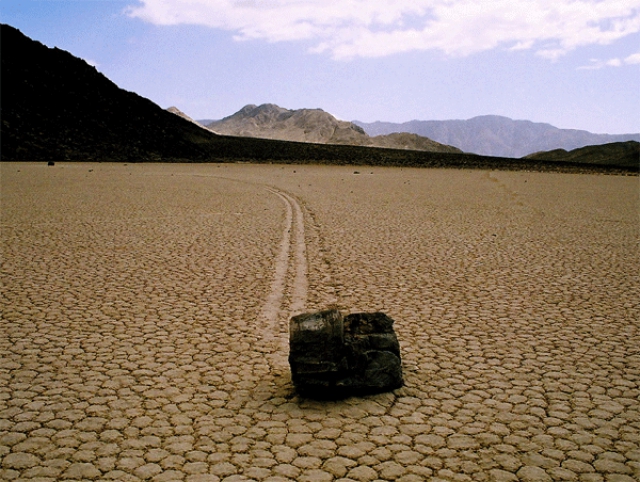
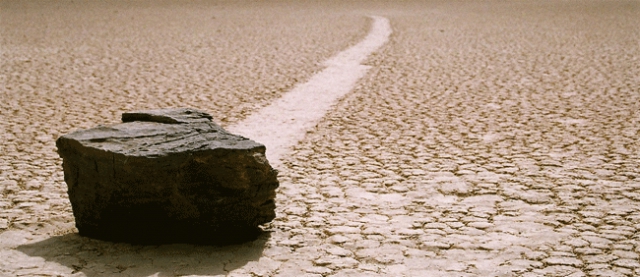
You’re referring to the "Racetrack" (officially, the Racetrack Playa) area within Death Valley, named for the boulders that move "by themselves," leaving a trail in their wake.
Until very recently it had been a mystery bewildering observers since the 1900s, how boulders weighing as much as 700 pounds could move, with no obvious or visible outside force, for distances of up to 1,500 feet across the flat dry lake bed (and when we say "flat," we mean it: There's only 1.5 inches difference in elevation between the north and south end of the 2.8-mile long lake).
While it's known colloquially as the "Racetrack," that's really something of an exaggeration, since the rock travel is so slow that until very recently no one had ever actually seen it happen in the more-than-a-century that has elapsed since the phenomenon was first observed. The speculation was that rock movement occurred when the lake bed was wet and when winds were simultaneously blowing at speeds of 50 mph or more. Another theory was that a combination of winds and ice would "float" the boulders enough for them to move. But no one knew for sure.
The average rainfall in Death Valley is just two inches per year, while in some years there's no rain at all. The area is technically an endorheic lake, meaning it's a closed-drainage basin. Hence, when rain happens, the runoff from the surrounding mountains all gathers on the lake bed. It has nowhere to flow to, but quickly evaporates in the desert heat, leaving a super-slippery mud slick in its wake. The mud then cracks when it dries and contracts, causing those familiar polygon-shaped "cornflakes" to form on the surface.
The "sailing stones" or "running rocks" – i.e., the boulders that move, not to be confused with the Rolling Stones, Rolling Rock, or Runnin' Rebels -– are slabs of dolomite and syenite that tumble off the mountains and previous studies had shown that they move only once every two or three years, with the resultant tracks enduring for three or four years. They tend to be concentrated at the southern, lower-level end of the lake bed. Interestingly, those stones with rough bases move in straight lines, while the smooth-bottom ones tend to wander. But, until recently, there was only speculation as to how and why any of this happens.
The headline you saw was most likely reporting on a recent study carried out by researchers who, for the first time, were actually present when the rocks moved. Their findings were published last month. Using motion-activated GPS sensors and time-lapse photography to document the study, the team chronicled a total of 60 rocks and boulders that moved between December 2013 and January 2014 and they determined that ice and wind are factors, but not in the way previously thought.
What has now been discovered is that the rocks move when ice sheets that are a few millimeters thick form on shallow water. As this "windowpane" ice starts to melt and breaks into large sheets, the wind blows the ice sheets across the lake surface and, when they come into contact with a rock, they have enough power and momentum to push the rock along the playa surface. So, it’s not that the wind blows the rocks across slippery mud, nor that the rocks "float" thanks to ice and wind, but rather that the wind pushes the ice and the ice pushes the rocks. Mystery solved! (Sorry, "Mythbusters," we beat you to it!)