It’s not a hotel sign but the biggest one on the Strip per se is the $10 million video screen atop Brett Torino’s Harmon Crossing mall, which measures 65 feet in height and 322 feet in width. For casinos, the big boy is Aria’s new, freestanding marquee, just south of The Cosmopolitan. It’s pretty hard to miss, standing 260 feet tall on two legs, with a 65-foot-wide, 15-foot-tall screen (11,000 square feet of LED video per side, according to MGM International). The lettering on the sign is massive, too, with the ‘A’ standing 26 feet high and the ‘ria’ all 16 feet tall. Made by YESCO (Young Electric Sign Co., the standard-setter in Las Vegas signage), the marquee cost MGM $18 million to erect. By contrast, at the far opposite end of the Strip, SLS Las Vegas’ main LED sign is 88 feet high and 47 feet wide.
MGM has a video marquee for every one of its Strip properties except Luxor and Circus Circus. The only other Strip casino without a video board is the Flamingo.
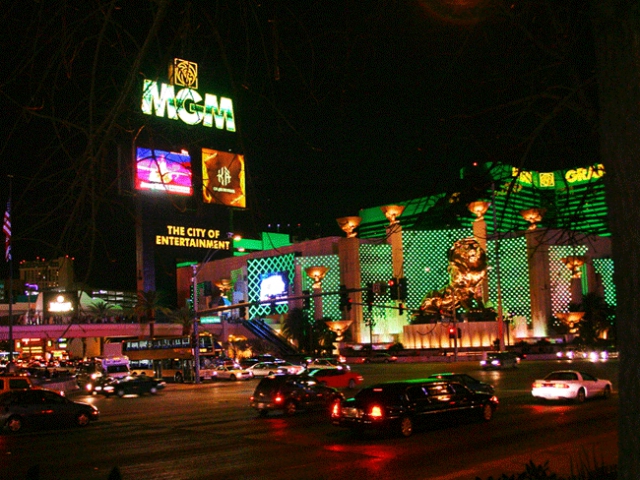
Strangely, few seem to know for certain whose video marquee was the first on the Strip – not even industry leader YESCO. "There were so many iterations of video screens, some of which didn’t run true video but animations," recalls John Schadler, managing partner of SKG Advertising. He believes that the MGM Grand was first. "There was this technology transformation back in ’98. It was not Mirage, it was not Treasure Island, even though Steve [Wynn] was always behind the latest and greatest, but MGM probably had it before."
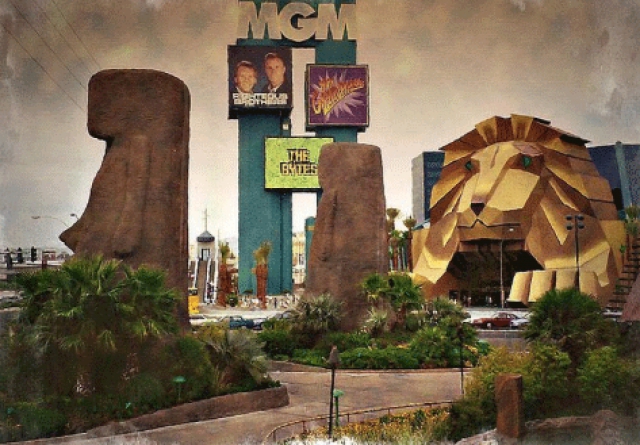
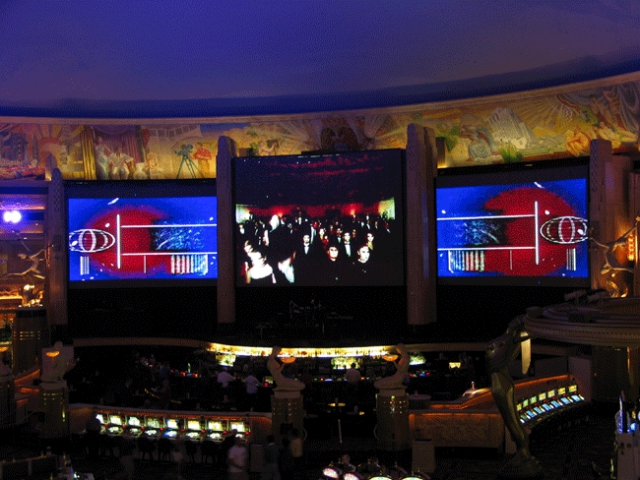
Bellagio Director of Production Frank Coccaro confirms Schadler’s hypothesis. He writes, "it was in 1998-1999 the hotel installed three large LED screens inside the Entertainment Dome, (formally Emerald City) where high-energy bands would perform daily. MGM also installed an exterior LED marquee, two bridge-walkover LED screens, and fifteen LED diamond walls. This was around the time when MGM replaced the Golden Leo entrance with a 50-ton gold statue of Leo."
As for YESCO, its contributions to the video-marquee art form also include the multi-story Bally’s Las Vegas tripod, erected in 2001, and the Wynn Las Vegas "moving eraser," unique on the Strip and unveiled in 2005.