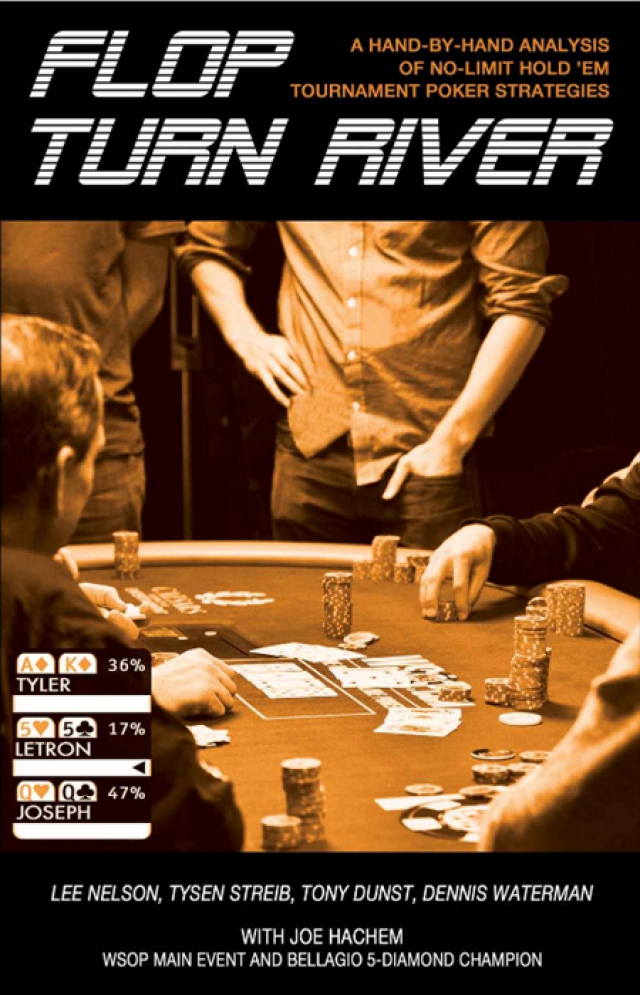
We’ll wager that you do know these players and we’ll combine the explanation with a little look behind the scenes of creating a book cover. There are two important factors involved. The first is obvious: The cover has to convey the essence of the book in a way that’s compelling to buyers. The second is you have to be sure you have the proper permissions to display everything that’s used to accomplish the first consideration. Sometimes it all falls into place – you have the perfect image or find it elsewhere and license it, which includes all the necessary clearances. Neither of these scenarios was the case with Flop, Turn, River.
We had to sift through hundreds of poker photos before we found even a few that we thought might work. We mocked up looks for each of the candidates and finally chose one. It’s an image of the final table in Event #54 of the 2014 World Series of Poker. As an aside, the event was won by Florian Langmann (seated opposite the dealer), who walked away with $303,909 and his first WSOP bracelet. Who the other players are, we have not researched, since the license we purchased from the photo library that markets this image covered permissions for the CET-owned Horseshoe logo on the table and the right to depict the other players present. But that still doesn't answer your question.
While the image was sufficient for our needs, we didn’t feel it was compelling enough on its own, nor would it resonate properly with the particular player we’re marketing this title to, one who's played a bit, but has a ways to go to make it to the big time. For many, the "big time" is best defined by playing for money on TV. To convey that the players on the cover are playing on television, we inserted the win-probability calculator, an element that’s become synonymous with the TV game. Because the cards on the table are mostly illegible, including the four community cards, we made best guesses for each hand, then calculated the percentages and put them into the graphic. And here's a secret: The game isn't hold 'em. We know from licensing that it's pot-limit Omaha hi-low split-8 or better, which, ahem, is a game where each player gets four, not two, starting cards. If you look very closely, you can see that, but if you didn't know, you probably wouldn't pick it out. The image was good and the calculator made it better, so we went with it.
Now all that was left was to fill in the names that you’re asking about. We couldn’t just use celebrity names like Phil Hellmuth, Johnny Chan, and Daniel Negreanu without permission, not to mention that it clearly isn't they who are playing. Neither did we want to use the real players, since the hands used in the calculation are fabricated. That left either using the authors or simply making names up. We chose a combination of the two.
Here’s the explanation, which we’ve never divulged before, even to the authors involved. "Tyler" represents Tysen Streib. We often refer to Tysen as Ty, and we wanted him represented among the three because of all the excellent work he’s done on the books in the Kill series – Kill Phil, Kill Everyone, and Raiser’s Edge – so Tyler worked there. "Letron" comes from Lee Nelson. Why "tron" at the end? Don’t know. It’s just the name that popped up and we thought it sounded French (or robotic?) and gave the game an international/Terminator-esque feel. And "Joseph" was a simple homage to the World Champion in the group, Joseph Hachem.
What of the two other authors, Tony Dunst and Dennis Waterman? They’re out of the hand, properly folding earlier for reasons they help teach you about in the book.
Editor’s Note: Flop, Turn, River – A Hand-By-Hand Analysis of No-Limit Hold ’Em Tournament Poker Strategies comprises 75 problems, 125 table graphics, and more than 150 playing decisions designed to improve your tournament game. It’s available with an exclusive publisher's discount from ShopLVA.com for $19.97 (reg. retail $29.95), or as an e-book for $9.99 from amazon.com, Barnes & Noble, and the iTunes store.