That depends upon which it is to which you're referring, since there were a few during the resort's lifetime, and a couple are, to the best of our knowledge, MIA (most likely in a landfill, we sadly suspect). However, read on for some good news...
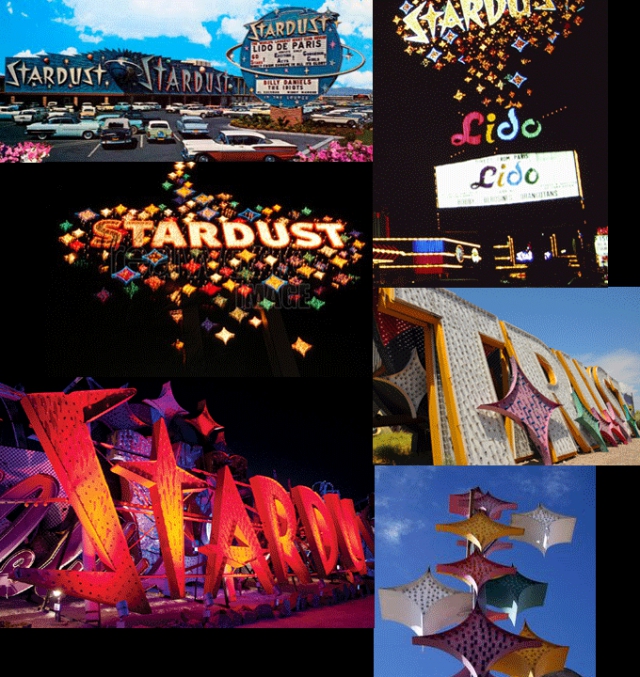
When the Stardust debuted on July 2, 1958, it was with an "outer space" theme befitting the Atomic Age and the general fascination at the time with all things cosmic. There's debate about whether the concept for the outer signage should be credited to Moe Dalitz (as he claimed) or to Tony Cornero (who died shooting craps at the Desert Inn, just before the resort was originally slated to open, on July 13, 1955), but the actual finished design can be attributed with certainty to Kermit Wayne of the Young Electric Sign Company, who was responsible for both the original façade and roadside signs.
The name of the property was emblazoned across the front, twice, in spiky Electra-jag Googie-style lettering, and incorporated a panoramic view of the solar system, with a 16-foot plastic model of Earth at its center. At 216 feet long and 37 feet high, it was at that time the world's largest electric sign. As Wikipedia describes it, "cosmic rays of neon and electric light bulbs beamed from behind the model Earth in all directions. Three-dimensional acrylic glass planets spun alongside 20 scintillating neon starbursts. Across the universe was a jagged galaxy of electric lettering spelling out 'Stardust'. The sign utilized 7,100 feet of neon tubing with over 11,000 bulbs along its 216-foot front. The 'S' alone contained 975 lamps." At night, it was said to be visible from 60 miles away.
The free-standing roadside marquee that complemented this was also impressive, comprising a huge disc, circled by an "orbit" ring, with the hotel name in the same funky font, all covered in dancing stars and glittering cosmic dust.
And so it remained until 1965, when the circular roadside sign was replaced by the first incarnation of the 188-foot-tall, $500,000 animated starburst that you're probably recalling in your question. It featured the same Googie lettering for the Stardust name until 1991, when the what-had-been "futuristic" design was replaced with contemporary letters using the far more pedestrian Futura font.
Then, in 1977, another remodeling took place, as the famous façade was stripped of its space-age lettering, to be replaced by red and neon tubing that stayed in place until the late '90s, plus a new port-cochère. And so it all remained until the Stardust officially closed, and the lights went out, at noon Pacific Time on November 1, 2006; the iconic, at times notorious, and still much-loved property was imploded in the wee hours on March 13, 2007.
That good news, however, is that the original Electra-jag façade sign can be viewed at downtown's Neon Museum, where it was joined, post-implosion, and at the cost of $80,000 to move it, by the "modern" starburst tower sign, or "cloud of dripping diamonds," as we saw it poetically referred to. The museum offers both daytime and nighttime tours, by appointment, when you can see some of the old Stardust signage lit up, so we recommend you book yourself on one of these next time you're in town.