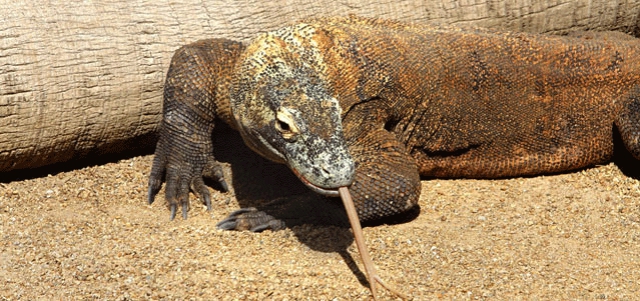
It was back in April 2008 that news broke of a new arrival for Mandalay Bay's Shark Reef attraction, but the June debut was not of an aquatic predator, but a land-dwelling one, in the shape of one of the world's 5,000-or-so surviving Komodo dragons.
Indigenous to various Indonesian islands and the largest living lizard, dragons can reach up to three meters in length and 300 pounds in weight and they're not something you want to bump into on a dark night, or even on a sunny day, for that matter. As Wikipedia explains, "It is able to locate its prey using its keen sense of smell, which can locate a dead or dying animal from a range of up to 9.5 km (5.9 mi). Komodo dragons have been observed knocking down large pigs and deer with their strong tails." And here's more, from the Shark Reef site: "Patiently, it will lie and wait, sometimes for hours, for a suitable meal to approach. When the Komodo attacks, it aims for the feet of its prey first, to knock it off balance. Once the prey is down, the Komodo will use its razor sharp claws and dagger-like teeth to devour its kill.
"If the prey somehow manages to escape this attack, its good fortune does not last long. Over 50 different bacteria strains have been found in Komodo saliva, with at least seven strains being deadly. Any animal bitten by a Komodo dragon faces a fierce infection that would typically kill them within a week. The Komodo will then stalk the wounded prey patiently until it dies. Once one Komodo begins to feed, the aroma of the kill will attract even more Komodos, and a frenzy ensues. Only about 12% of the prey remains uneaten. By comparison, lions leave nearly 30% of the carcass of their prey behind."
Nevertheless, these creatures are on the IUCN Red List of Threatened Species, the world's most comprehensive inventory of the global conservation status of biological species, and it's feared there may be as few as 350 remaining breeding females in the wild, so now there are conservation efforts underway, but Komodos don't fare well in captivity. Hence, it's good to know that the Shark Reef specimen is still alive and well and on display during the attraction's regular hours which, commencing May 24, will be 10 a.m. to 10 p.m. daily, through September 1 (currently it closes at 8 p.m. Sun.-Thurs., but then the extended summer schedule kicks in).
In addition, we're happy to report that the original male from 2008 was joined, back in 2013, by two juveniles that were among 10 dragons captive-hatched at the Praha Zoological Garden in the Czech Republic. They're part of the Association of Zoo and Aquariums (AZA) Species Survival Plan (SSP), and as an accredited member of AZA, Shark Reef was among just seven locations that has pledged to cooperatively manage, conserve, and protect this endangered species. As director of Shark Reef Adrienne Rowland explained at the time, "It’s rare to have Komodo dragons with bloodlines completely unrelated to dragons hatched in North America. These juvenile males will be high priority for future breeding attempts for the Komodo SSP and will be critical in producing future generations of healthy and genetically diverse populations of Komodo dragons."
The two youngsters are currently in Shark Reef's husbandry center, a helpful PR rep informed us, so they're not on public display and in fact the trio will never appear together in the same enclosure, since they could prove deadly to one another so, for now at least, only the original "daddy" dragon is on public display.
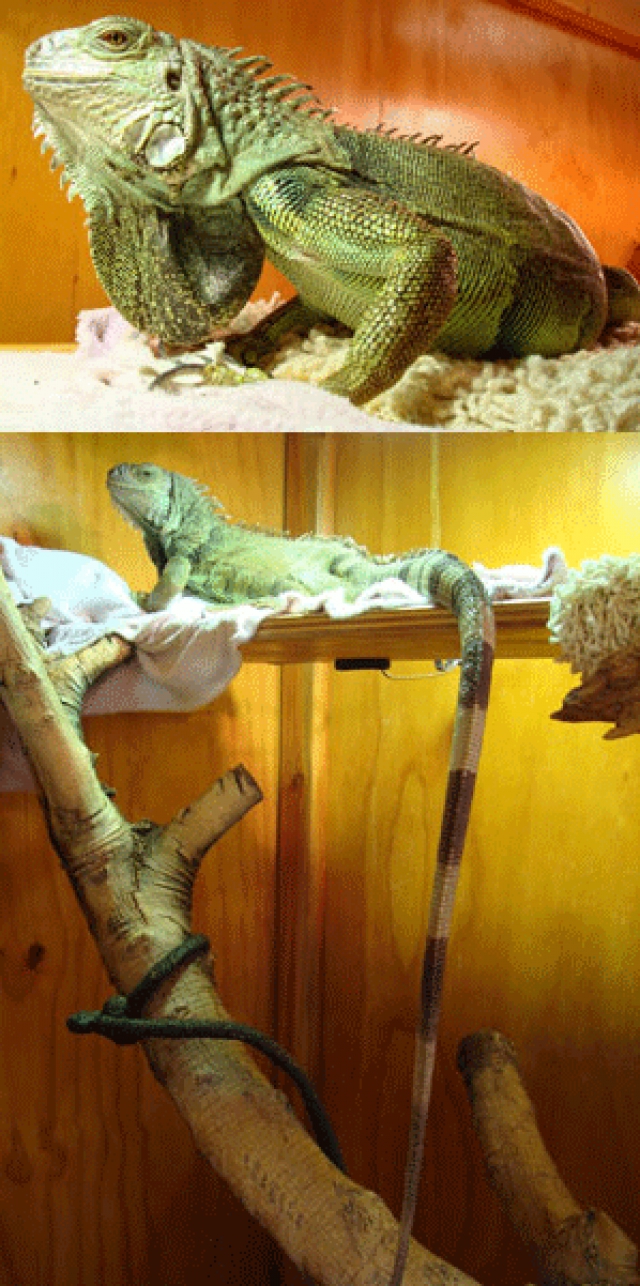
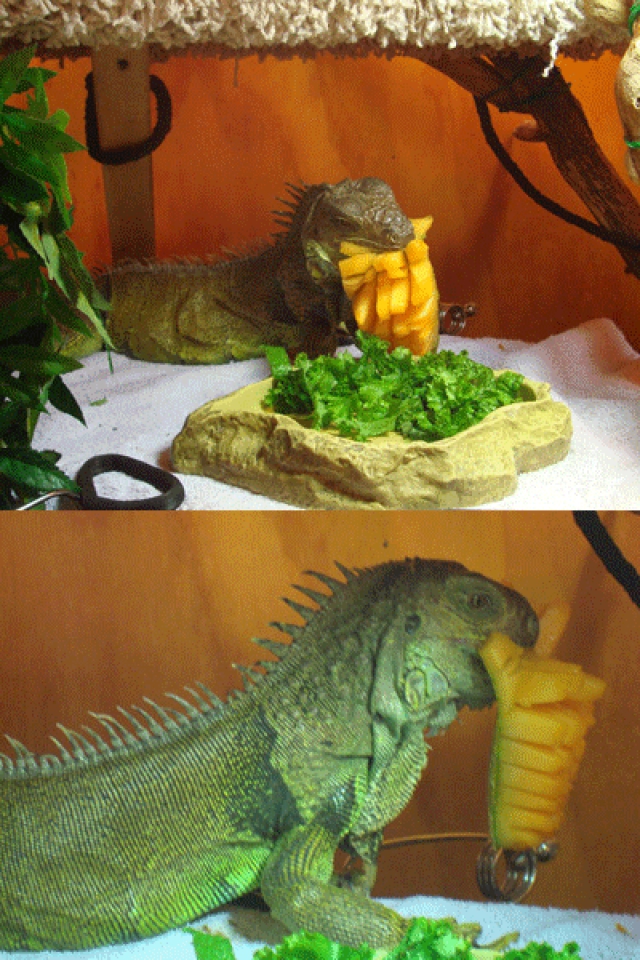
While we're on the subject of reptiles, for those readers who were intrigued by our office Green Iguana (some of whom even came to pay a special visit, including one brave but bald male LVA member, who allowed her to sit on his head!), we're very sad to relate that Mojo passed away last summer. She was almost 15 years old and had dodged death on more than one occasion, not least when "he" turned out, at age seven, to be an egg-bound "she" in urgent need of a C-section and a hysterectomy to remove 38 malformed eggs, an operation duly performed by Las Vegas' most awesome "exotic" vet (thank you, Dr Kolmstetter!)
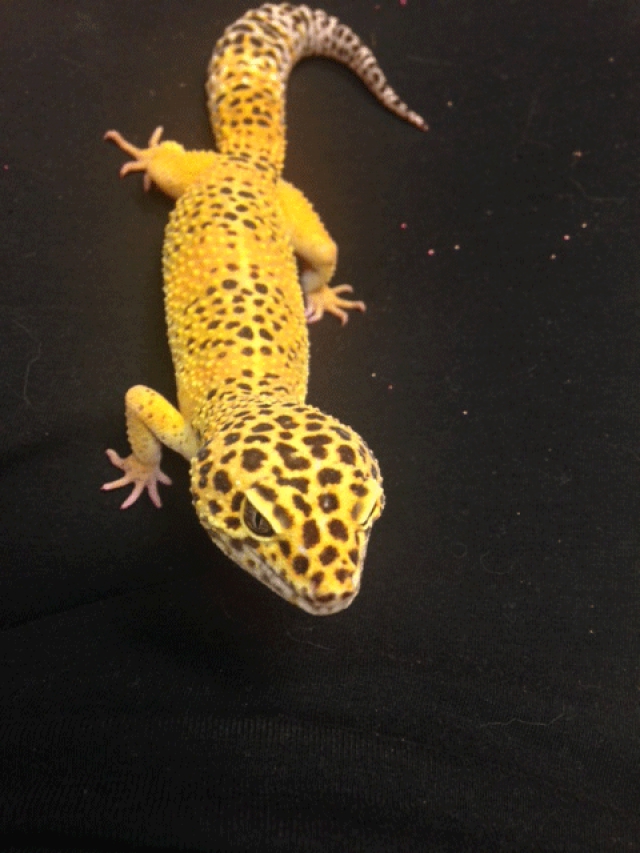
Towards the end she was suffering badly from arthritis and was off her food, but we still miss Mojo very much indeed. The good news is that we recently inherited a beautiful leopard gecko, named Fred, who is settling in nicely, although he's way too wriggly to sit on my lap while I write Question of the Day, unlike his predecessor. It's also a little disconcerting watching him devour live crickets--iguanas are vegetarian, so Mojo may have cost a small fortune in fresh raspberries and papayas when they weren't in season, but no blood was shed, whereas Fred seems to have more of a Komodo-like disposition! Still, we feel no office should be without a lizard and we're very happy about our new arrival.