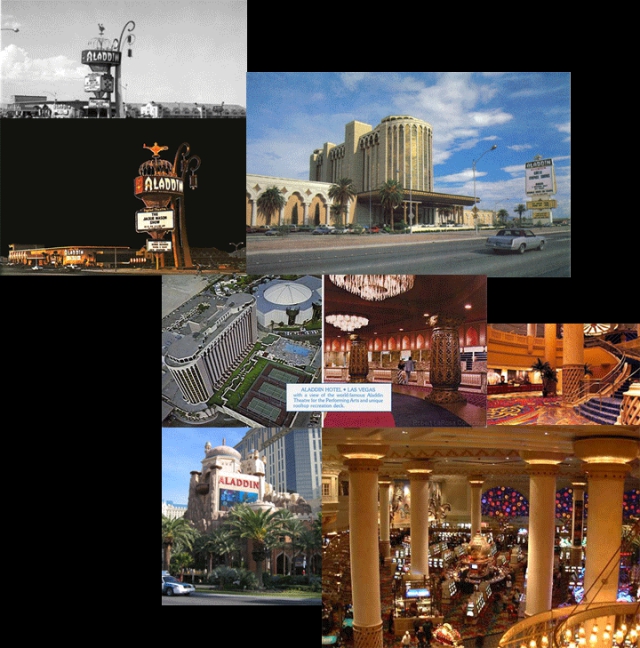
Prior to its pretty generic modern/party/music-centric vibe, Planet Hollywood had not one, but two previous incarnations as the Aladdin, with successive attempts at an "Arabian Nights" theme. In the first instance, which was debuted by Sahara-owning Milton Prell in 1966 as the Strip's first major resort, the Aladdin opened with amenities including a by-then de riguer nine-hole golf course, while the former English Tudor style of its Tally Ho/King's Crown predecessors was substituted for a flat-roofed serrated-canopy over the casino area.
A 15-foot "Aladdin's Lamp" sign and marquee, designed by YESCO, echoed the same mysterious "eastern" theme borrowed from the Sahara, via its logo, window treatments, and some architectural embellishments, like the metal-work pillars in the check-in area that you can see in the postcard below. However, this original version of the property long pre-dated the era of immersive resort branding, as a result of which the Aladdin's early Persian identity was essentially surface-cosmetic and didn't extend much beyond some fixtures and fittings and gimmicky names like the 500-seat "Baghdad Theater" or the "Sinbad Lounge," the latter which was treated to a $750,000 makeover in 1969, when it became enclosed and leveled above the casino floor and introduced a more pronounced "Arabian" motif.
With some pioneering "only-in-Vegas" chronology-flouting defiance, the Arabian Nights theme was long juxtaposed with the original Tudor-look hotel wings to the rear of the property (similar to the Tropicana's foray into random Polynesian accents, highlighted in yesterday's QoD, or as seen in recent times at the modern-look former Quad, where anachronistic pagoda accents endured at the back of the hotel long after its Imperial Palace days). Not even the opening entertainment at the Aladdin was themed, with acts including Jackie Mason, the Jet Set Revue (a musical showcase for The Three Cheers vocal group), and the Petite Rockette Dancers being first to grace the stage in the main theater.
In November 1997, the original and bankrupt Aladdin closed, pending a complete implosion the following April, having been deemed structurally unsound (only the Theater for Performing Arts was preserved). Three years later, in August 2000, this ill-starred property (which was long-rumored to be jinxed) rose once more from the ashes, although as what proved to be more of a turkey than a phoenix.
"Opening Night at the Aladdin: The Sequel" was delayed by fire-inspectors, surveillance-equipment issues; and ongoing construction work, which saw valet attendants and front-desk staff all sporting hard hats, although no similar protection was offered to the somewhat disconcerted first-arrivals, who had to be accommodated in other hotels. Guests who lined up on the Strip the next morning to be be first in the casino doors were greeted by banks of out-of-order slot machines and not much in the way of "theming" aside from details like the gaudily jeweled pillars and other overblown accents.
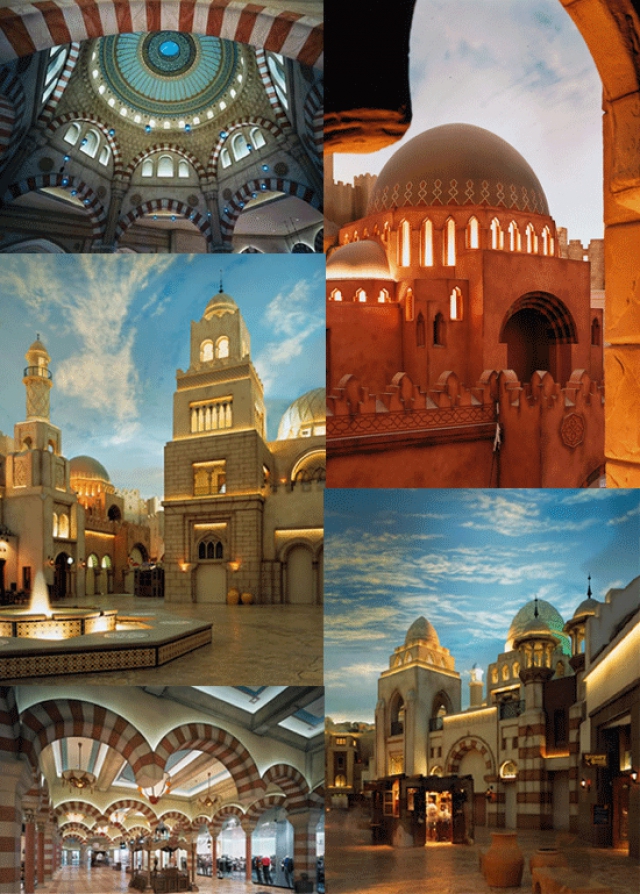
Ironically, the second time around it was more the adjacent Desert Passage Shopping Mall that ventured into the realm of themed attractions, to the extent that either venue did, with its then-fashionable "changing sky"-effect" ceiling and Moroccan souk-like architectural embellishments that were aimed not to evoke the kitsch Arabian Nights-fantasy feel of the casino, but instead transport shoppers "on a journey from Gibraltar to India." Anthony Curtis was distinctly underwhelmed, however, when he reviewed the half-hourly indoor thunderstorm that was touted as the next BIG free "spectacle" on the Strip: "Every half-hour, on the hour, a mock thunder- and rainstorm occurs inside Desert Passage. People stand around and watch water fall from the ceiling into a pool. It’s pretty lame, which would have been fine if it hadn’t been touted in some circles as something just short of a quantum leap for Las Vegas spectacles. It ain't."
This mini-storm, which continues to operate today in the new Miracle Mile Shops incarnation of what was Desert Passage, also features an indoor fountain show at various intervals throughout the day, with lighted water effects, color-changing fog, bursts of light and "dramatic, original soundtracks broadcast via a state-of-the-art surround-sound system." Right.
Returning to the casino, the exterior did go the distance to include a facade of evocative minarets (albeit with a giant video screens as the centerpieces), while the main attraction inside was the "Enchanted Garden." Described as the "world's largest indoor light board," it was a 21-foot-tall and 120-foot-long "mini-spectacle" located high on the west wall and featuring close to 2,200 fiber-optic flowers that lit up in a variety of displays. Mildly interesting, but not exactly on a par with Bellagio's Conservatory, and what did it have to do with 1,001 Nights?
Above the casino flew a small herd of "ebony" horses, evoking the enchanted equine of one of Scheherazade's stories, while the casino bars were staffed by costumed bartenders and waitresses and each featured a giant model of an iconic symbol from the Arabian Nights, from the 36-foot-long lamp atop the aptly named Lamp Bar, to the upper-level Roc Nest venue, where drinkers were subjected to the mute scrutiny of the giant eye of the gargantuan bird from Sinbad the Sailor's second voyage.
So much for the Aladdins, I and II.
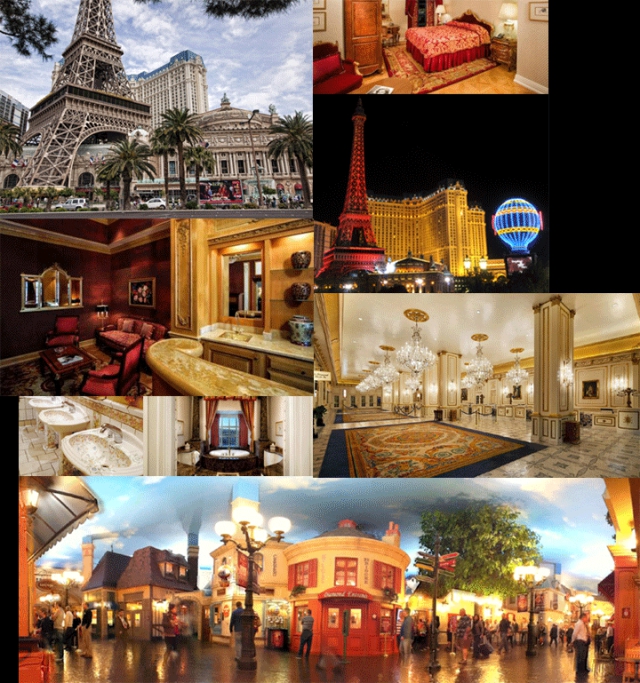
1999's September opening of Paris Las Vegas, by contrast, took its theming a little more seriously, albeit in a somewhat tight footprint that saw architectural features literally piled on top of one another, with half the base of the Eiffel Tower intruding through the ceiling of the casino, whether by necessity or design.
With a façade suggestive of the Paris Opera House and Louvre museum, featuring landmarks including a two-thirds-size version of the Arc de Triomphe and replicas of La Fontaine des Mers (since removed to make way for the now-defunct Sugar Factory American Brasserie) and the famous Montgolfier Balloon (extant, if having seeing much better days), complemented by a chandelier-studded hotel-casino and Rue de la Paix shopping district that today still features "cobbled" streets, those painted skies again, faux gas lamps, and stores with names like "Les Eléments" and "Le Necessities" and restaurants dubbed "Le Village Buffet" and "Les Artistes."
Gimmick-wise, Paris' theming was perhaps taken most to extreme when it came to its staff, who were actually required to take French lessons and greet hotel guests and phone customers who dialed 888/BONJOUR with a spiel of essentially accurate, if also largely ill-comprehended français in the resort's early days (our devilish streak led us to respond in-kind a couple of times, much to the confusion of the person on the other end of the phone).
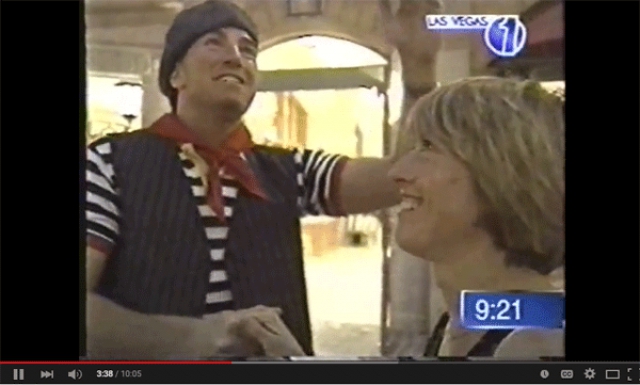
A personal favorite touch, however, was the early fabulous presence of bicycle-riding onion sellers, who sported the cliched striped shirts, cravatte's, and berets straight out of Central Casting, as they randomly wove their way across the casino floor and through the shopping plaza, or delivered a fresh baguette on-demand to a guest room, a service very briefly extended to guests staying at the hotel who suddenly found themselves gripped by the urgent need of a French loaf.
Pre-dating Paris, of course, was neighboring Bally's, the notorious reinvention of the original MGM Grand property that opened in '73 but was then victim to a tragic blaze in 1980 and a few years after reopening, was in 1985 sold to business-like gaming company Bally Technologies, which evidently wasn't in the the "theming' game. The resort's sole "attraction," if you could ever call it that, was the somewhat incongruous "Garden Walkway" out front, with its tunnel-shaped people mover and random color-changing neon tubes that were vaguely reminiscent of a Star Trek set and now stands the equally non-event-of-an-attraction that is the Grand Bazaar Shops, with its Swarovski crystal "sound and light" thingy.
Images appear courtesy: UNLV; KHS$S; Caesars Entertainment; News 1.