On the next leg of our Strip hotel-attraction odyssey, we can gloss pretty quickly over the Flamingo and Imperial Palace, the latter which started life as an adjacent motel that piggybacked on its bigger neighbor's amenities. The style of the Flamingo itself was the vision of original developer Billy Wilkerson, a big player on the L.A. nightlife scene and owner of the Hollywood Reporter, who wanted to recreate the Sunset Strip in Las Vegas but ran out of money.
By the early '50s, Vegas was ditching its old marketing slogan as "the old west in modern splendor" was being sold as the chic place to vacation. Hence, the Flamingo was designed to exude modern European luxury and a hip Hollywood-celebrity vibe -- kind of the Hard Rock/Cosmopolitan/SLS of its day, in contrast to what Wilkerson disparagingly referred to as the "sawdust joint" on Fremont Street.
If Jay Sarno can be credited for the "perpetual night" concept that he introduced to the casino at Caesars Palace, Billy Wilkerson gets props for the complementary policy debuted at the Flamingo, whereby there were no windows and no clocks on the walls of the casino. As to the inspiration for fun, versatile, stylish flamingo-bird motif, while legend has it that Bugsy Siegel named the resort after his girlfriend Virginia Hill, on account of her long skinny legs and red hair, the more accepted wisdom is that it was Wilkerson, with his personal love of exotic birds, who adopted the tall, colorful, leggy species as the logo for his new resort. (As an aside, the Flamingo was begun in 1945 but was still not quite completed when Siegel held the official Grand Opening the following year; it should be noted that the popular pink plastic lawn ornament was not invented until more than a decade later, in 1957, and hence had no bearing on the Las Vegas casino's concept.)
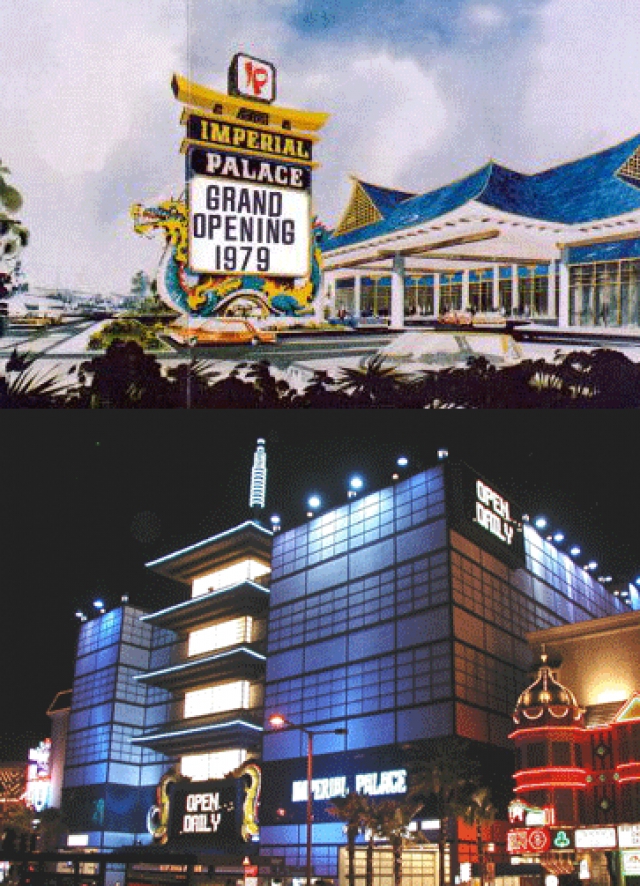
As to the "theming" of the Imperial Palace, history doesn't seem to relate why Ralph Engelstad chose that particular styling for the low-rent mid-Strip property he purchased in 1971, other than perhaps that fact that no one else had yet done 'Oriental.' In reality, the actuality didn't live up to the theming promised in an early brochure for the property (see below) and the IP's identity wasn't much defined beyond some Chinese-inpired lettering and plaster "pagoda" accents. In light of the controversy around Engelstad and his apparent Nazi sympathies and secret Hitler birthday parties, it's probably best to move swiftly past what type of "imperial" vision he may have had him mind...
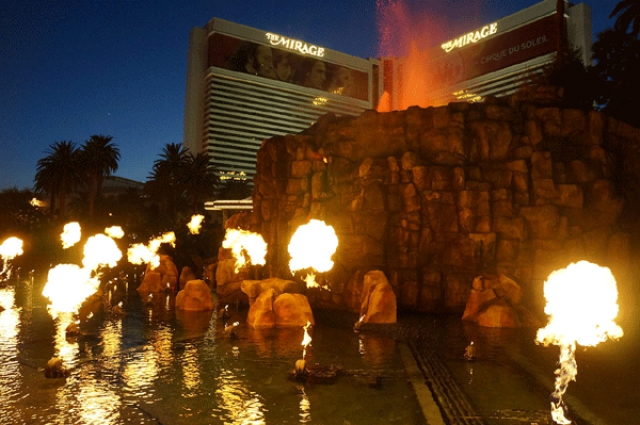
Moving northward, and across the street, we come to the Mirage, the property credited for changing the whole Las Vegas paradigm when it opened in 1989. Located in the township of Paradise, Nevada, it was a tropical, vaguely Polynesian theme that Steve Wynn chose for his flagship Strip resort, a vibe evoked at every opportunity, from the lush "rain forest" foliage and palm trees to be found in the public areas, to the signature tropical scent pumped out through the air-conditioning system, to the exotic animal habitats featured among the new resort's multiple attractions.
The most iconic of these, of course, was the volcano out front, which raised the bar for what an attraction could or should be in the context of Las Vegas. "Risk and being new was not on anybody’s radar," recalled operations chief Bobby Baldwin in an interview with VEGAS Seven."The Mirage was as foreign to that environment in the mid-1980s as was Jay Sarno in the early 1960s with his concept for Caesars Palace." As Wynn himself describes, "Designing The Mirage took one year of R & D and three years of further development. Nothing was conceived in one brilliant stroke. It was done an inch at a time, step by step. If every idea we explored was reduced to paper, it would fill a warehouse."
By 2006, the once-pioneering nightly eruptions on the Strip were beginning to look a little tired and underwhelming, not least when compared to sister-resort attractions like Bellagio's fountains, so the volcano received a massive makeover and remodel, with the introduction of taller explosions, more fireballs, and a driving new soundtrack composed by The Grateful Dead’s Mickey Hart and Indian tabla sensation Zakir Hussain.
While Mirage's non-specific "tropical" theme has proved generic and timeless enough to endure, the kitsch level introduced by successor Treasure Island proved not quite as evergreen. To quote an interview for Elle Decor with Steve Wynn's long-time designer Roger Thomas, who's the co-visionary behind Mirage, Bellagio, Wynn/Encore, and TI, "We don't do theme design at Wynn, not since we learned our lesson at Treasure Island. We thought it would be great fun to design a pirate village with sinking ships and pyrotechnics. The day after it opened, we all looked at each other and said, 'What have we done? This is so not us.'"
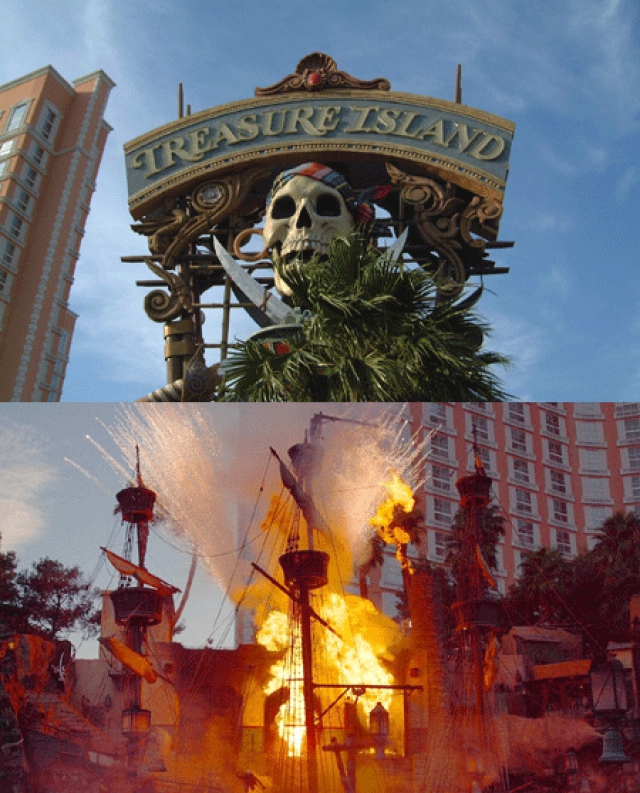
What they 'had done' was expand Wynn's original concept of an additional hotel tower for the Mirage into a fully-fledged stand-alone resort with an immersive pirate theme, from the skull-and-crossbones marquee, to the cliched treasure chests, parrots, and "pieces of eight" scattered through the interior design, to the pirate battles staged nightly in "Buccaneer Bay" in front of the casino entrance on the Strip. "At the time, we tried to think about what we could do that would enhance the Strip, that would be really exciting for us as well for our patrons. It just felt good. All of a sudden, we started talking like pirates, and Steve [Wynn] described the scenario, as only he can do, going through all of the voices of the various characters," recalls Wynn architect Joel Bergman.
From opening, Treasure Island offered a free show nightly every 90 minutes in the man-made Buccaneer Lake out front, with a cast of 30 stuntmen and actors enacting the showdown between HMS Britannia and the pirates from the Hispañiola. By 1999 the pirate battle had been witnessed by more than 16 million people.
Still, by the early 2000s the whole family-friendly experiment had been abandoned and the kitschy pirate theme was considered long past its sell-by date. Hence, yet another "de-theming" program got underway, with an attempt to rebrand the resort as "TI" with a new swashbuckling-free modern video marquee. In 2003 the the pirate battle was transformed into the "sexy" Sirens of TI show -- another misstep that had patrons calling for the return of the campy old High Seas showdown. The new show closed in 2013, after lasting a surprising decade in its new incarnation, to make way for a shopping mall concept that so far has delivered nothing more remarkable to the Strip than another CVS pharmacy.
In fact, much as for a time the overly themed properties like Luxor, Excalibur, and Treasure Island were perceived as vestiges of an embarrassing past era, like those overdressed, overly-loud relatives who invariably show up to make you look bad at family events, but there quickly followed a nostalgia backlash, with many visitors (among our readers, at least) bemoaning the "blanding" of Las Vegas and mourning the passing of the adult-Disney era, when no one took everything quite so seriously and Las Vegas was all about escapism. (The Pirate/Sirens show was runner up in a 2004 Reader Poll we ran about Las Vegas' disappearing attractions, second only to the MGM Grand's lions.)