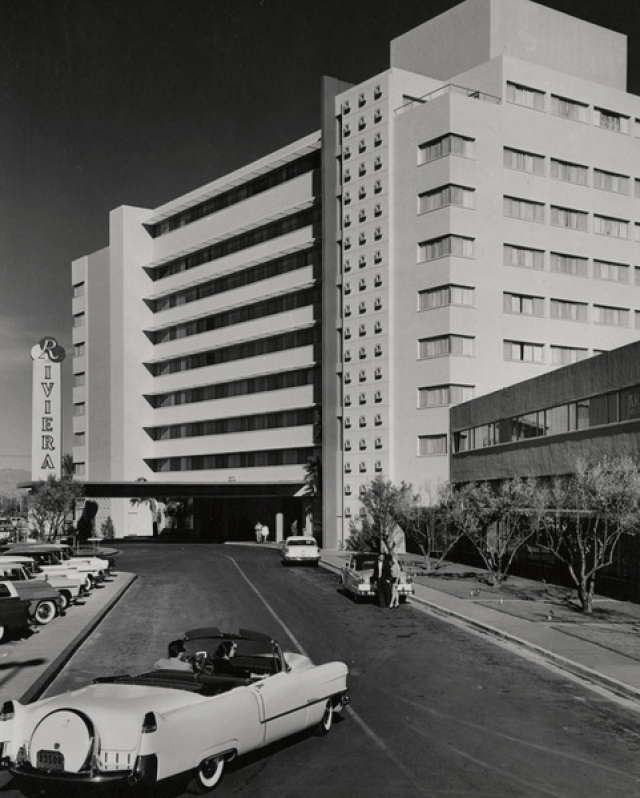
When the Riviera opened on April 20, 1955, the biggest innovation it introduced to the Las Vegas Strip was the presence of a high-rise hotel tower which, with its nine floors of guest rooms, marked a significant departure from the low-rise, two-story, garden-style motel rooms that had typified Las Vegas accommodation since the early '40s.
If there was any "theme" informing the design, it was "South Beach meets French Riviera," with interiors that allegedly aimed to be modern and chic, while bringing to mind the palace of Fontainebleau, with their imported Italian marble and corrugated cooper fixtures (another example of how evidently there's nothing much "new" in Las Vegas' repertoire these days -- who knew there had already been a resort identity inspired by the famous French château?). The various floors of what was originally to have been named the Casa Blanca were named after French resort cities, including Cannes, Monaco, and Nice, and were reached via the Strip's first elevator, off the largest hotel lobby in town.
As far as attractions were concerned, there were no gimmicks at the Riv, just a line-up of top entertainers who packed the showroom, beginning with Liberace on opening night, and over the years including a string of big names, including: Dean Martin; Shecky Greene; Bob Hope; Frank Sinatra; Barbra Streisand; Elvis; Louis Armstrong; Joan Rivers; George Carlin; Phyllis Diller; Don Rickles; The Beach Boys; Steve Martin; Liza Minelli; Betty Grable, and Charo; to name just a few.
The Stardust, by contrast, which opened three years later on July 2, 1958, was all about theming and attractions. To quote a recent "Question of the Day" regarding the hotel's signage (see QoD Archives 5/4/15):
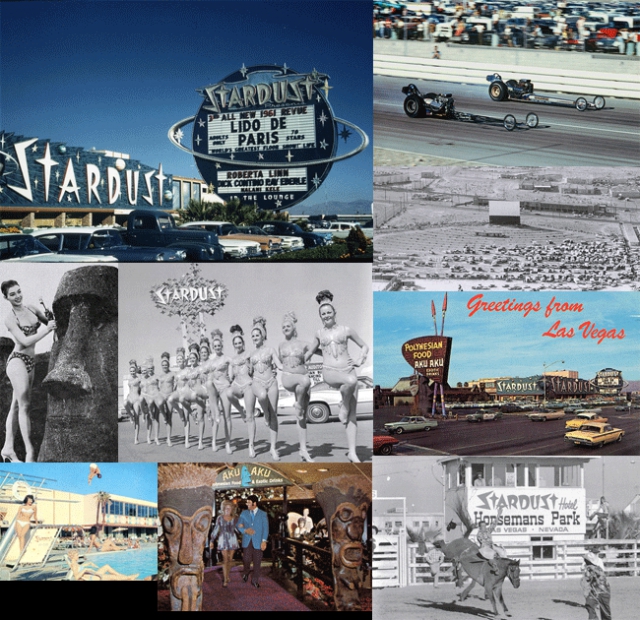
When the Stardust debuted on July 2, 1958, it was with an 'outer space' theme befitting the Atomic Age and the general fascination at the time with all things cosmic. There's debate about whether the concept for the outer signage should be credited to Moe Dalitz (as he claimed) or to Tony Cornero (who died shooting craps at the Desert Inn, just before the resort was originally slated to open, on July 13, 1955), but the actual finished design can be attributed with certainty to Kermit Wayne of the Young Electric Sign Company, who was responsible for both the original façade and roadside signs.
The name of the property was emblazoned across the front, twice, in spiky Electra-jag Googie-style lettering, and incorporated a panoramic view of the solar system, with a 16-foot plastic model of Earth at its center. At 216 feet long and 37 feet high, it was at that time the world's largest electric sign. As Wikipedia describes it, "cosmic rays of neon and electric light bulbs beamed from behind the model Earth in all directions. Three-dimensional acrylic glass planets spun alongside 20 scintillating neon starbursts. Across the universe was a jagged galaxy of electric lettering spelling out 'Stardust'. The sign utilized 7,100 feet of neon tubing with over 11,000 bulbs along its 216-foot front. The 'S' alone contained 975 lamps." At night, it was said to be visible from 60 miles away.
The free-standing roadside marquee that complemented this was also impressive, comprising a huge disc, circled by an 'orbit' ring, with the hotel name in the same funky font, all covered in dancing stars and glittering cosmic dust. And so it remained until 1965.
What Tony Cornero envisioned for what he originally he planned to call the "Starlight," was a giant casino that didn't cater to high rollers or the sophisticated clientele wooed by other Strip resorts, but instead was aimed truly at "regular joes who were loading up their Chevys and taking the family on vacation," to quote the "Classic Las Vegas" blog. Apparently, the Stardust was doing "family-friendly" decades before the Mirage volcano or MGM Grand Adventure Park had even been dreamed of.
Speaking of volcanoes, it turns out there's nothing new there, either: The 1965 version of of the Lido de Paris topless revue, which debuted with the resort and was the largest production ever to have graced the Strip at that time, featured a live chariot race, a locomotive crashing into an automobile, and the eruption of Mt. Vesuvius, complete with molten lava.
But this was just the tip of the entertainment iceberg (no pun intended, but at this juncture we'll point out that Lido creator Donn Arden debuted his famous "sinking of the Titanic" sketch at the Stardust, many years before it became incorporated into his Jubilee! spectacular at Bally's, while the inaugural Lido de Paris production featured a fireworks display from the top of a replica of the Eiffel Tower... But we digress.)
The defunct Motor Vu theater out back was renamed the Stardust Drive-In and opened on March 20, 1959 showing Disney's The Shaggy Dog. It would close nine years later in December 1968, with a fitting triple bill of gangster movies, including The Scarface Mob, Young Dillinger and Pretty Boy Floyd.
Located immediately north of the Drive-In was Horseman's Park, a rodeo arena that featured bleachers, 300 stalls, corrals, a lighting system, and a judging stand. The facility hosted rodeo and horse-riding events until 1972, when the land was appropriated to expand the hotels' "Camperland" parking; the fixtures apparently were donated to Dixie College in St. George, Utah.
Another attraction was The Stardust International Raceway, located off-property (like the golf course) in what is now Spring Valley Township, in an area between Tropicana Avenue and Flamingo Road and bordered by Rainbow and Piedmont Boulevards. Designed to be a "pull" for jet-setting high rollers, the facility debuted on October 21, 1965, and featured a flat, 3-mile, 13-turn road course and a quarter-mile drag strip, placing it among what were considered the elite "supertracks" of the time.
Although it never hosted a major drag race, the track did welcome some of the greats, including "Big Daddy" Don Garlits and Jim Dunn, while in its capacity as home to the Can-Am championship finale and the USAC Champ Cars, it would see the likes of of A.J. Foyt, Mario Andretti, Parnelli Jones, and Bobby Unser competing on the road course. But it failed to make money and by 1969 had been abandoned by the hotel. It was briefly leased as a going concern to the track manager, but in the early '70s the land was sold to a real estate developer who constructed the Spring Valley residential development on the site of the former race track.
Some other significant boasts at opening time included the fact that the Stardust had the largest private telephone switchboard in Nevada, no doubt necessary to service its 1,032 rooms, regarded as a world record at the time. At 105 feet long, it had the largest swimming pool, not to mention the largest casino (16,000 square feet), which in turn is credited with introducing keno to the Strip.
With the dawn of the 1960s, the Stardust hopped on the South Pacific bandwagon and the contemporary love of all things Polynesian, by debuting in January 1960 what would become a cult favorite among tourists and locals alike, Aku-Aku Restaurant. Located between the Stardust and the old Royal Nevada, this homage to island culture cost $620,000 to build and decorate (according to menu, the "primitive art carvings" were the work of a member of the Honolulu Art Academy, who faithfully copied them from originals on Easter Island and New Guinea) while outside, in a classic instance of Strip-style cultural juxtaposition, a neon-rimmed shield-and-giant-arrows sign was added to the existing cosmic marquee presentation, along with the giant moai head (later copied by the Tropicana, see QoD 5/29/2015) that now resides in Sunset Park (see QoD 9/5/2013). Only in Vegas.
Still, if the Stardust entered enthusiastically into the "theming" game, its efforts would pale into insignificance next to neighboring Circus Circus, which opened on October 18, 1968.
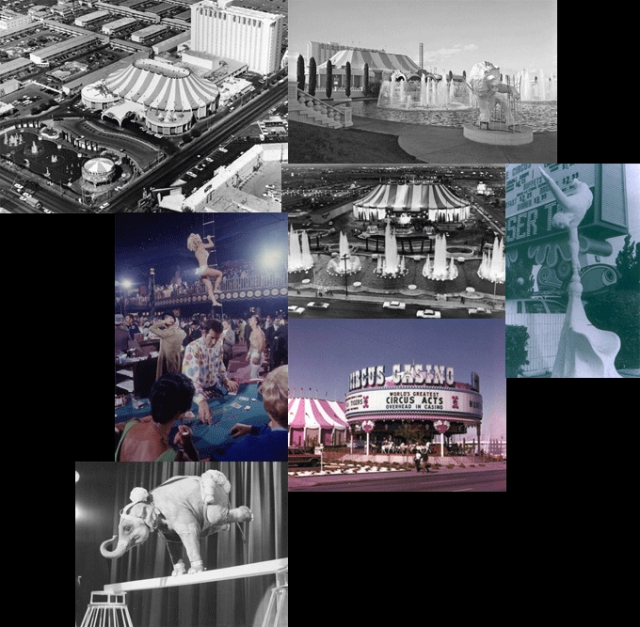
The dream of Jay Sarno was to build the world's largest Big Top, to which end he hired architects Rissman and Rissman Associates, who duly designed a giant circus tent-shaped main structure, a plan that was then brought to fruition by R.C. Johnson Construction of Las Vegas.
At its opening, the $15 million facility featured a water-fountain feature out front which, at 306 feet long, was the world's largest (naturally), while the casino was larger than a football field. The era of Las Vegas-resort hyperbole had truly begun. As to the theming, a member of the design team, who'd previously worked on Caesars Palace with Sarno, summed up their ethos by describing how, "I believe very strongly that when you select a theme for a hotel, you ought to follow that theme in every aspect of the operation where it is possible to do so." With its giant pink-and-white tent exterior, novel carnival midway, trapeze acts overhead, live "flying" pink elephant, a bar built into a merry-go-round, and a casino floor that could be accessed via a slide or a fireman's pole (in addition to more conventional means), Circus Circus was definitely a realization of that philosophy. Sarno was so proud of the entertainment and attractions on offer that initially he actually charged patrons a nominal entry fee, a policy that totally flew in the face of the prevailing wisdom and which was soon dropped in light of customer complaints.
Still, while this novel themed property definitely had its eye on the family-vacation crowd, Sarno did not abandon the adult side of Sin City entertainment, and other opening attractions included peepshows and a "knock-the-girl-out-of-bed" game, both of which featured topless women. During 1969, a new 750 seat Hippodrome showroom opened with Nudes in the Night, starring the curvaceous 25-year-old Babette Bardot, who stated, "I am the highest-paid dancer in America. I studied ballet, which helps. I used to earn $250 a week, but not I get $2,500 a week. I have played before a record 18,000 people in Chicago. I do a very different act. I sing--I love singing--and my act is 45 minutes. Only the last 10 are stripping." During the day, the theater displayed the family-friendly Dancing Waters spectacle, made famous by Radio City Music Hall (the cover was 75 cents, with children under 12 admitted free when accompanied by an adult).
In March of 1969, Circus Circus advertised that it featured 700 musical slots, 14 bars and restaurants, family-priced buffet meals, $.25 food specials, Big Top trapeze acts, shows, clowns, games, and prizes. The only notable thing it didn't offer was a hotel, because Sarno had run out of money, and it would prove to be a major impediment to the resort's commercial viability. Before the end of '69, Sarno was obliged to step down and hand over casino operations to one of his executives. Loans from the Teamsters Union financed the building of the first hotel tower, which debuted in 1972 and featured an authentic Japanese bath, where trained Geisha girls pampered guests with aromatic soaps, prior to guiding them to a steam bath and cool plunge pool.
With Sarno mainly out of the picture, the early '70s saw other changes at the property, with the removal of some of the carnival games and a new focus on attracting gamblers. In mid-'73, both the Hippodrome Theater and the Gilded Cage Lounge were removed in order to make way for the new Circus Circus buffet. And, while Circus Circus certainly retains something of Sarno's original vision to this day, the process of down-playing the carnival dimension of the property has continued ever since, culminating in the 2006 removal of a suite of five statues commissioned by Sarno from local artist and worldwide circus performer Montyne, which had resided in front of the property since opening.
The best-known of these statues, of an acrobat balancing on a single finger (see image below), was a self-portrait, while another, of a young female acrobat gracefully balancing on a board, atop a cylinder, was modeled after Montyne's wife and theatrical assistant, China. Also removed were the statue of Gargantua, the "World's Largest Gorilla," and one of a male lion. Today, only the clown remains; the others, instead of being returned to Montyne's family, as Sarno had agreed contractually in the event of their removal, were dumped unceremoniously in a Las Vegas landfill (where they likely joined part of the original Stardust sign, among countless other items of vintage Vegas memorabilia). According to an official spokesperson at the time, they were removed "because they were very old and had been painted over many times. They had deteriorated to the point that the statues no longer represented what we thought was the great Montyne's original vision when he created them in the 1960s."
Images appear courtesy of Las Vegas News Bureau; UNLV Special Collections; Ernie Ohlson; Dragzine.com; HeritagePreservation.org; and Museum of Gaming History.