After a brief hiatus yesterday to accommodate the new LVA Reader Poll, we return for what was to be the final leg of our Strip-resort history, highlighting opening attractions and what became of them. This will still be the final installment hotel-wise, but an unexpected discovery has obliged us to deliver just one more episode, which will feature three attractions that were added to a major Strip property. That's all we're prepared to divulge for now, but trust us, our find definitely merits one more QoD on this subject (inspired by one of the follow-up QoD queries we received on the back of this epic series). In the meantime, here's what was to have been the concluding part.
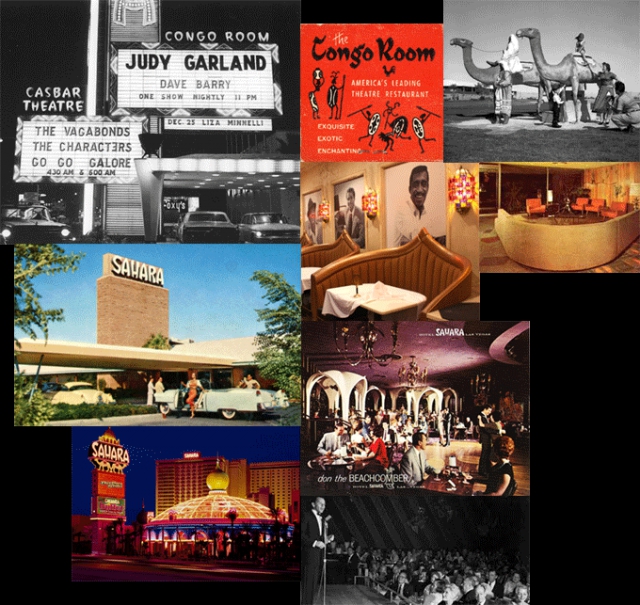
When the Sahara opened on October 7, 1952, on the site of the former Club Bingo, its theme was North African -- "The Jewel of the Desert" as owner Milton Prell described the property. Still, the theming was of the cheesy (and decidedly politically incorrect) variety, with plastic model camels and riders forming a nomadic caravan on the lawn outside, and other camels and miscellaneous Arabs lounging around the interior, not to mention the life-size models of African warriors, spears in hand, flanking the entrance to the famed Congo Room. Aside from these ethnic embellishments, the exotic font used for the hotel logo, the "eastern" styling of venues like the House of Lords and Don the Beachcomber restaurants, and the plants and murals that bestowed a lush "desert oasis" feel on the showroom, however, the Sahara was basically just another two-story chip off the same Googie-style block as the Thunderbird and Desert Inn, with its de rigueur manicured lawns and Olympic-sized pool.
Just like the Riviera, it wasn't gimmicks but Hollywood glitz that the Sahara really wanted to be known for. "Our goal is now to make the name 'Hotel Sahara' synonymous with everything that is unsurpassed in the finest hotel luxury," stated Prell, and his property soon became the top celebrity hangout, with hotel guests who included The Beatles, Sinatra, Steve Allen, Elvis, Marty and Frenchy Allen, Telly Savalas, and Sonny and Cher. It was the Sahara, with acts like Louie Prima, Keely Smith, and Sam Butera and the Witnesses, that's credited with revolutionizing the Las Vegas lounge scene in the mid-1950s. As Classic Las Vegas" recalls, "The Casbar Lounge was the jumpingest place in town and everyone from Frank Sinatra to Judy Garland was in the audience" for this non-stop party. Performer Sonny King recalls in Mike Weatherford's Cult Vegas how "In the corner they had a barbecue pit. You'd eat sausages and peppers on Italian bread, steak sandwiches -- in the lounge. I think the fire marshals came in and took it out."
So much for the Sahara, whose iconic neon Moroccan dome-styled porte-cochère was a $4.6 million, 140-foot high 1997 addition, along with the tiled entryway arches, Moroccan art and fabric canopies, and exotic jeweled chandeliers that gave the old joint one final facelift. We continue our journey northward to the final stop on the Las Vegas Strip, where the tallest observation tower in the United States, the Stratosphere Hotel and Casino, debuted a year prior to the Sahara's upgrade, on April 30, 1996.
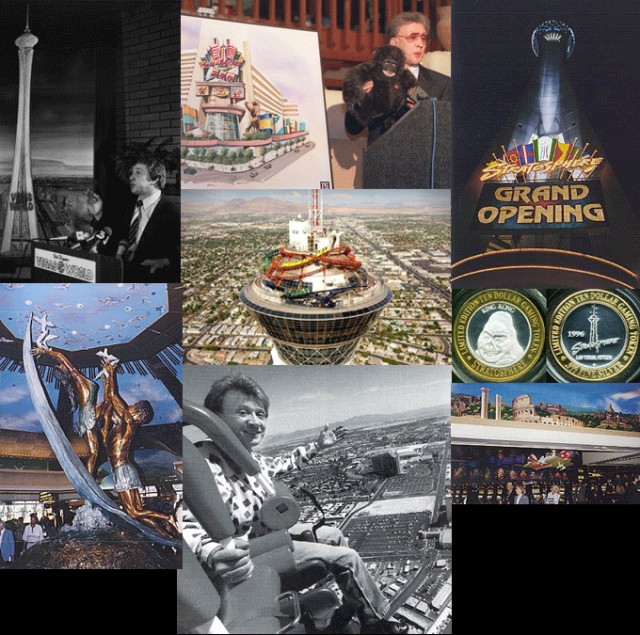
Standing at a height of 1,149 feet (Stupak had dreamed of a 1,800-foot tower, but the FAA had other ideas), with its observation deck offering panoramic views of the Las Vegas Valley, Bob Stupak's tower was an attraction in its own right. The self-styled Polish Maverick was never one to do things by halves, however: One of his original entertainment concepts was for a ride in the form of a giant ape that would carry riders up and down on one of the tower's columns, à la King Kong, only inside a viewing compartment in its belly. The $6 million, 70-foot-tall Belly of the Beast ride never came to fruition, however, although evidently the plan was abandoned after they'd already minted some "King Kong" Silver Strikes (see image gallery).
In the end, the first two rides offered by the Stratosphere Tower were the pneumatically powered Space Shot (now known as the Big Shot) and the High Roller roller coaster, which opened April 29, 1996 and was the highest roller coaster in the world, when compared to the surrounding terrain. The latter never proved as popular with the public, however, and when a half-million dollar refurbishment became due at the end of 2005, it was considered an opportune time to close and dismantle the attraction, which wound up in the collection of local memorabilia collector/junk hoarder Dr Lonnie Hammargren, which is generally open to the public to visit each Nevada Day (October 31). Hammargren was Lieutenant Governor at the time of the Strat's opening night, and happily piled on the hyperbole, declaring: "This tower will be the symbol of Las Vegas for all time. What Howard Hughes didn't do, Bob Stupak has finished off." More than 18,000 people per day ascended the tower during its first week.
On the lower level of the observation deck was the Top of the World rotating restaurant, which is still going strong to this day, while the casino was divided into three distinct themed zones, like the World's Fairs. The "Pavilion of Fun" was filled with whimsical cartoon figures of characters like circus strong men superhero types, scattered among the tops of the banks of slot machines. The "Pavilion of Imagination," by contrast, was represented by an incongruous statue of two young fairies cavorting on a sliver of a moon (apparently someone soon had the good sense to move it out of sight), while the "Pavilion of the World" featured a ceiling-level mural of notable architectural wonders from around the world, like the Colosseum of Rome and the rooftops of notable European cities.
While the opening night was well attended and featured a spectacular fireworks display, the resort had already been plagued with problems, including a construction fire that delayed the opening of a second hotel tower, plus additional delays with the opening of retail-tenant outlets, and a reluctance among the general public to fork over the high prices charged by the attractions and restaurants. Losing money hand over fist, the Stratosphere filed for bankruptcy in January of 1997, amid countless lawsuits.
The following August, financier Carl Icahn gained preliminary state approval to become the majority shareholder in the property for 50.04% of stock, with the promise of up to $100 million in investment to complete the hotel rooms and tower and build a swimming pool and a race and sports book. "As you know, I buy things when nobody wants them and in the case of the Stratosphere, nobody wanted it so we were there," he would later observe.
Images courtesy of: George Johnson/Santa Fe Review; UNLV Special Collections, Las Vegas News Bureau; Stratosphere Casino, Hotel & Tower; Las Vegas Review-Journal; and Steve Miller