Yes you can -- right here, right now! (You think QoD would lie to you? Never!) One of them -- the more tangential of the two -- may have been so indirectly related that you failed to notice the association, but it was about the killing of Tupac Shakur, which coincidentally took place right outside the Maxim (see QoD 8/24/15).
Today we'll supply the final (as far as we know...) in the series of Maxim-related QoDs, with the story the other Las Vegas' Maxim casino -- the one that never was.
While the original Maxim on E. Flamingo opened in 1977, almost two decades before the 1995 launch of the international men's magazine, the latter at one point entered into negotiations with what was then the Harrah's Corporation (now Caesars Ent.) to bring the Maxim brand to Las Vegas in a manner not dissimilar to Playboy's dalliance with the Palms, although without creating a dedicated physical space.
It was back in October 2001 when both local media and the Wall Street Journal reported in that the notorious British-founded "lad mag" (by that point based out of New York) was in talks with Harrah's to bring a series of Maxim-themed parties to the Rio under the Maxim Lounge brand. As the WSJ reported at the time, these events were conceived with the intention "to draw New York hipsters, Hollywood celebrities and gamblers that want to be around them," while the LV Sun observed that, "Unlike competitors Esquire and GQ -- which include serious stories on social, business and political issues -- Maxim focuses on sex, adventure, and partying and publishes lots of photos of barely clad women." The once hip-and-popular off-Strip Rio had lost its cache with the "in" crowd, who since the purchase by Harrah's had relocated their patronage to the Hard Rock and Mandalay Bay, so this was evidently some desperate bid to get back on the "cool" map.
The Las Vegas Business Wire reported the following month that the first of these events had been scheduled for November 17, and would be an invitation-only affair hosted by the Palazzo Suites high roller villa located at the back of the Rio. The Maxim Lounge party was planned to coincide with the Hasim Rahman-Lennox Lewis heavyweight title fight, expected to draw a host of entertainers and other celebrities to Las Vegas as big fights tend to do, and apparently additional festivities were being planned around this event for Maxim Lounge party attendees.
Since it was slated to be an entirely private affair, we cannot confirm whether or not the inaugural "Maxim Lounge" event actually took place or not, but this was the last mention we could find of the whole idea, so evidently it didn't pan out as hoped.
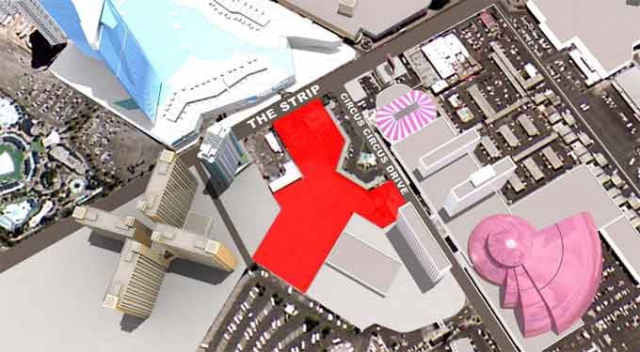
However, fast forward to the summer of 2006 and the names "Maxim" and "Las Vegas" were again appearing next to each other in print headlines, this time on the back of stories that the magazine entity was planning to lend its moniker and brand to a full-on $1.2 billion, 2,000-roomed Maxim-themed resort-casino on the Las Vegas Strip, close to Circus Circus (see image below), and featuring a 60,000-square-foot casino, high-end retail outlets, a full complement of the by then de rigueur "celebrity" chefs, some hip nightlife venues, and both indoor and outdoor concert spaces, to be run in conjunction with Dennis Publishing's music-magazine brand, Blender.
It all sounded like a serious project, with real estate developer Concord Wilshire apparently paying Dennis Publishing an "upfront fee in the middle seven figures," according the the New York Times, with an agreement that the latter would continue to receive an annual licensing fee, plus a cut from non-casino revenue and exclusive control over any stylistic/aesthetic considerations, including the "choice of architect, the décor of the rooms, or the thread count of the bed linen." Concord Wilshire had already purchased an eight-acre plot to the north of the Stardust for somewhere between $74 million and $95 million (accounts differ) and at the time all parties sounded pretty gung-ho about the project, with only the niggling issue of a gaming license/licensed casino-operating partner left to contend with. The plan was for the resort to be open by 2010.
That matter of a gaming license, together with the impending onset of the Great Recession, may have been enough to nix this project, not least since Corcord Wilshire CEO and former stock market trader Steve Sirang had in 1988 been convicted in federal court of seven counts of bank and wire fraud -- convictions upheld by a federal appeals court in 1995 and for which Sirang was ordered to pay $1.4 million in restitution and spend a year in prison (whether or not any time was served remains unclear). Even given the fact that Sirang would not be directly involved in casino operations, such a dark blot on his past was taken very seriously by the Gaming Control Board, which stated that a background investigation would likely still be required, given the existence of a criminal conviction. As to the naming of the property, a spokesman for Dennis Publishing felt that "enough time has passed so there wouldn't be any confusion" between this new property and the former Maxim on E. Flamingo, which by that point was known as the Westin Casuarina.
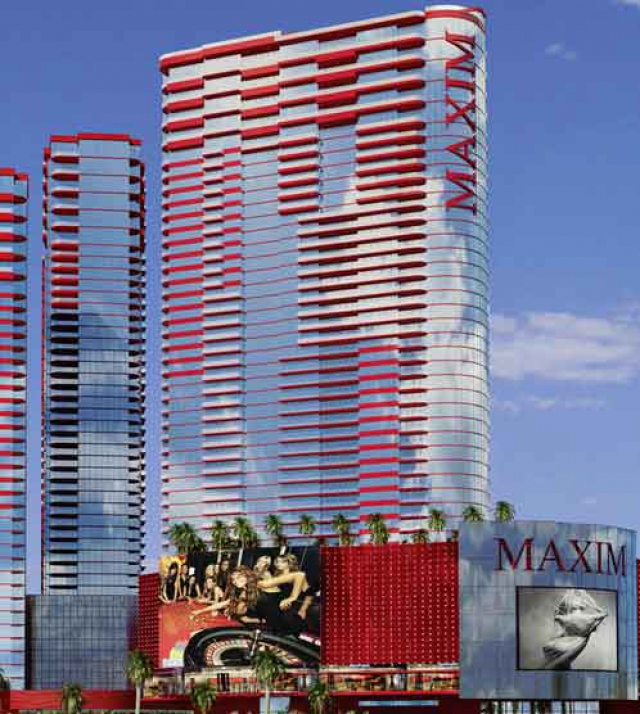
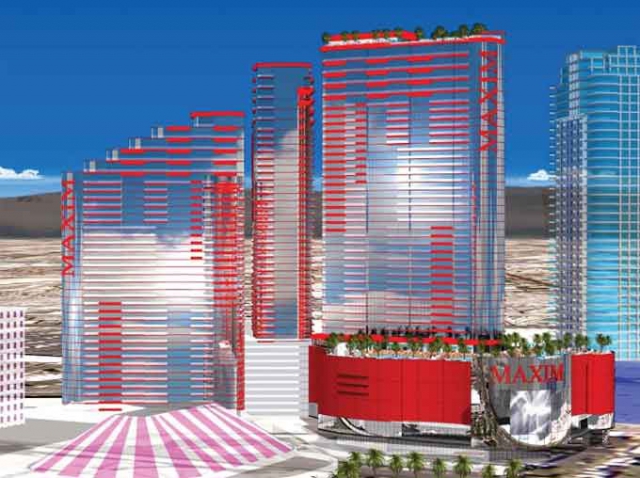
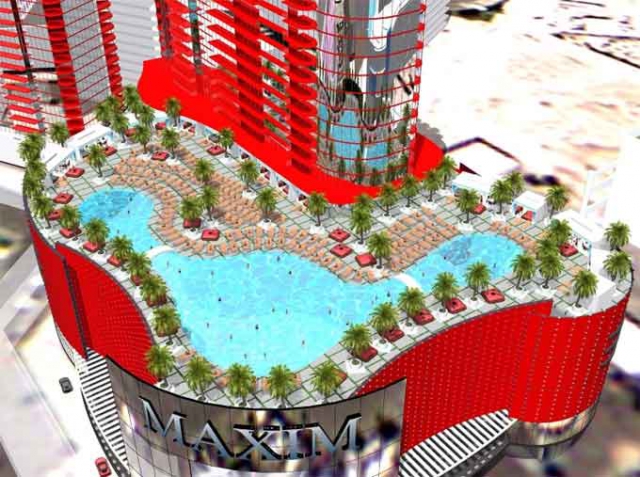
Whatever the ultimate reason(s) may have been -- and we also gather that condo owners in Turnberry Place and nearby Allure complained that the proposed structure would block their view -- the Maxim Hotel & Casino got as far as existing in a series of ambitious artist's renditions (see below), and in obtaining the relevant Clark County usage permits for the site, but no further; in April 2007 the Las Vegas Review-Journal reported that the 7.6-acre parcel purchased in order to house the project had been sold to MGM Mirage for $131 million. At the same time the corporation purchased an additional 25.8 acres, for $444 million, from Gordon Gaming Corp., giving MGM Mirage 100 contiguous acres at the north end of the Strip -- land which to date has seen no further development beyond its temporary kitting out to host the Rock in Rio music festival last May.