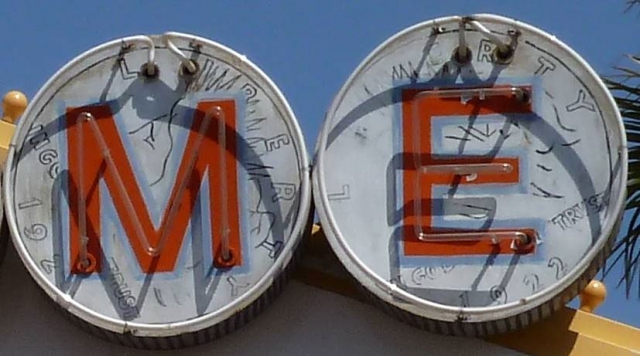
Why is the year 1922 used on the coins represented in the "welcome" letters on the famous "Welcome to Fabulous Las Vegas" sign?
This is a detail few people other than the most observant might notice, the numbers being faintly visible at the bottom of the "Welcome" letters. The backdrop corresponds to the "Peace" silver dollar that was in circulation in 1922 and coined until 1935. However, the "Welcome" sign wasn't built until 1959 and the primary significance of 1922 in Vegas history was a railroad strike that shut the city down, so the choice of imagery is somewhat mysterious. (The Union Pacific got back at the workers by closing its Las Vegas machine shops, so 1922 hardly seems a landmark year worthy of celebrating.)
"Nobody seems to know" why the 1922 dollar was chosen, says University of Nevada-Las Vegas history professor Michael Green, "and the general conclusion (I believe Mark Hall-Patton [museum administrator for Clark County] has suggested this, too) is that sign-designer Betty Willis (who sadly passed away last April, at the grand old age of 91), wanted silver dollars to represent the Silver State, and that those happened to be the ones around and in circulation at the time." It was also the last silver dollar ever circulated, mainly in the West, thereby holding some significance for Nevada, the Silver State.
There was an abortive effort to bring back the "Peace" dollar in 1964, partly to contain the inflationary effect of the hoarding of silver dollars (which had also been illegally defaced by casinos by scratching off the original minted date in an attempt to ward off coin collectors). Nevada casinos are also credited with creating new demand for the dollar, due to their need for "hard money." Although 316,076 were struck, however, all were melted without going into circulation, due to the fact that coin dealers were already speculating in silver dollars, offering up to $7.50 apiece.
Patton-Hall utters a hearty guffaw when asked about the silver dollars, then says, "The [1922] date's not significant but the dollar is used because that's what we used as a chip here [prior to the introduction of plastic gaming tokens]. They were supposed to evoke an image of good luck. It meant you were going to be lucky in Las Vegas."
The "Welcome" sign was erected at the time when Las Vegas Boulevard was still U.S. 91 and the Strip ended several blocks northward, at the one-story Hacienda hotel-casino. The sign owes its placement to being opposite the stone-pillared entrance to McCarran International Airport, at that time the main entryway to the airfield. Its eye-catching sight is an example of what was then known as Exaggerated Modern/Googie design, as practiced by Betty Willis, creator of the Moulin Rouge marquee. ("Googie" refers to visually influential Googie's coffeeshop, on Sunset Boulevard, a celebrity hangout frequented by buddies James Dean and Vampira, among others.) "I added a Disney star for happiness," Willis said. The sign was built by Western Neon and subsequently purchased by Young Electric Sign Co.
In an application (accepted) to put the sign on the National Register of Historic Places, the authors wrote that it was an expression of Fifties Las Vegas, "as it established itself as a nationally and internationally important center of gambling-related tourism … While so much of that period was demolished to make way for larger development, and the Strip itself has repeatedly transformed over the years, the 'Welcome' sign remains unchanged as a symbol of one of the more dynamic stories in the history of entertainment and tourism in the nation." As the report concludes, the sign "is one of the few things that be counted on to remain in place after 50 years" (assuming it does stay in that same spot, which is considerably farther south than the site on which it was originally installed, much closer to where SLS currently sits).