We resume our Who's Who -- and who knew who -- study of Las Vegas casino magnates, picking up where we left off yesterday, which was with Steve Wynn's relationship/interaction with Benny Binion and family.
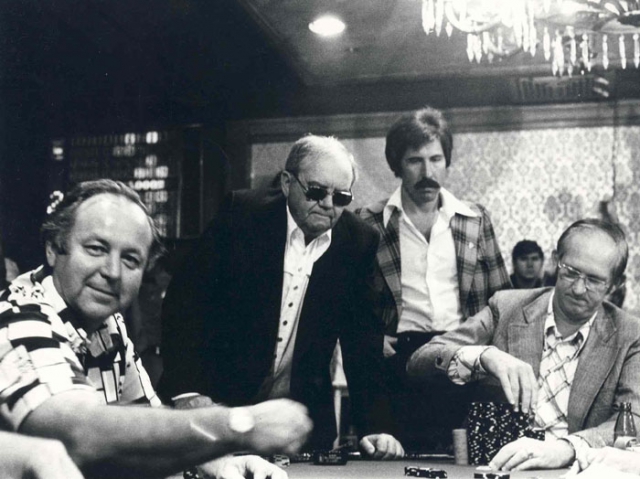
Steve Wynn is the son of a gambling man and grew up around that world, and he's not averse to the odd wager today: When Downtown Grand debuted in 2013, Wynn was there on opening night to support his old buddy Seth Schorr and the two of them blew a few grand having fun on at the crap tables together. But while these days Wynn's presence on the other side of the gaming tables is a rarity, back in his Golden Nugget days he was a regular at the poker tables and not only supported and promoted the game of poker, but even played in some of the earliest World Series of Poker events (hence his portrait being among those Hall of Fame pictures on display at the Binion's today).
It's primarily through the game of poker that the remaining names on yesterday's list came to cross paths although, as we prefaced yesterday's answer, Las Vegas was still a pretty small town back in the era we're discussing and there was one particular specialist store, named the Gambler's Book Club (now GBC), whose website proudly boasts how "anyone who was or is anyone in the gambling world has passed through the doors of the GBC ... Ex-mobsters, FBI agents, and law enforcement personnel regularly shop at Gambler's Book Club, as well as casino owners such as Steve Wynn, Jackie Gaughan, Bob Stupak, Carl Icahn, and Jack Binion, who have patronized the store." So, you just never know how or where some paths may have crossed unexpectedly...
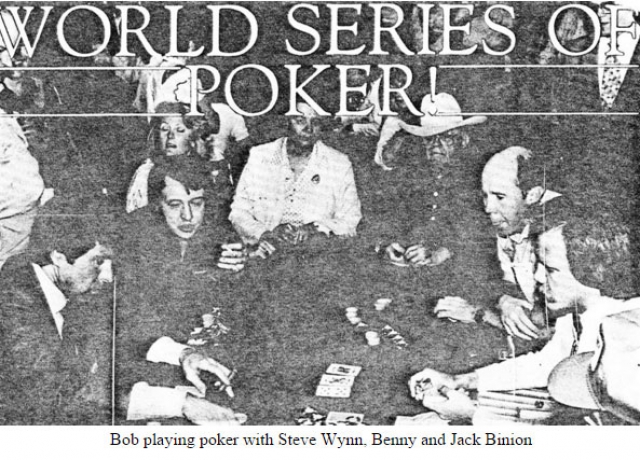
But returning to the world of poker, a couple of years back long-time WSOP media director Nolan Dalla posted a series of stories about Binion's Horseshoe on his blog. One was centered on an incident involving 1982 WSOP champ and legendary bluffer Jack Straus, but the preamble to the anecdote sets the scene we're interested in, by relating how, "This was sometime in the mid-1980s. There was a big no-limit game going on. A couple of million on the table. Among the players, in addition to Straus, were Jack Binion, Steve Wynn, Sarge Ferris, and Bob Stupak." Wow!
By this juncture, Stupak had already had a presence on Fremont Street -- but on the other side of the tables -- thanks to his 1974 purchase of a grind joint called the Sinabar, which he renamed The Vault. Then, when the insurers finally agreed to a $300,000 payout following the destruction of Stupak's Million Dollar Historic Gambling Museum (the misleading name of his casino) in a suspicious fire, Stupak sold The Vault and used his newly acquired funds to first buy the lease on Fremont Street's Glitter Gulch strip club, and then purchase it outright from owners Jackie Gaughan and Mel Exber, renaming it (of course) Bob Stupak's Glitter Gulch.
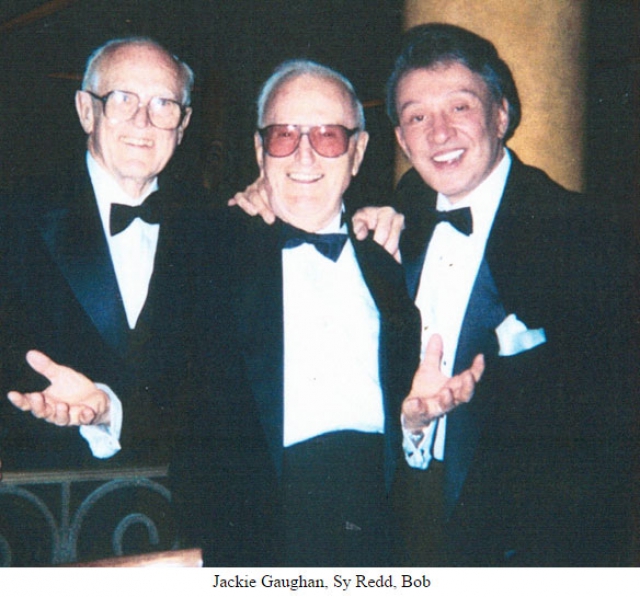
Whether this business transaction was how Bob Stupak and Jackie Gaughan first became acquainted, we can't say, but a few years later in 1984, when the former took on ORAC, a poker-playing computer programmed by well-known professional player and author Mike Caro, it was Jackie Gaughan who staked the computer to the tune of $500,000. Stupak won. And just like Steve Wynn, Bob Stupak evidently had much respect for Gaughan. As John L Smith relates in No Limit, his excellent and sympathetic biography of the man who gave Vegas the Stratosphere Tower, Stupak would recall how "There was a time here when a man's word was his bond. Men like Benny Binion, Jackie Gaughan, Mel Exber. Their word was good and they knew the business. It takes years to learn the business, and they probably knew more than anybody."
So, Wynn and Stupak evidently (and not surprisingly) had a shared respect and admiration for, and some mutual friendships with, their legendary predecessors. The two men had more in common that that, too, having both gotten their careers as casino owners underway thanks to Valley Bank founder E. Parry Thomas (the "Thomas" in Thomas and Mack) when Thomas was with the Bank of Las Vegas, the first to offer loans to casino businesses. He financed Wynn's first real estate transactions, which led to his purchase of the Golden Nugget, and when Stupak needed seed money to finance his Vegas World project in the late '70s, E. Parry Thomas was his lifeline.
Nevertheless, it was around that time, as Stupak began to realize his own bombastic ambitions on Las Vegas Boulevard, that relations began to frost between him and his more sophisticated contemporary to the south. On July 13 (a Friday...) 1979, his space-age themed Vegas World debuted, massively late and over budget. Most-charitably described as a fun and amusing mess, as John L Smith puts it, "Glorious, Vegas World was not." (On opening night it boasted a mere 120 hotel rooms and the location, where the Stratosphere now stands, was even worse then than it is today. See QoD 10/1/14 for details.)
While Stupak, the flashy salesman, pursued his tacky pipe dreams at the north end of the Strip, while simultaneously aggravating the powers that be with his unorthodox business practices, Steve Wynn was off on an altogether different tack. As Smith writes, "Stupak had long since begun to wear out his welcome with gaming regulators and corporate gaming bosses. Take Steve Wynn, for instance. Although Stupak would recall many instances in which he and Wynn had 'partied together, hung out together,' by the mid-1980s Wynn was embarking on a personal mission to remake the Strip in his own image. That image had no place for tacky Vegas World and its uncultured owner."
Whether Stupak's later snipes in the direction of his former buddy stemmed from sour grapes, or a genuine disdain, it's hard to say -- the truth probably lies somewhere in the middle. When the Las Vegas Review-Journal was conducting a survey of casino-executive salaries and asked Bob Stupak if he'd disclose what he earned, for example, he quipped that it was $1 more than whatever Steve Wynn had said he made. But for all his faults and flaws, the "Polish Maverick" is remembered not just fondly, but with respect, by those who knew him well.
Long-time Caesars Entertainment executive and former Las Vegas Mayor Jan Jones originally had a contentious relationship with Stupak, as so many did over the years, but over time her opinion shifted. It was during Jones' stint in the mayor's office that the City of Las Vegas issued an official proclamation, bestowing on Stupak the official title of "Mr. Las Vegas" and "honoring this great man, father, leader, philanthropist and humanitarian whose impact will continue to endure in the hearts and minds of all Las Vegans." Heady words, indeed!
When Stupak passed away in 2009 following a long battle with leukemia, Jones observed: "There was only one Bob Stupak. Right or wrong, Bob Stupak stood behind what he believed [in]. He would not compromise, for better or worse. He never apologized for himself, nor should he have."
"Mr. Las Vegas" also earned himself much respect at Benny, and later Jack Binion's, poker tables. To again quote No Limit, "It didn't hurt his image as a gambler to begin showing up at the final table in the high-profile games at Binion's Horseshoe's World Series of Poker. In 1989, Stupak turned a $5,000 buy-in in the duece-to-seven-draw competition into a $139,000 win and a world title ... By 1993, his career earnings at the World Series were $222,700, with an incalculable figure attached to the publicity his casino received." Not bad for a guy who, contrary to his popular image, had never played a single hand of poker until 1980 -- a mere four years before he beat ORAC.
Returning to the original question and Stupak's relationship with the Binion's, Smith writes:
"When Vegas World's cage ran short of money, like many operators Stupak took advantage of Binion's ready cash loans.
"One night, a gambler appeared at a Vegas World crap table and began a run that depleted the casino's reserves and threw a genuine scare into Stupak ... 'He had more money on the f***ing crap table than I had in the f***ing cage,' Stupak recalled. 'There was nothing I could do but let him play and get on the phone to Jack Binion.'
"It was after midnight when Binion answered the phone. The request neither shocked nor dismayed the casino veteran, who had broken into the business before he was old enough to vote.
"'Go to the cage,' Binion said. 'It'll be waiting for you when you get there.'"
And it was ("it" being $300,000).
Similarly, many years later, when Stupak was feuding with Jack's sister and her husband Nick Behnen, who by that point were running the Horseshoe [into the ground] and were acrimoniously contesting the legitimacy of a bunch of $5,000-denomination Binion's chips (known as "chocolates" for their brown color) that Stupak was attempting to cash, Jack was to prove his friendship once again.
As the legal feud became increasingly bitter, Nick Behnen harshly denied Stupak's claim to have been a friend of his deceased father-in-law, declaring, "Benny Binion never considered him a friend. He was always known as a small-time operator."
That's as may be, but Stupak countered not only with his opinion -- shared almost universally -- that "Nick has done irreparable harm to the Horseshoe" (and by extension, to Benny's legacy) but also with a letter from Becky's brother Jack. In his written testimony, Jack Binion confirmed that Bob Stupak had been a "valued customer" of the Horseshoe for more than 20 years and stated his belief that Stupak's claims were legit and that he was entitled to redeem the chips. It was a contention with which the Gaming Control Board concurred, and which they followed up with a letter to the casino stating that it had an obligation to cash the chips and give Stupak -- "a longtime, well-recognized patron of the Horseshoe Club" -- his money.
Just as we concluded Part I yesterday with the thought that the Binion patriarch would not have approved in the matter involving Steve Wynn and his duty to safeguard the integrity of his mother's bread pudding recipe, in the mysterious case of Bob Stupak and the "chocolate" chips, we think Binion Snr. would absolutely have approved of his son's handling of the situation, including his respect for Stupak as a poker player (if not necessarily as a casino operator), and surely would have echoed Stupak's horror at the fate befalling his legendary casino at the hands of his own flesh and blood.
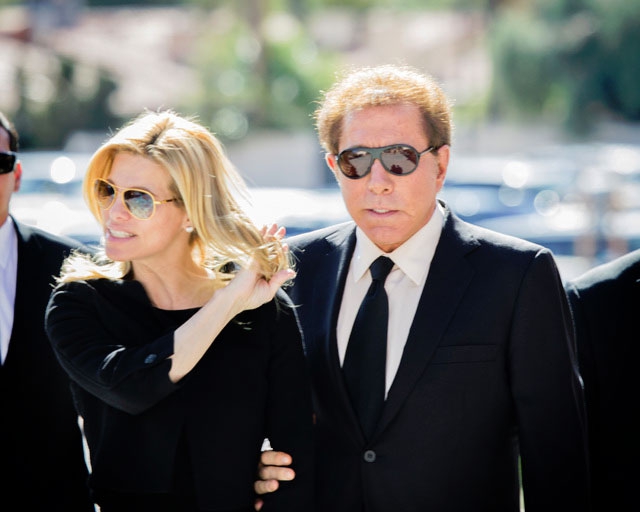
Images L-R: A young Steve Wynn looks on as Benny Binion monitors the action at an early WSOP (c.1974-76), courtesy UNLV Special Collections; Steve Wynn, Bob Stupak, Benny, and Jack Binion playing poker, courtesy of former Las Vegas councilman and Stupak friend Steve Miller; Jackie Gaughan, Sy Redd, and Bob Stupak, courtesy of Steve Miller; Steve Wynn and wife Andrea Hissom attend the funeral of Jackie Gaughan, courtesy Las Vegas Review-Journal