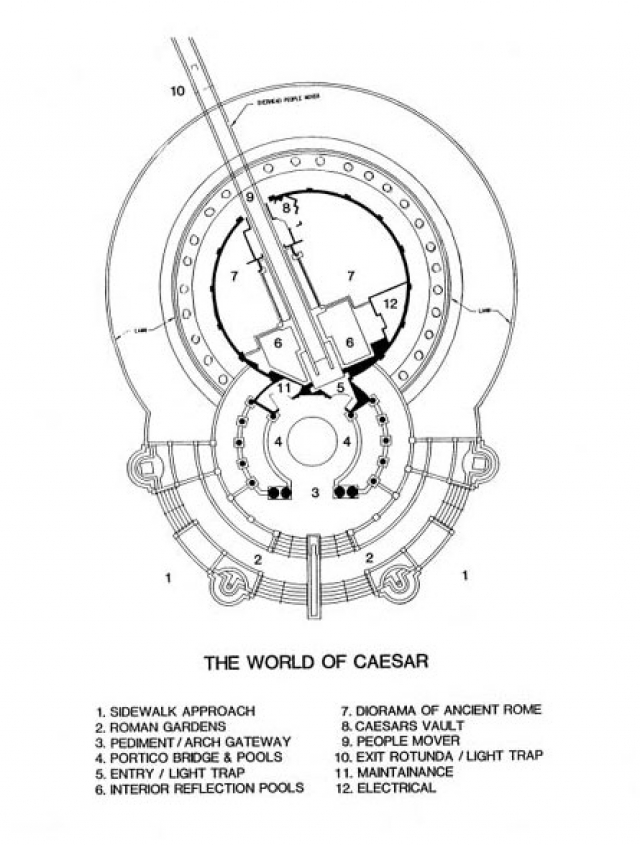
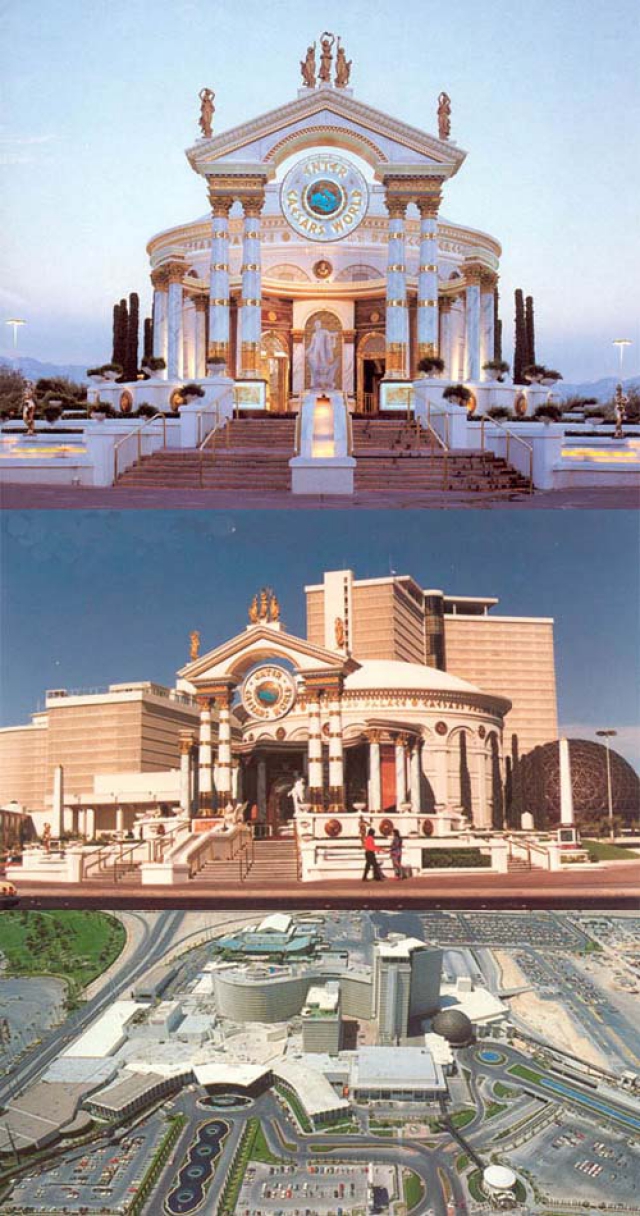
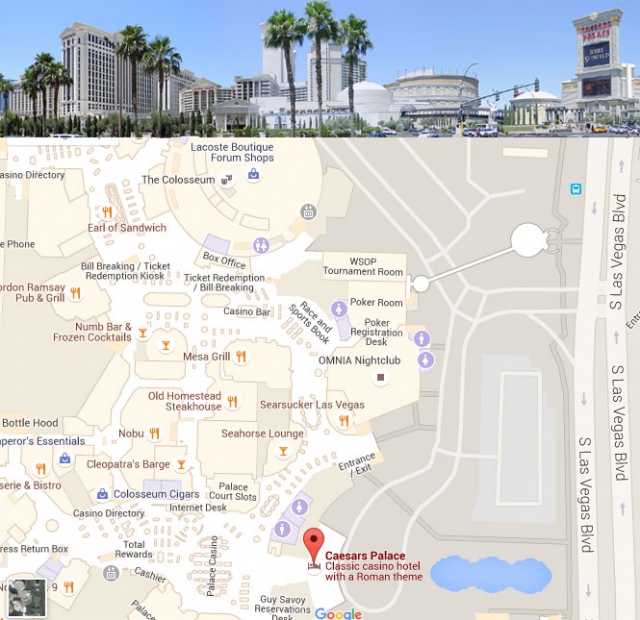
In 1985, the Landmark Entertainment Group was hired by Caesars Palace to come up with the design concept for a new entrance to the moving walkway in front of the resort, which was failing to deliver foot traffic from Las Vegas Boulevard that it. The end result would turn out to be a game-changer that not only inspired future additions to one of the world’s most iconic casinos, but also played a role in design innovations that would take place citywide (the once-ubiquitous day-for-night ceilings of the Forum Shops et al, for example).
What Landmark was tasked with creating in The World of Caesar went far beyond the realms of the fanciest of hotel lobbies; instead, this "milestone themed environmental project" was on a scale of grandeur that encompassed water features, audio-visual elements, fiber optics, 'simulated holography,' dioramas, animatronics, complete sensory immersion (although plans to implement the Strip's inaugural use of "digitally controlled environmental fragrances" had to be abandoned due to the inadequacies of "immature technology"), and something called the 'Leprechaun Effect.' Disney's Fantasia is an oft-cited source of inspiration in the project plans, which shed a rare light on the "secret" science of psychological and sensory manipulation that informed every aspect of this apparently "innocent" architectural folly.
While the project's vision and execution may have been highly complex, the objective was pretty straightforward. "I was asked to come up with a way to attract more pedestrian traffic into Caesars' Olympic Casino, making use of an existing people mover. The client's goal was to double the number of people entering at this location," wrote the lead designer, reflecting a corporate decision made back in 1982 to diversify the resort's appeal to include middle- and lower-level players, in addition to Caesars' traditional customer base of high rollers.
"At the main entrance, people get intimidated by the fountains, the cypress trees, the doormen," explained Caesars Palace assistant vice president for public relations at the time, Don Guglielmino, in a 1987 interview with the Washington Post. "So we built this rotunda -- it's kind of a lighthearted thing, poking fun at the whole Caesars theming. It takes you into the Olympic casino, which is our mid-market casino for the John and Mary Doe who are coming here on a limited budget, who are looking for a more economical version of entertainment." While this sounds like a not-so-subtle euphemism for "a notch above the tradesman's entrance," with competition heating up on the Strip, Caesars' old-school design model, with the elegant sweeping approach set way back from the Boulevard, was now hurting the casino's bottom line in an increasingly pedestrianized age.
Hence, every facet and detail of the new feature was carefully calibrated to achieve the desired result, which was to attract guests into the domed Temple of Overflowing Abundance, and from thence to the Olympic Casino, "like salmon going upstream" in the words of the design specs (or lambs to the proverbial slaughter). "Our mission is to attract additional guests (mostly middle-income pedestrians) and to psychologically prepare them for a positive experience at Caesars Palace," expounds the plan under sub-heading, "The Mood," in which a list of adjectives are listed. These include: festive; alluring; opulent; wondrous; playful; adventurous; passionate; stunning; uninhibited; tantalizing; mysterious; and arousing. "Above all, we need to create ANTICIPATION!" gushes the official blurb, which sounds a lot more like the description of a Sultan's harem than a casino entrance and a lot to ask of a lowly people-mover
In order to achieve this ambitious objective, the experience was choreographed according to an elaborate storyline set on the living streets of Ancient Rome, to which the hapless tourist would, if all went according to plan, be convincingly transported via complete sensory immersion (shame about the whole smell-o-vision thing not working out; but then again, authentic Roman street odors might not have been conducive to the desired overall effect...)
Each facet of every step along the way on this "magic-carpet" ride was tasked with eliciting a different feeling or emotion, from the Approach (designed, obviously, to "attract" what one document refers to as "particles" rather than people), through the "anticipation-creation" of the Roman Gardens, to the Portico, which delivered the guest 2,000 years back in time, courtesy of the Diorama. This grande finale would be realized not only via the use of "extensive lighting and fiber-optic animation with synchronized music and color," but also, we note, using "pixie dust and glitter" (because evidently even the Wonders of Ancient Rome could use a dab of that Spearmint Rhino-effect if they hope to impress the denizens of the Las Vegas Strip).
Guests -- who would arrive feeling like "little Caesars" (or "particles") -- would be transitioned-out the other end of the whole experience in an elevated state and with a new "Big Caesar" sense of themselves. The final unavoidable moving-walkway element was designed to "preserve the mood" of uninhibited playfulness and arousing adventure until the patrons had finally been delivered safely into the welcoming bosom of the awaiting casino floor. As the finishing touch, upon arrival they'd be personally welcomed by a virtual Caesar in his Treasure Vault, "possibly be played by George Burns" (who happened to be headlining at Caesars at the time) and definitely accompanied by two beautiful women. (As an aside, note that the people-mover went in one direction only, which was into, but not out of, the casino.)
How effective the whole grandiose concept was in its execution is something to which this writer cannot personally attest, but when a reporter from the Washington Post tried out the whole experience the following year, she observed how "tiny glowing figures sway in some ancient dance, but there is barely time to take in their revelry before a metal-clad Caesar and his feathered consort Cleopatra appear in all their hologram glory. 'May the gods of fortune be with you in Caesars Palace,' Cleopatra croons, and then you are gone, swept by a moving walkway, past the nighttime scene of Rome, out of the $2 million 'rotunda,' into the heat of a Las Vegas day. But only for a moment. The unfinished Caesars Boulevard passes, along with four columns that will soon hold yet another statue of a man in a chariot pulled by the requisite bronze horses, and then the walkway 'dumps' you, as one Palace employee puts it, into the casino, where the processed air jingles with the sound of money."
Still, effective or not, the attention to detail paid to each major design element makes it sound as if the architect was required to have an advanced degree in psychology. For example, there's a flowing-water feature that forms the "median" to that first crucial set of steps that must not only entice people away from the Strip, but also persuade them to climb up, using their actual legs -- a pretty tall order. But failure at this crucial juncture would mean that all that followed was in vain.
Hence, the entry, as viewed from street level, was "designed like an alluvial fan, where the excess wealth of Caesars World is spilling out to the streets. The built moving sidewalk – a bridge – suggests a physical connection to the source. Of course, molten gold – a lava-like stream of it - flows from the source outward and downward, falling at the feet of the future casino patron." Wow!
Surprisingly, however, it seemed to work: When the new feature debuted in '86, it more than achieved its goal of doubling foot traffic which, according to Landmark Entertainment's official website, rose by 900 percent! The designer would note, some years later, how "the diorama within was used as the inspiration for the recent redevelopment of Caesars. The new Roman-themed high-rise hotel towers match very closely those from the diorama. In fact, a new Colosseum sits now, in reality, where we placed it years ago in the diorama/model. The same columns with winged angels triumphant upon them and the torchieres I sketched years ago are abundantly placed throughout the renewed resort."
While the iconic people-mover ceased to move anyone many years ago, Caesars World marked the beginning of an ongoing relationship between the resort and Landmark Entertainment that continues to this day, with subsequent projects including the creation of Caesars Magical Empire and the Forum Shops, both subjects of a future feature in this series, which we'll resume tomorrow with more history of Caesars and its attractions, befitting of the Strip veteran's 50th anniversary celebrations this year.