Meanwhile, returning to its opening attractions, guests who entered the Luxor's atrium were greeted by a trio of paid attractions that collectively made up a $50-million "participatory adventure" in time travel under the umbrella moniker of "Secrets of the Luxor Pyramid." What were billed in this fantastically cheesy and hyperbolic official-preview video as a "trilogy of cutting-edge special-effects attractions" included: In Search of the Obelisk, which took guests on a virtual journey inside an underground pyramid; Luxor Live - a kind of interactive contemporary talk show set in New York (which for some reason featured a 3-D solar eclipse); and the Theater of Time, in which guests could experience a time tunnel to the future featuring three alternate realities, set in the year 2300, via an IMAX screen.
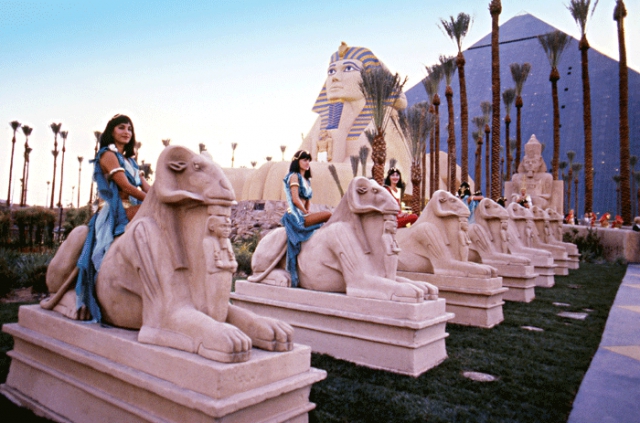
Back at opening time, the exterior also featured a laser-imaging show that interacted with the exterior fountains and the Sphinx, whose eyes projected "Luxor" onto the side of the pyramid. As Anthony Curtis wrote at the time in the LVA newsletter, "It's meant to be the pyramid's answer to the Mirage's volcano, but it's not." The whole attempt at a "hi-tech futuristic" vibe was complemented by the 18,000-square-foot Sega VirtuaLand arcade.
Then, of course, there were all the ancient-Egyptian replica artifacts, which debuted collectively shortly after the resort itself in the King Tut's Tomb Museum attraction (admission $1). Both this, and the IMAX theater, fell victim to the de-themeing juggernaut back in 2008, evicted to make way for Bodies ... The Exhibition and Titanic: The Artifact Exhibition.
Last but not least, let us not forget Elias and Jodi (a.k.a. "Humpy and Lumpy"), the animatronic dromedary duo named for two close friends of Luxor's head developer. These talking camels were originally located in an oasis area in the casino but were later relegated first to the casino lobby and then (Office Space-style) in 2003, to the walkway between Luxor and Excalibur, before being removed from the property entirely. (These were the subject of a "Question of the Day" all of their own back in March 2014, which you can find in the QoD archives.)
Today, pretty much all that remains of Luxor's opening attractions are the famous lightbeam (the pharaohonic equivalent of a stairway to heaven), the exterior statuary, and the pyramid itself which, to-date, has defied de-theming.
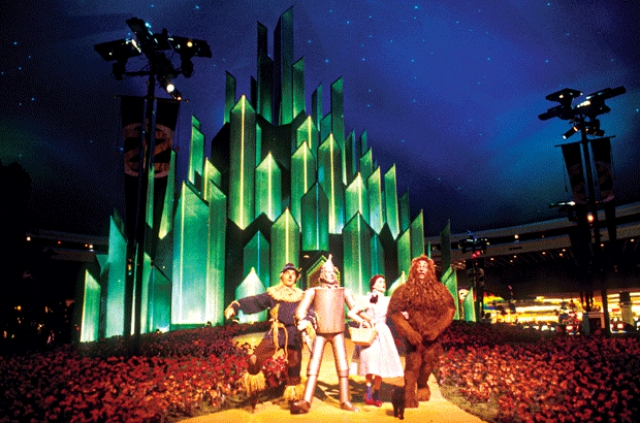
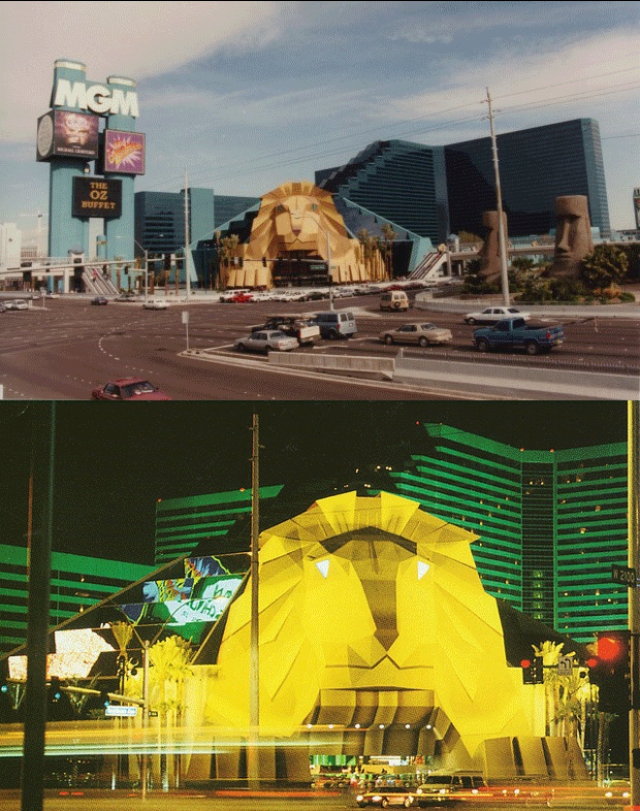
Once inside, visitors found themselves in the Oz Casino, facing Emerald City. Dorothy, the Scarecrow, the Tin Man, the Cowardly Lion, and the Wicked Witch of the West were all present, in audio-animatronic form, as was an elaborate yellow-brick-road walk-through, complete with cornfield, apple orchard, and a haunted forest. The road led guests to the door of the city and, once inside, to a performance of The Wizard's Secrets show. This all lasted until 1996 only, however, when the Oz Casino was axed and The Emerald City completely demolished (aside from a gift store, which was relocated and remained open until early 2003).
Also debuting with the resort-casino was the MGM Grand Adventures amusement park, occupying a massive 33 acres out back and featuring seven (relatively) big rides and attractions, four theaters with shows, and about a dozen eateries, plus another dozen shops. It can be considered another casualty of Las Vegas' ill-fated attempt to beat Disney at its own game and would shrink, in terms of both visitation and area, over the next few years, prior to vanishing off the map altogether in May 2002, when it closed for good after a Jimmy Buffett concert private "Parrothead" after-party.
QoD will resume its trip down Memory Lane [or Boulevard] in the coming days, so tune in as we chronicle the next batch of resort-casino hits and misses following Saturday's poll results.
Images appear courtesy of: Las Vegas News Bureau; NW Indiana Times; Vintage Vegas Collections; VEGAS Seven magazine.