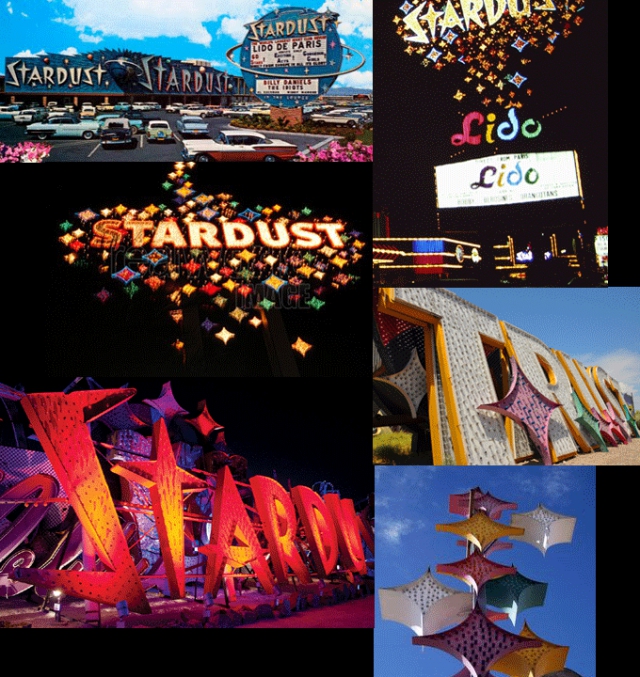
From the moment it opened, the Stardust was all about theming and attractions. To quote another archived "Question of the Day" (5/4/15) regarding the hotel's signage:
When the Stardust debuted on July 2, 1958, it was with an 'outer space' theme befitting the Atomic Age and the general fascination at the time with all things cosmic. There's debate about whether the concept for the outer signage should be credited to Moe Dalitz (as he claimed) or to Tony Cornero (who died shooting craps at the Desert Inn, just before the resort was originally slated to open, on July 13, 1955), but the actual finished design can be attributed with certainty to Kermit Wayne of the Young Electric Sign Company, who was responsible for both the original façade and roadside signs.
The name of the property was emblazoned across the front, twice, in spiky Electra-jag Googie-style lettering, and incorporated a panoramic view of the solar system, with a 16-foot plastic model of Earth at its center. At 216 feet long and 37 feet high, it was at that time the world's largest electric sign. As Wikipedia describes it, "cosmic rays of neon and electric light bulbs beamed from behind the model Earth in all directions. Three-dimensional acrylic glass planets spun alongside 20 scintillating neon starbursts. Across the universe was a jagged galaxy of electric lettering spelling out 'Stardust'. The sign utilized 7,100 feet of neon tubing with over 11,000 bulbs along its 216-foot front. The 'S' alone contained 975 lamps." At night, it was said to be visible from 60 miles away.
The free-standing roadside marquee that complemented this was also impressive, comprising a huge disc, circled by an 'orbit' ring, with the hotel name in the same funky cosmic font, all covered in dancing stars and glittering space dust. And so it remained until 1965.
What Tony Cornero envisioned for what he originally had planned to call the "Starlight," was a giant casino that didn't cater to high rollers or the sophisticated clientele wooed by other Strip resorts; instead its aim was to appeal to "regular joes who were loading up their Chevys and taking the family on vacation," to quote the "Classic Las Vegas" blog. Apparently, the Stardust was doing "family-friendly" decades before the Mirage volcano or MGM Grand Adventure Park had even been dreamt of.
Speaking of volcanoes, it turns out there's nothing new there, either: The 1965 version of of the Lido de Paris topless revue, which debuted with the resort and was the largest production to have graced the Strip at that time, featured a live chariot race, a locomotive crashing into an automobile, and the eruption of Mt. Vesuvius -- complete with molten lava!
This was just the tip of the entertainment iceberg (no pun intended, although it was at the Stardust that creator Donn Arden debuted his famous "sinking of the Titanic" sketch, later to be incorporated into his Jubilee! spectacular at Bally's, while the inaugural Lido de Paris production also featured a fireworks display from the top of a replica of...the Eiffel Tower.)
The defunct Motor Vu theater out back was renamed the Stardust Drive-In and opened on March 20, 1959, showing Disney's The Shaggy Dog. It would close nine years later in December, 1968, with a fitting triple bill of gangster movies, including The Scarface Mob, Young Dillinger and Pretty Boy Floyd.
Located immediately north of the Drive-In was Horseman's Park, a rodeo arena that featured bleachers, 300 stalls, corrals, a lighting system, and a judging stand. The facility hosted rodeo and horse-riding events until 1972, when the land was appropriated to expand the hotels' "Camperland" parking. (The fixtures, apparently, were donated to Dixie College in St. George, Utah.)
Another attraction was The Stardust International Raceway, located off-property (like the golf course) in what is now Spring Valley Township in an area between Tropicana Avenue and Flamingo Road, bordered by Rainbow and Piedmont Boulevards. Designed to be a "pull" for jet-setting high rollers, the facility debuted on October 21, 1965, and featured a flat, 3-mile, 13-turn road course and a quarter-mile drag strip, placing it among what were considered the elite "supertracks" of the time.
Although it never hosted a major drag race, the track did welcome some of the greats, including "Big Daddy" Don Garlits and Jim Dunn, while in its capacity as home to the Can-Am championship finale and the USAC Champ Cars, it would see the likes of of A.J. Foyt, Mario Andretti, Parnelli Jones, and Bobby Unser competing on the road course. But it failed to make money and by 1969 had been abandoned by the hotel. It was briefly leased as a going concern to the track manager, but in the early '70s the land was sold to a real estate developer who constructed the Spring Valley residential development on the site.
Some other significant boasts at opening time included the fact that the Stardust had the largest private telephone switchboard in Nevada, regarded as a world record at the time and which in part was necessary to service its 1,032 rooms (but would also prove handy for the illegal sports-betting activities of Frank "Lefty" Rosenthal, as did the private pay-phone conveniently located by the swimming pool at his Country Club residence). At 105 feet long, the Stardust had the largest swimming pool on the Strip, not to mention the largest casino (at 16,000 square feet), which in turn was credited with first introducing keno to the Strip.
With the dawn of the '60s, the Stardust hopped on the South Pacific bandwagon, embracing the contemporary love of all things Polynesian when, in January 1960, it debuted what would become a cult favorite among tourists and locals alike in its Aku-Aku Restaurant.
Located between the Stardust and the old Royal Nevada, this homage to Island culture cost $620,000 to build and decorate (according to menu, the "primitive art carvings" were the work of a member of the Honolulu Art Academy, who faithfully copied them from originals on Easter Island and New Guinea) while outside, in a classic instance of Strip-style cultural juxtaposition, a neon-rimmed shield-and-giant-arrows sign was added to the existing cosmic marquee presentation, along with the giant moai head, later copied by the Tropicana, that now resides in Sunset Park (see QoD 9/5/2013). Only in Vegas!
Images appear courtesy of UNLV Special Collections; Ernie Ohlson; Dragzine.com; HeritagePreservation.org; and Museum of Gaming History.