A:
Your guess is as good as ours.
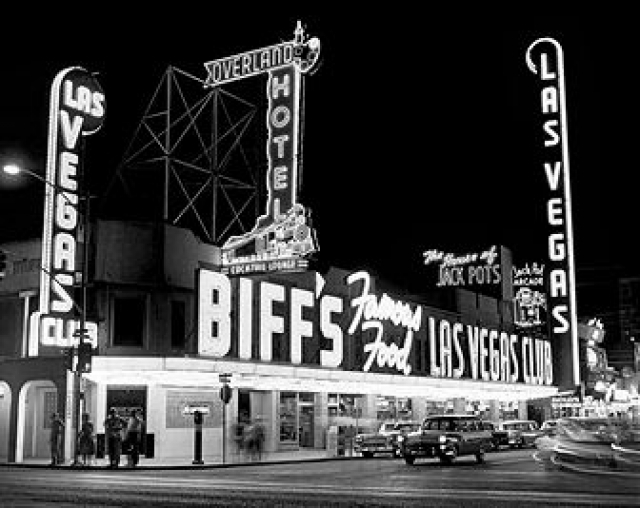
Sometimes we get a Question of the Day that proves utterly baffling and this is one such instance. As you can see in the accompanying photo, the property was called "Biff's Famous Food and Las Vegas Club." So it wasn’t, as you say, called Biff’s Las Vegas Club. The "Famous" adjective modified the "Food" noun. In fact, in another (unavailable) photo, under Biff’s Famous Food, a smaller sign read, "Specialties Miner’s Chuck [and] French Dip."
However, if "Biff" was a real person, he has left no traces other than an old long-since-removed sign. (The Biff's era, in the mid-’50s, from what we can tell by this and a few other photos, preceded the makeover of the Las Vegas Club into a sports-themed property.)
We consulted several local historians, who came up empty. We asked former Las Vegas Review-Journal publisher Sherman Frederick, an old golf partner of the late Mel Exber, onetime co-owner of the Las Vegas Club, but got nowhere. We were unable to run Mel's son, Brady Exber, to ground.
As for the Las Vegas Club, it’s presently closed and its future is cloudy, as new owners Derek and Greg Stevens brainstorm what to do with the property, having purchased it, the small La Bayou and Mermaids casinos, and the Glitter Gulch strip bar to make way for something new and undoubtedly exciting.
There’s a separate "Biff" angle to Fremont Street: In Back to the Future II, Marty McFly's nemesis, Biff Tannen, owned Biff Tannen’s Pleasure Palace Casino Hotel, whose entrance, tower, and lights bore a striking resemblance to the Plaza Hotel, directly across the street from the Vegas Club. (The Plaza was also owned by Gaughan and Exber for a time, until multinational conglomerate Tamares Group bought them out in 2005.) Thus, whoever named the restaurant at the Las Vegas Club "Biff's" was inadvertently clairvoyant. Either that, or whoever named the Back to the Future character knew a little something about an obscure moment in Las Vegas history.
Update 26 September 2016
[Editor's Note: Thanks so much to Dave Feldman for sending the following link, http://www.worthpoint.com/worthopedia/biffs-coffee-shop-restaurant-vintage-menu, for Biff's menu. And to Al Fisicaro of southern California for the first alternative answer to today's question. Also to William Wingo for the extensive history of the Las Vegas Club.
Al Fisicaro: This is a comment and follow-up on your response to the "Biff's" question. After studying the signage in the old photo you posted, I respectfully have to disagree with your claim as to what the business was called.
The small nitpicky error in your claim is that the word "and" does not appear between "Famous Food" and "Las Vegas Club". But the more important thing is that it is eminently clear to me what the different parts of the signage are doing, which you did not catch, and so your rendition of how the sign reads is incorrect. Despite the sequence of words, there is no name or phrase "Biff's Famous Food" or "Biff's Famous Food Las Vegas Club." Rather, "Famous Food" is a 2-word advertising blurb for the business, for the purpose of attracting hungry customers. This is clear from its font, which is similar to the other ad blurb "The House of JACK POTS" and entirely different from the font of the business name. "BIFF'S" and "LAS VEGAS CLUB" have identical or near-identical fonts, and so it is clear that they comprise the business' name: "BIFF'S LAS VEGAS CLUB."
The placing of "Famous Food" such that it splits the business name is an artistic device. It wasn't placed in the dead middle of the name because it would look stupid to have "BIFF'S LAS" on one side of the ad blurb and "VEGAS CLUB" on the other side. It is clear that "BIFF'S" is a 1-word name and "LAS VEGAS CLUB" is a 3-word name, so inserting the ad blurb between these two names makes sense.
In sum, it is clear that the business' name is "Biff's Las Vegas Club."
As for who Biff was, I believe I have the answer. Here in the Los Angeles area, there was a 1950s' "Googie" diner chain named "Biff's" that was started by restaurateur W. W. "Tiny" Naylor in 1948, and Biff was his son. There were eventually 9 locations (as well as 39 locations of Tiny Naylor's Restaurants). But later on, Naylor opened a restaurant in the Golden Gate hotel, so he may very well have opened one in the Las Vegas Club too.
You can see several relevant photos and blurbs on Pinterest at the following URL: https://www.pinterest.com/hweir/tiny-naylors-biffs-and-du-pars.
So maybe Mr. Naylor owned both the restaurant and the casino in the Las Vegas Club. With this head-start, you might be able to get all the way to the bottom of this. Though "Tiny" Naylor passed away in 1959, perhaps his son Biff is still alive (he appears to currently be on LinkedIn) and can tell the whole story. In addition to trying to locate Biff Naylor, you could try to contact subsequent owners of Biff's Restaurants, Tiny Naylor's Restaurants, and Du-Par's Restaurants, including the Naylor Establishment (Google that in addition to "Biff Naylor").
William Wingo:
Several pictures of the Las Vegas Club are shown on the website http://www.inoldlasvegas.com/downtown.html . According to their timeline, the Las Vegas Club opened in 1931, but Wikipedia says 1930. https://en.wikipedia.org/wiki/Las_Vegas_Club
According to Wikipedia the Las Vegas Club had the first neon sign on a hotel gambling establishment, and only the second neon casino sign in the city.
Unfortunately, most of the pictures were shot facing west on Fremont Street, toward the train station. However several older places are identifiable, including the Lucky Strike Club with gold-panning prospector statues (now at the Gold Strike parking lot in Jean), the Pioneer, Vegas Vic, and lots of shots of the Golden Nugget and the Apache/Horseshoe. The Las Vegas Hotel and Cafe became the first Las Vegas Club in the early 1940s. It was right next to the Pioneer. By 1950 it had moved across the street and was replaced by the Westerner, itself replaced in the early '60s by Club Bingo.
The Overland Hotel originally occupied the corner where the Las Vegas Club stands today, and LVC was in the middle of the block. It is shown in a picture with a 1955 Chevy and a 1957 Ford parked out front. This picture is the earliest on the site to show the "Biff's Famous Food" logo. The style of lettering is completely different from the "Biff's" of "Back to the Future."
In a picture labeled "early '70s," the name "Biff's" has been changed to "The Dugout," but the words "Famous Food" appear the same. The Dugout was the name of LVC's restaurant for many years, and one of the few places in Vegas where you could get creamed chipped beef on toast.
Another website (http://vintagelasvegas.com) has a picture dated 1954 taken from the train station, showing the Overland Hotel on the corner, and no "Biff's." Here's what they say about it:
1906-1961: Overland Hotel | 9/28: first documented neon sign in Las Vegas; 1949: Las Vegas Club moves to part or all of first level, hotel remains on second level; 1948: Talk of the Town Bar (RJ 7/11/48); 1953: Talk of the Town becomes Chatterbox; (c.1958-61 not clear if hotel is open); 1961: purchased by J.Gaughan and M.Exber, merged with Las Vegas Club (CLV).
1949-2015: Las Vegas Club | 1949: relocated from 21-23 Fremont St in June (RJ 6/16/49, 7/26/49). c.1957-58: Expansion to Main St with Overland Hotel on top floor, Biff’s Famous Foods on the corner. 1961: Gaughan & Exber purchase (CLV). 1969: Dugout replaces Biffs. [ *** NOTE: Biff's sign was still there in 1971--see below *** ] 1978: facade remodeled (Las Vegas Club and Overland signs removed, see 1978 construction, 1978 construction, 2/79 new facade). c.1980: 16-floor tower addition (Source). 1996: second 16-fl. tower. 2015: closed 8/19/2015.
The "Biff's" logo can also be seen in several period movies, including "Kiss Me, Stupid" (1964) where Dean Martin drives past it on his way out of town--supposedly heading for Los Angeles but actually in the direction of Salt Lake City; "In Cold Blood" (set in 1959 but filmed in 1967) where Dick and Perry (Robert Blake and Scott Wilson) drive past it just before getting arrested, and even "Diamonds are Forever" (1971) where Sean Connery and Jill St. John drive past it at the beginning of the famous downtown car chase sequence.
No part of this answer may be reproduced or utilized in any form or by any means, electronic or mechanical, without the written permission of the publisher.