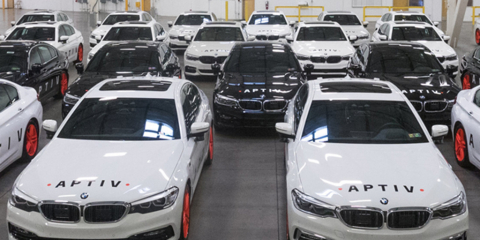
In January 2018, the U.K.-based Aptiv Plc, a global auto-parts company that specializes in vehicle electronics, systems, modules, and components and has $15 billion in annual sales and 150,000 employees worldwide, demonstrated its self-driving, a.k.a "autonomous," vehicles. Five months later in May 2018, Aptiv launched a fleet of 30 self-driving BMWs in Las Vegas, linking up with ride-share passengers via the Lyft network. By CES 2019, Aptiv cars, with their distinctive orange wheel rims, had given 30,000 rides, originating from 37 ride hubs on the Strip, in downtown, and at the Las Vegas Convention Center, what Aptiv calls "high-demand locations." In May 2019, a year into the service, Aptiv surpassed 50,000 rides in Las Vegas.
Yes, it's part of a trial, but a big ongoing one. The one-week experiment period originally envisioned actually never ended. And Las Vegas is such a good place to hold it, given all the visitors making short hops in a limited area with a lot of traffic challenges, that Aptiv opened a 130,000-square-foot technical center about a block south of the McCarran runways on Paradise near E. Sunset Road to house its fleet and research-and-development engineering team. Aptiv engineers gather and analyze massive amounts of data on how these cars react to countless unpredictable scenarios to improve the self-driving systems.
A safety driver behind the wheel can switch to manual in an emergency; also, when pulling into private property, the driver takes the wheel until the car is back on a public road. Riding shotgun, an Aptiv engineer monitors the systems second by second. Together, the two front-seat personnel ensure Lyft passengers' safety. Aptiv admits to a handful of incidents involving their cars, but claim that none of those crashes was their fault.
Passengers summon their cars just like a normal ride, but they have to opt-in to Aptiv, so tech-averse riders aren't forced to accept an autonomous vehicle. According to Lyft, the average ride has received a rating of 4.97 out of 5 stars, with 92% of riders saying they felt very safe or extremely safe during the ride.
As for tipping, Lyft has disabled the tipping function on self-driving rides, but doesn't charge extra for autonomous rides.
Why BMWs? BMW has an extensive self-driving division; it's conducting several robo-taxi trials of its own around the world and heads up a consortium of companies, including Aptiv and Google affiliate Waymo, developing this technology. BMW also has partnerships with Maserati, Fiat, and Chrysler to use its autonomous tech. Other participants in the consortium are Audi, Baidu, Here Technologies, Intel, and Volkswagen. So BMWs were a natural fit with Aptiv's ambitions.
Still, Aptiv and Hyundai-Kia have entered into a $4 billion autonomous-driving joint venture in which the firms will each have a 50% stake, so Aptiv's vehicles won't be limited to BMWs for long.
 |
Dave
Jan-19-2020
|
 |
rokgpsman
Jan-19-2020
|
 |
JimBeam
Jan-19-2020
|
 |
David Miller
Jan-19-2020
|
 |
Roy Furukawa
Jan-19-2020
|
 |
Dave
Jan-20-2020
|

