The Helen Stewart Story, Part 2
And your link to the new poll on your favorite things to do downtown.
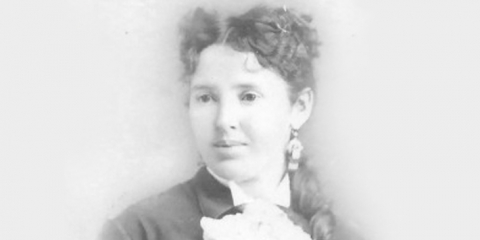
As we saw in yesterday's QoD, Helen Stewart, of Las Vegas Ranch, was widowed at the age of 29 when her husband was shot and killed by a hand at the neighboring Kiel spread.
Helen had been married to Archibald Stewart for 10 years and had four children; she was also three months pregnant with her fifth.
She buried her husband and picked right up where he left off running the the vast property. Her parents moved from Sacramento to the ranch and with her father, a prospector by trade, she speculated in real estate along the predicted right-of-way of the rumored Salt Lake-Los Angeles railroad. She established a comfortable campground for travelers and miners with water, good grub, and shade. She befriended the local Pauite and accumulated a collection of their finest baskets.
Finally, in 1902 at age 47, she'd amassed 1,800 acres to sell to William Clark's San Pedro, Los Angeles and Salt Lake Railroad for $55,000. She then married her longtime Scottish foreman, Frank Stewart (no relation to her first husband Archibald) and reigned as the First Lady of Las Vegas till her death in 1926 at age 71.
Sorry for the long and winding detour, but in our experience, few people know the pre-railroad history of Las Vegas and now it's part of the Question of the Day archive. Also, it provides some background on the original question about how the Paiute wound up with 10 acres downtown.
Throughout the last years of the 19th century, Las Vegas remained isolated enough for the Natives to retain a modicum of their traditions, but the arrival of the railroad ushered in decades of hardship for them. As the white population exploded, the Paiute population quickly declined, due primarily to displacement, disease, destitution, and despair.
In 1912, Helen Stewart deeded 10 acres of what remained of her Las Vegas Valley holdings as a colony for the surviving Paiute in the desolate desert north of the railroad town. The federal government paid her $500 for the land, but at her insistence, the Indian Affairs bureaucrats drew up the title in the name of the tribe.
Tourists in the 1920s created a market for Paiute baskets, but at wildly exploitative prices. Family heirlooms, or new creations that took a year to produce, sold for a mere $5 or $10. Paiute children were sent away to boarding school, first at Fort Mojave, Arizona, then to the Stewart Indian School in Carson City.
Improvements were planned for the Las Vegas Indian Colony in the early 1930s, but never implemented. By the late 1940s, the Colony had been mostly enclosed by the growing city. Local officials tried to sell the land out from the under the Indians in the 1950s, but Helen Stewart's prescient gift of title to the tribe prevented it. Finally, in 1962, the Colony received water and sewer services.
So Helen married a second Stewart 20 years after the death of the first, deeded the 10 acres to the few who remained of the tribe, retained water rights to her family cemetery, and was buried next to her first husband Archibald, father of all five of her children. All this evidence, if you want to call it that, could, in the end, confirm that she did, indeed, fend off Schuyler Henry at gunpoint.
Thanks for getting to the end of this history two-parter. We hope you enjoyed reading it as much as we enjoyed researching and writing it.
If you did, we ask you to take another minute or two to vote in the new poll on your favorite things to do in downtown Las Vegas.
 |
thebeachbum
Oct-02-2019
|
 |
Susan Johnson
Oct-02-2019
|
 |
Hoppy
Oct-02-2019
|
 |
Diane Crosby
Oct-02-2019
|
 |
Patrick Campbell
Oct-02-2019
|
 |
Birdie
Oct-02-2019
|
 |
Ray
Oct-02-2019
|

