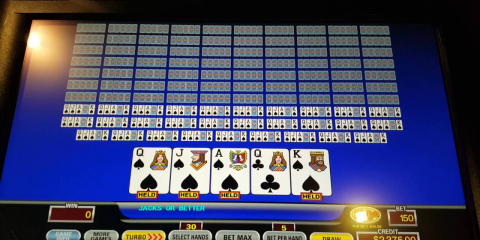
When playing multi-line video poker, how do the machines determine the next card on each line? Is it a card that is already there in each spot, or are the decks being shuffled all the time until the button is pushed, or something else?
We contacted Global Gaming Business Managing Editor Frank Legato, a leading expert on slots. He told us, “One RNG. The RNG is simply a utility program that runs through the numbers and freezes whatever numbers the cycle lands on when the deal and draw buttons are pushed,” he writes. “It will cycle through all the sets of numbers in the program, for all of the multiple hands at once, and then again through all the numbers minus the dealt cards for the draw. There's no need for a separate utility for each hand. At least that's how I understand it.”
We also asked John Robison, author of our book Slot Expert's Guide to Playing the Slots, to help answer this question. "Multi-hand video poker machines choose the replacement cards for each hand when you hit the Draw button.
"Many years ago before multi-line games, video poker machines chose all 10 cards that might be needed to decide a hand when you hit the Deal button. But after a group of cheats reverse-engineered the RNG function in a machine, so they knew the five cards waiting to be used as replacements, regulations were changed to require that the machines choose only five cards on the deal, then the replacements on the draw. That applies to single-line as well as multi-line machines."
But Pahrump Jackie, who knows a thing or two about RNGs, disagrees.
"One RNG would mean that it would have to be halted at the instant it picked cards from a simulated deck, with only the initial five cards drawn missing, and do this for each individual line in the multi-line, each with its own deck to choose from, then run a second RNG to pick the draw cards.
"Ahh, but a better idea might be to use multiple RNGs, one for each line each choosing all ten cards as before, knowing full well that reverse-engineering multiple RNGs would be insurmountable. If you ask Gaming Control, I think you'll find that multiple RNGs is the true answer."
So we did. Here's what we heard back from the Gaming Control Board's Senior Research Analyst Michael Lawton. “The implementation of the random selection process is proprietary and confidential and the Board does not discuss the methods that RNGs are implemented.
“However, the requirements for the random selection process and random number generators can be found in our Technical Standard 1.400.”
1.400 Random Selection Process and Random Number Generator
1. The random selection process must meet 95 percent confidence limits using a standard chi-squared test for goodness of fit.
2. A gaming device using a software random number generator (RNG) shall: (a) Not use static seed upon initialization; (b) Cycle the RNG at a minimum average rate of 100Hz (100 times per second); and (c) Not draw RNG values for future play.
3. A gaming device using a hardware random number generator shall: Technical Standards for Gaming Devices and Associated Equipment Page 15 Integrity of Gaming Devices (2/15/16) (a) Continually monitor the RNG to ensure compliance with this standard. This shall be done by performing a chi-squared goodness of fit evaluation over the most recent 10,000 random outcomes selected for game play; (b) Automatically maintain an event log displaying the results of the most recent 10 chisquared tests to include the result of the test and the date and time the test was performed; (c) Display a visual indicator of a failure; and (d) Upon, two consecutive failures, enter into a tilt condition.
4. RNG’s used for purposes other than determining the game outcome must either: (a) Be implemented as a separate instantiation of the RNG process; or (b) Be based on an algorithm or method that can be demonstrated does not affect the game outcome.
5. A game that draws a predetermined set of outcomes for a game, such as a shuffled deck of cards, must prevent the information from being accessible.
6. Additionally, video poker games must not determine replacement cards prior to the player selecting hold cards and initiating a draw.
7. The RNG and random selection process must be impervious to influences from outside the device, including, but not limited to, electro-magnetic interference, electro-static interference, and radio frequency interference.
8. A gaming device must use appropriate communication protocols to protect the random number generator and random selection process from influence by associated equipment or other devices which is conducting data communications with the gaming device.
Jackie comments, "The regulation is typical bureaucratic double talk. The 'kicker' rule is '6. Additionally, video poker games must not determine replacement cards prior to the player selecting hold cards and initiating a draw.'
"In other words, as I've always said, 10 cards are drawn. Whether you hold none or up to all 5, the 'draw' comes from the second five sets of cards in the order in which they were drawn, satisfying all conditions of this rule. The draw cards were not predetermined, but naturally occurring, as if you took any deck of cards and dealt off ten cards. Or think of it as a 5-card-stud game, you're first to act (as you will always be in a VP game), you discard 3 cards, and the deck gives you the next 3 cards in the order they appear in the shuffled deck. No predetermination.
In order to satisfy all of the rules, the Gaming Commission had no other choice except to assign a separate RNG to each line in a multiline machine each drawing an initial 10 cards. They had to satisfy those rules when only single-line VP machines existed and did so by using an RNG that initially drew 10 cards. So how could they possibly obey those rules while not also breaking in a multi-line machine? Simply put, they used a single RNG drawing 10 cards for each line."
Even though we figured that video-poker-machine manufacturer IGT wouldn't/couldn't further clarify the situation, we sent an inquiry, but didn't hear back.
So in the end, you'll have to draw your own conclusions from the dual points of view we've presented: Frank/John's (one RNG) or Jackie's (multi-RNGs)?
 |
Dave
Feb-07-2020
|
 |
Reno Faoro
Feb-07-2020
|
 |
Jeff
Feb-07-2020
|
 |
Bob Nelson
Feb-07-2020
|
 |
Pat Roach
Feb-07-2020
|
 |
Jackie
Feb-07-2020
|
|
Jackie
Feb-07-2020
|
 |
Kenneth Mytinger
Feb-07-2020
|
 |
King of the Bovines
Feb-08-2020
|
 |
Diane Crosby
Feb-10-2020
|

