Well, just in case no one else takes the bait and asks the question that you seemed to want to get in your answer about cheap cigarettes, here goes. How did the Las Vegas Paiute tribe wind up with 10 acres of prime downtown Las Vegas property?
Thank you! Actually, we heard from several QoDers who were anxious to hear about it (including a couple who were effusive in their love of this feature, which we really appreciate).
This is a story we've always been fond of, illustrative as it is of the generosity, foresight, and compassion of the First Lady of Las Vegas, Helen Stewart.
To answer the question properly, we have to back up a bit and talk about the settlement of Las Vegas Valley.
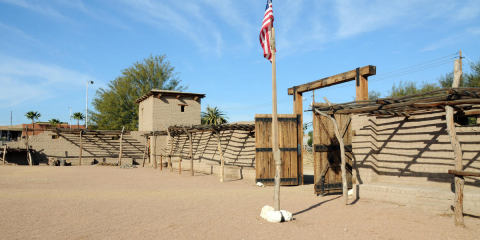
Octavius Decatur (O.D.) Gass was an itinerant gold prospector who, while wandering the west, wound up seeking his fortune at the lead mine at Potosi, near Las Vegas Valley, that had been developed to a certain extent by the Latter-Day Saint missionaries who set up camp around Las Vegas' Big Springs in the mid-1850s. In 1865, Gass built a ranch house and shop inside the small stockade that had been built and abandoned by the Mormons. He irrigated 640 acres of surrounding property and raised produce, grain, and cattle. By the mid-1870s, he'd bought up or simply taken most of the homesteaded land in the valley, including the rights to most of the water.
In the late 1870s, Gass, perennially short of cash, borrowed $5,000 from a prosperous freight, lumber, and ranching baron from Pioche, Archibald Stewart. Taciturn and miserly, the Scottish Stewart used Gass' now-800-acre ranch and 400 head of cattle as collateral. It's an insight into Stewart's character, and Gass' desperation, that they agreed on a 30% interest rate, principal and interest due in one year. When the year was up, Gass couldn't pay and negotiated a nine-month extension. When the grace period expired, again without payment, Stewart foreclosed and took possession of all Gass' property for the pittance of $5k.
The only other ranch in the Big Springs neck of the desert, two miles north, was owned by Conrad Kiel, a close friend of O.D. Gass'. Thus, when Stewart moved next door with his family, the blood already ran bad between him and Kiel.
In July 1884, Stewart and one of Kiel's ranch hands, Schuyler Henry, got into a fight. The only reports we've ever seen of the incident say that Schuyler Henry "badgered" Stewart's wife Helen, and "spread rumors about her conduct during her husband's extended absences."
As far as we know, nothing more sensational than that has been written about the incident. But given the Las Vegas tradition, literary and otherwise, of extravagance, one might imagine the following scenario.
Stewart, 48, had admonished Henry, 33, about the manner in which the latter looked at the former's wife Helen, 29. Despite the warnings, one hot evening while Stewart was away on business, the frustrated ranch hand showed up and propositioned Helen, who might or might not have held him off with a gun.
Whichever way it went, Henry later bragged that his advances had not only been encouraged, but also accepted.
When Stewart heard of this, he went after Henry at the Kiel Ranch to defend his wife's honor.
Since Stewart emerged on the dead side, divine justice might absolve Henry of idle bragging. Human justice certainly did: The grand jury ruled that Henry acted in self-defense.
Which brings us to the newly widowed Helen Stewart, whom we'll discuss in Part 2 of The Helen Stewart Story tomorrow.
 |
Dan McGlasson
Oct-01-2019
|
 |
O2bnVegas
Oct-01-2019
|
 |
jeepbeer
Oct-01-2019
|

