Logout

Question of the Day - 27 February 2020

Q:

I have heard from reliable material that any gaming company approved to do business in Nevada must certify that all their games in all states are random. Example, if IGT wants to be approved in Nevada for a video poker machine, the same randomness must be found in all IGT machines in Oklahoma, California, etc. Is this true? The only “guarantee” that video poker players have outside of Nevada is the name on the screen. That is why I do not trust any machines with names not seen in Las Vegas.

A:

According to the Nevada Gaming Control Board, “We base our approval solely on gaming devices meeting Nevada regulatory requirements. Three independent test labs registered in Nevada provide certification of gaming products. In addition to the uses of independent test labs, the NGCB also performs testing of gaming products.”

The requirements for deployment of a gaming device in the Silver State can be found under Regulation 14 of the NGCB’s articles. It’s a 31-page document and covers such items as, “Certain themes prohibited in association with gaming devices” and “Approval to sell or dispose of gaming devices.” 

With regard to specific demands on machines, the regulations specify that they must “theoretically pay out a mathematically demonstrable percentage of all amounts wagered, which must not be less than 75 percent for each wager available for play on the device … Once a game is initiated by a player on a gaming device, the rules of play for that game, including the probability and award of a game outcome, cannot be changed. In the event the game or rules of play for the game, including probability and award of a game outcome, change between games during a gaming session, notice of the change must be prominently displayed to the player.

“Gaming devices that offer games of skill or hybrid games must indicate prominently on the gaming device that the outcome of the game is affected by player skill,” the regulation continues. “Gaming devices must not alter any function of the device based on the actual hold percentage.”

There’s a great deal more, but we don't see anything that stipulates that games in all states must be random. Hence, it seems that you have to rely on each jurisdiction's regs, rather than counting solely on a Nevada presence, to have the "guarantee" that you seek. To that end, other states — particularly New Jersey — have standards almost as exacting as Nevada’s. Also, many of them farm out their game testing to the highly respected Gaming Laboratories International, tester for 475 jurisdictions worldwide.

We can't vouch for tribal casinos. Though they have to abide by compacts negotiated with their host states, they're sovereign nations and obey their own rules and regulations.
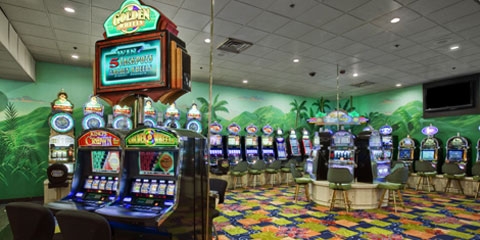
 

Is it true that any gaming company approved to do business in Nevada must certify that all their games in all states are random?
No part of this answer may be reproduced or utilized in any form or by any means, electronic or mechanical, without the written permission of the publisher.

Have a question that hasn't been answered? Email us with your suggestion.

Missed a Question of the Day?
OR
Have a Question?
Tomorrow's Question
Has Clark County ever considered legalizing prostitution?

Comments

Log In to rate or comment.
  • Kevin Rough Feb-27-2020
    VLTs
    I was under the impression that VLTs don't have to follow the standard rules.  For example if you play "video poker" on a VLT, your payout is determined when you hit the deal button, holding the cards and drawing are all for show.  The problem I find is knowing when a machine is a VLT or not.

  • Ray Feb-27-2020
    randomness
    To Kevin's comment, my understanding is that VLT's are the equivalent of lottery scratch-off tickets. (and maybe with the kicker that you randomly get one of the remaining tickets, rather than the next one in the book) which accounts for the "payout determined when you hit the deal button". Other than that, most states with commercial casinos were so paranoid when forming the laws to allow them that it seems like they are at least as stringent as Nevada. They are so afraid of something bad happening and the anti-gambling people saying "I told you so".

  • rokgpsman Feb-27-2020
    VLT
    I agree with Ray, VLT's are not the same as a true Vegas-style slot machine. VLT's are nearly always a "Class II" gambling machine, they don't have a random number generator, they are connected to a central computer somewhere and the VLT player is competing against other players on similar VLT machines, sort of like buying a lottery ticket or playing bingo, but all done electronically. You can win money but it's a different type of game compared to a Vegas-style Class III machine. With that said, there are now some Class III VLT's operating in the states of Oregon, South Dakota and Montana and they have random number generators so they act similar to the machines in Las Vegas. For a long time Native American (Indian/Tribal) casinos used Class II machines (many still do) so they wouldn't have to pay a bigger share of the earnings to the state they are located in. The agreement (called a compact) that a Tribal casino has with the state specifies how much money the state receives. 

  • rokgpsman Feb-27-2020
    VLT's con't
    As far as how to tell a VLT from a true slot machine - you can ask someone at the casino, they aren't trying to hide anything, if they are using VLT's they will tell you (if the person you ask knows). Also, another name for Class II VLT machines is "Bingo machine", and all the ones I've seen have a small image of a bingo card somewhere on the front of the machine. It's only about 1 or 2 inches square, but it indicates the machine and the player is actually part of a large group of other machines and players involved in a big interconnected electronic bingo game. The VLT machine is made to pretty much look and act like a Vegas-style machine, that's what people want to play and the casinos don't want to scare off any players. And honestly many players don't know the difference between Class II and Class III machines anyway. But VLT's generally have lower payoff odds than Class III machines, as low as 80-85%, whereas Class III machines are usually around 92-95% and even higher.

  • Deke Castleman Feb-27-2020
    This in from Jackie
    NO!
    
    Nevada can only make that requirement for Nevada.
    
    Each State has its own rights know in our Constitution as State Rights meaning that the Federal Government and all other States have no rights whatsoever to tell any State to do anything. The only exception to this is Federal laws which must apply equally to all of the States, therefore Nevada can not make such a requirement.
    
    Only games sold to legal casinos where State laws permit them might be random if the State or Tribal laws require them.
    
    Early Tribal Casinos had difficulty even getting Las Vegas style machines even within their right to have them as the Tribe existed within a State that prohibited gambling of any sort and would confiscate gaming equipment shipments to that Tribe since the trucks had to pass through that State property.
    
    Gaming Companies provide games that are not random for entertainment purposes only and do not accept nor return any form of money.


  • Deke Castleman Feb-27-2020
    Jackie con't
    Some games were slot machines known as "Pull Tab" or "Bingo" games and could be random or not and used mainly by Tribes.
    
    Some slot machines were made to use special tokens to simulate gambling and some parties who had these machines would sell and redeem tokens which was illegal to do. Such machines have since been outlawed as they were found to be to easily converted to accept and give actual coins.

  • RichM Feb-27-2020
    well.....
    Yes, Nevada cannot tell Oklahoma casinos how to run their businesses, but the state can prohibit participation in Nevada businesses for behavior in other states. 

  • Lucky Feb-27-2020
    Random
    I interpret the question this way.  Can Nevada demand that the specifications for a machine be the same as all the machines they make no matter where they sell them, the answer is yes.  That may not be a law, but if it was it would be legal.  If IGT makes VP machines to Nevada specifications, they can also tell IGT that if you want to sell in Nevada, you can only sell that same machine in the exact same electronic form elsewhere.  If the Nevada Gaming Commission find out that IGT makes a certain VP machine that they sell in Nevada, but it has a Royal Flush lockout in CA, the NGC can say you cannot sell that type of machine in Nevada, unless everywhere else you sell it, it is the same.  I do not know if the NGC rules are like that, but if they were, it would be legal.  But look at it this way, with class III gaming, why make it different.  You can change the payout tables and make them worse, just like you can in NV. Its all about what the market will bear. If no winners, no one comes. 

  • cjen Feb-27-2020
    What are VLT's?
    what are VLT's?  The Ultimate X VP IGT I play in Oklahoma does not have a bingo card.  The VGA slots, Neptune's, Mr. Money Bags, etc. do have a bingo card.  Neptunes, pay out more than any other slot I've seen.

  • rokgpsman Feb-27-2020
    Oklahoma slots
    In Oklahoma the compact agreements between the tribal casinos and the state that allowed Class III machines expired on January 1, 2020 (a few weeks ago). Many casinos in Oklahoma have/had a mixture of Class II bingo machines and Class III true Vegas-style machines. The state has ordered that all Class III machines be removed or deactivated from the casino until the compact agreement is renewed and it is now illegal for the Class III machines to be in operation. But the casinos have taken this to court, saying the compact agreement is "self-renewing". The state says no, the compact agreement has to be renegotiated at every renewal date. So they are in court over this and many Oklahoma casinos continue to operate their Class III machines since those are much more popular and profitable. The state wants the casinos to pay a higher percentage of the Class III revenue they get and the tribes owning the casinos naturally want to keep the old terms of the original compact agreement. 

  • rokgpsman Feb-27-2020
    Oklahoma cont'd
    In Oklahoma all casinos are tribal casinos. Part of the compact agreement that the state has with the various tribes is the state will not permit non-tribal casinos to operate in the state, so the tribes enjoy a monopoly on all casino operations in Oklahoma. Under the old compact that just expired the tribes pay about 4% to 6% of Class III revenue to the state, smaller casinos pay the 4%. The Governor wants the new compact agreement to raise that to 20% going to the state. The Governor has said that the old compact has expired and the state will now consider inviting outside companies (Caesars, Penn National, MGM, etc) to open new casinos in Oklahoma on non-tribal land that will compete with the tribal casinos unless the tribes agree to renegotiate the compact. Many people would welcome having non-tribal casinos, they are better regulated for players and you have a better chance in public court when there is a dispute over a jackpot, instead of you dealing with a tribal court system.

  • Eggheaddoggy Feb-27-2020
    Feedback
    VLT stands for Video Lottery Terminal with the keyword being Lottery. It typically means the provincial (CAN) or state (USA) lottery has something to do with it (usually they own the machines - Oregon & Canada markets).  They can be class 2 or class 3. Seems like a lot of people are assuming VLT means only Class 2 which is far from the truth. Since a lot of the comments have been about Class 2 VLT, I’ll just comment on Class 3 VLT. 
    In class 3 VLT (which use RNG) the only difference between that and casinos is VLTs have limited pays (meaning max win restrictions). The games are mix of casino titles and non-casino titles. Typically you’ll find a better RTP in many of the class 3 VLT markets as they have standard RTPs they must follow. You can debate whether they are worse or better but class 3 VLTs are going to almost always be better than 90%. 
    Wikipedia actually has a pretty good entry for VLTs if you are interested. Covers various markets 


  • Eggheaddoggy Feb-27-2020
    Feedback Clarification 
    I meant you can debate whether Class 3 VLTs have better RTP than Class 3 casinos. As i believe one of the commenters stated Class 3 VLTs are between 92-95% which is fairly spot-on. You can look at some of the state & provincial websites and they’ll tell you the RTPs. 
    
    Just be careful and don’t assume VLTs are the same thing across all markets. (Can be different class types: 2 vs. 3, different RTP mandates).