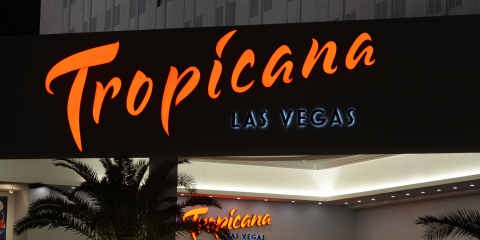
The Tropicana is the oldest hotel casino on the Strip, isn't it? All the other casinos from the 40s and 50s are gone. That makes the Tropicana ancient in Vegas years, so it must have a long and interesting history. Your writers are great at writing these kind of stories, so I'd like to hear one about the Trop.
Actually, the Flamingo is 10 years older than the Tropicana; it opened in 1947 as the Fabulous Flamingo, then was called the Flamingo Hilton for a while. And the Sahara is five years older. It opened in 1952, while the Trop opened in 1957, the last of the string of hotel-casinos that sprouted up on the Strip in the 1950s. It closed and reopened as SLS, before it was sold and it's name changed back to the original. So we suppose you can say that the Tropicana is the oldest casino on the Las Vegas Strip whose name has never changed.
As for the history, you're right: It's long and twisty. Here ya go.
In 1957, it was a full 25 years since wide-open gambling was legalized in Nevada and more than 10 years since the Nevada Tax Commission was granted policy and procedure powers over the casino industry. Prior to 1945, the individual counties oversaw the casinos within their jurisdictions, but in 1945, state officials authorized the Tax Commission to collect a 1% tax on gross gambling revenues over $3,000 and to have a hand in approving licenses for operators. After two years of tax collecting and a better idea of revenues, the state increased the tax to 2% and in 1949, after the Bugsy Siegel-Flamingo debacle and with Las Vegas gaining a reputation as a haven for the underworld and its money, Tax Commission agents were deputized and given broad authority to investigate gambling-license applicants.
Anyway, by 1957, 15 major resorts had amounted to a total investment in the Las Vegas gambling industry of more than $100 million and already accounted for more than half of the entire state's gaming revenues. Yet the state Gaming Control Board had been in existence a mere two years, carved off the Tax Commission with its investigators and agents. Mob money and the jungle law of gamblers and gangsters, ruled the day. Nowhere was this more evident than in the situation of the second-to-last hotel-casino to be built on the Strip in the Grifty Fifties: the Tropicana.
The Trop was the brainchild of "Dandy" Phil Kastel, who'd spent 25 years managing the entire gambling scene in Louisiana for Frank Costello, a boss of bosses in New York who was partners with Meyer Lansky and Lucky Luciano. Kastel enlisted Ben Jaffe, of the Miami Fontainebleau resort, to invest and front for him in the Tropicana. Jaffe, who also held an interest in the Riviera, which had opened a couple years earlier, hired the same Miami construction company to build the Trop. On opening night in April 1957, Jaffe had infused more than $7 million of his own money, plus $7 million of other investors' capital, to Kastel's $300,000. Licensing had been held up for a full year, until Kastel's name was dropped from the application.
The $15 million total investment was more than double that of the next most expensive Strip casino and the 300-room Y-shaped Tropicana quickly earned the nickname, "Tiffany of the Strip." Designed as the ultimate resort-hotel in the desert, the Trop oozed elegance in a Havana Modern style. Its 60-foot tulip-shaped fountain in the center of the 110-foot diameter pool stood as a landmark at the south end of the Strip for 20 more years. The mahogany-paneled casino was tastefully screened from the lobby by ornamental horticulture and "Peacock Alleys" from the front desk to the rooms actually bypassed the gambling tables. The Celebrity Gourmet Room was enclosed by a 15-foot curved glass wall, highlighted by colorful dancing fountains and massive Czech-crystal chandeliers.
The genteel calm, however, was shattered only a month later, when Frank Costello was wounded in an attempted hit in New York and detectives found a slip of paper in his pocket with a tidy sum of figures, which turned out to the gross profits from the Trop's first three weeks of operation. Out went Kastel as the casino manager and in came J. Kell Houssels, a powerful juiceman from downtown.
Houssels had earned his stake by fading an illegal blackjack table in Ely, Nevada, in the 1920s, then moved to Las Vegas just after gambling was legalized in 1931. He spent 25 years as an owner of the Las Vegas Club, El Cortez, and Showboat before taking on the Tropicana. He was the big boss for the next 10 years, adding 300 rooms, an 18-hole golf course and country club across Tropicana Avenue (the property on which MGM Grand was built), and the famous Parisian floor show Folies Bergere.
That brings us up to the 1970s, during which the Trop changed hands several times. And we'll continue our history of the Tropicana in part 2 tomorrow.
 |
Ray
Mar-30-2020
|
 |
gaattc2001
Mar-30-2020
|
 |
Deke Castleman
Mar-30-2020
|
 |
O2bnVegas
Mar-30-2020
|
 |
Jeff
Mar-30-2020
|
 |
Bill Hirschman
Mar-30-2020
|
 |
Roger Sulkowski
Mar-30-2020
|
 |
[email protected]
Mar-30-2020
|
 |
Roy Furukawa
Mar-30-2020
|

